

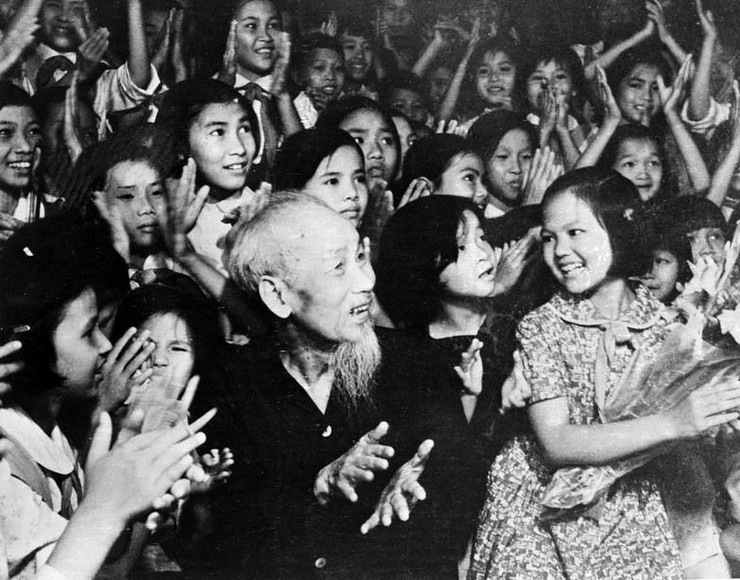
On November 24, 1946, the first National Cultural Conference opened at the Hanoi Opera House, drawing more than 200 cultural activists representing the nationwide cultural movement alongside representatives of the Government and the National Assembly Standing Committee.
In its November 25, 1946 issue, the Cuu Quoc (National Salvation) newspaper published an article titled “Because of the Situation, the National Cultural Conference Closes After a Day of Discussion,” reporting on President Ho Chi Minh’s address. He stated: “For society, culture must enable every Vietnamese citizen, from the elderly to the young, both men and women, to understand their duty and know how to enjoy the happiness they rightfully deserve. The destiny of the nation lies in the hands of our people. Culture must illuminate the path for the nation to follow.”
“Culture must illuminate the path for the nation to follow” went on to become an enduring guiding maxim, frequently cited whenever discussing the historic conference and Vietnam’s cultural policy ever since.
On January 7, 2026, on behalf of the Politburo, General Secretary To Lam signed and promulgated Politburo Resolution No. 80-NQ/TW on the development of Vietnamese culture. The resolution states: “Unanimously designate November 24 annually as Vietnam Culture Day, with the policy that it be a paid public holiday for workers, enabling the people to enhance their cultural enjoyment, encouraging artists and writers in their creative endeavors, and promoting a cultured, civilized way of life across society.”
On April 24, 2026, the National Assembly passed Resolution No. 28 on the development of Vietnamese culture, with Article 2 specifically codifying Vietnam Culture Day: “November 24 each year is Vietnam Culture Day; employees are entitled to a day off with full pay. Admission fees and service charges at public cultural and sports facilities shall be waived or reduced on Vietnam Culture Day in accordance with decisions by competent state agencies. Citizens, particularly youth and children, are encouraged to participate in cultural activities during major national holidays.”
Selecting November 24—the opening date of the first National Cultural Conference—as Vietnam Culture Day honors the vital role of culture in national construction and defense, anchored by the overarching principle that “culture illuminates the path for the nation to follow.”

President Ho Chi Minh examines a rubbing of the Ngoc Lu bronze drum at the Vietnam Museum of History. Photo: Museum archives

Photograph of Uncle Ho conducting the choir singing the song “Ket Doan” (Unity). Photo: Lam Hong Long
A Theoretical Breakthrough and Strategic Consistency
Research by Associate Professor Dr. Nguyen Toan Thang and Dr. Nguyen Minh Thong of the Ho Chi Minh National Academy of Politics assesses Resolution No. 80-NQ/TW on Vietnamese cultural development (dated January 7, 2026) as a landmark theoretical breakthrough. Among the core guiding viewpoints established by the resolution is: “Developing culture and people serves as the foundation, an essential endogenous resource, a powerful driving force, a pillar, and a regulatory system for rapid and sustainable national development. Cultural values must be tightly and harmoniously integrated, permeating every aspect of social life—from politics, economics, society, and the environment to national defense, security, and foreign affairs—truly becoming the nation’s soft power in the new era.”

General Secretary To Lam speaks at the nationwide conference to study, grasp, and implement Politburo Resolution No. 79 on state-owned economic development and Resolution No. 80 on Vietnamese cultural development on February 25. Photo: Gia Han
The study also ranks Resolution No. 80—which established Vietnam Culture Day—as one of six major theoretical breakthroughs across Party Congresses since 1986. Other milestones include the 6th National Party Congress (1986), which championed “facing the truth squarely, speaking the truth clearly, assessing the truth accurately, critiquing rigid cultural thinking, and paving the way for creative freedom in culture and the arts,” as well as Resolution No. 03-NQ/TW (dated July 16, 1998) on “building and developing an advanced Vietnamese culture imbued with strong national identity.”
Dr. Pham Thi Thanh Huong, Head of the Culture Sector at the UNESCO Office in Vietnam, likewise highlighted strategic consistency as one of Vietnam’s standout cultural achievements. Throughout this trajectory, the principle that culture serves as society’s spiritual foundation—both a goal and a driving force of development—has been steadfastly upheld and enriched from the 5th Plenum Resolution of the 8th Central Committee and Resolution No. 33 through to Resolution No. 80.


Cinema stands as one of the sectors with strong competitive advantages, contributing significantly to the growth of Vietnam’s cultural industries. Photo: Courtesy of film crew


Illustrations by artist Hoang Giang in the bilingual picture book Kho tang cua bo – Loving Eyes, which recently won the Grand Award (International Category) at the 2026 Golden Pinwheel Young Illustrators Competition—making him the first Vietnamese illustrator to claim this honor. Photo: Kim Dong Publishing House


Valuable artworks by renowned Vietnamese painters converge at the Ho Chi Minh City Museum of Fine Arts. Photo: Quynh Tran
Running through this entire evolution is the principle of building a culture characterized by “unity in diversity.” Vietnam’s cultural policy embraced inclusivity early on, treating the cultural diversity of its 54 ethnic groups as a vital resource backed by preferential, tailored policies for ethnic minority regions. This commitment shines through in numerous UNESCO-inscribed elements, including the Space of Gong Culture in the Central Highlands (2005), Practices of Then by Tay, Nung, and Thai ethnic groups (2019), the Art of Xoe Thai Dance (2021), and the Art of Pottery-Making of the Cham People (2022).
According to Dr. Pham Thi Thanh Huong: “Safeguarding and honoring the heritage of diverse communities helps strengthen great national unity and foster intercultural dialogue, true to the spirit of UNESCO’s Universal Declaration on Cultural Diversity, which affirms that heritage must be preserved to inspire dialogue among cultures.”
Nationwide Celebrations Mark the Inaugural Holiday
Tonight, November 24, the national concert Muon Sac Viet Nam (Myriad Colors of Vietnam) takes place at My Dinh National Stadium in Hanoi. Early demand underscored its massive appeal as tickets quickly sold out, with audiences queuing in long lines to redeem pre-registered passes. Beyond multi-generational musical collaborations, the show brings together a cast and crew of up to 3,000 performers. Recognizing the centrality of identity, Chief Director Dang Le Minh Tri shared that the concert will unite all 17 UNESCO-inscribed Vietnamese heritages on a sprawling 3,000-square-meter stage.


The To Quoc Trong Tim (Homeland in Our Hearts) concert held in August 2026 in Ho Chi Minh City. Photo: Bui Quoc Hoang
Five audience zones at the stadium are named after the pillars guiding Vietnamese culture today and into the future: Coi Nguon (Origins), Ban Sac (Identity), Tinh Hoa (Quintessence), Rang Ro (Radiance), and Hoi Nhap (Integration)—celebrating unity in diversity across Vietnam’s 54 ethnic communities. Organizers have also encouraged attendees to wear Viet phuc (historical Vietnamese attire), traditional ethnic costumes, or outfits inspired by Vietnamese heritage.
Extending festivities for Vietnam Culture Day 2026, Ho Chi Minh City is hosting an array of art programs, cultural experiences, light shows, and fireworks displays, creating vibrant spaces for residents and visitors to enjoy the arts.
The 2026 Great Unity Festival – Colors of Vietnamese Culture, themed “Ho Chi Minh City – Convergence of Vietnamese Cultural Colors,” opened on November 22 and runs through November 24 along Nguyen Hue Pedestrian Street. The festival showcases heritage values, cultural products, and tourism destinations through interactive activities incorporating digital technology, virtual reality (VR), and augmented reality (AR).


Artists and production crews rehearse intensively ahead of the Muon Sac Viet Nam national concert taking place tonight, November 24, at My Dinh National Stadium in Hanoi. Photo: Organizing Committee


The ceremony announcing the Dong Son bronze drum repatriated from the French Republic took place on the morning of November 23 at the Vietnam National Museum of History. Photo: Vietnam National Museum of History
The centerpiece of the southern celebrations is the special art program Tu Hao Ban Sac Viet (Proud of Vietnamese Identity), airing at 7:30 p.m. on November 24 via a live television bridge linking three locations: Saigon Ward, Thu Dau Mot Ward, and Vung Tau Ward. The show honors traditional cultural values, distinctive art forms, and the spirit of Vietnamese people in labor, creativity, and global integration. By connecting these three venues, the production portrays the interplay between tradition and modernity, heritage and innovation, while radiating national solidarity.
Featuring vocal and dance performances, traditional and contemporary arts, documentary reports, and symbolic large-scale stage tableaux, the program highlights the stature of Ho Chi Minh City following its expanded development space—a dynamic, modern metropolis that remains deeply rooted in preserving and promoting national identity.
An artistic fireworks display scheduled for 9:00 p.m. the same evening will cap off the festivities, alongside ongoing 3D mapping light projections in front of the Ho Chi Minh City People’s Committee headquarters offering immersive visual experiences for locals and tourists.
On the Digital Cultural Map (CMAP) maintained by the Ministry of Culture, Sports and Tourism, approximately 500 cultural events have been logged nationwide, reflecting the dense wave of activities commemorating Vietnam Culture Day. These span grassroots community events infused with local flavor as well as major institutional showcases rich in historical and cultural value. Standout highlights demonstrating Vietnam’s vibrant cultural network include the Hanoi Creative Design Festival—featuring broad international participation—and the unveiling of the repatriated Dong Son bronze drum from France at the Vietnam National Museum of History, underscoring Vietnam’s deepening international cultural cooperation.
Source: thanhnien.vn
Discover more from Vietnam Insider
Subscribe to get the latest posts sent to your email.