

General Secretary To Lam requested key investments to develop research organizations and deploy breakthrough solutions to attract science and technology talents abroad and overseas Vietnamese to work.
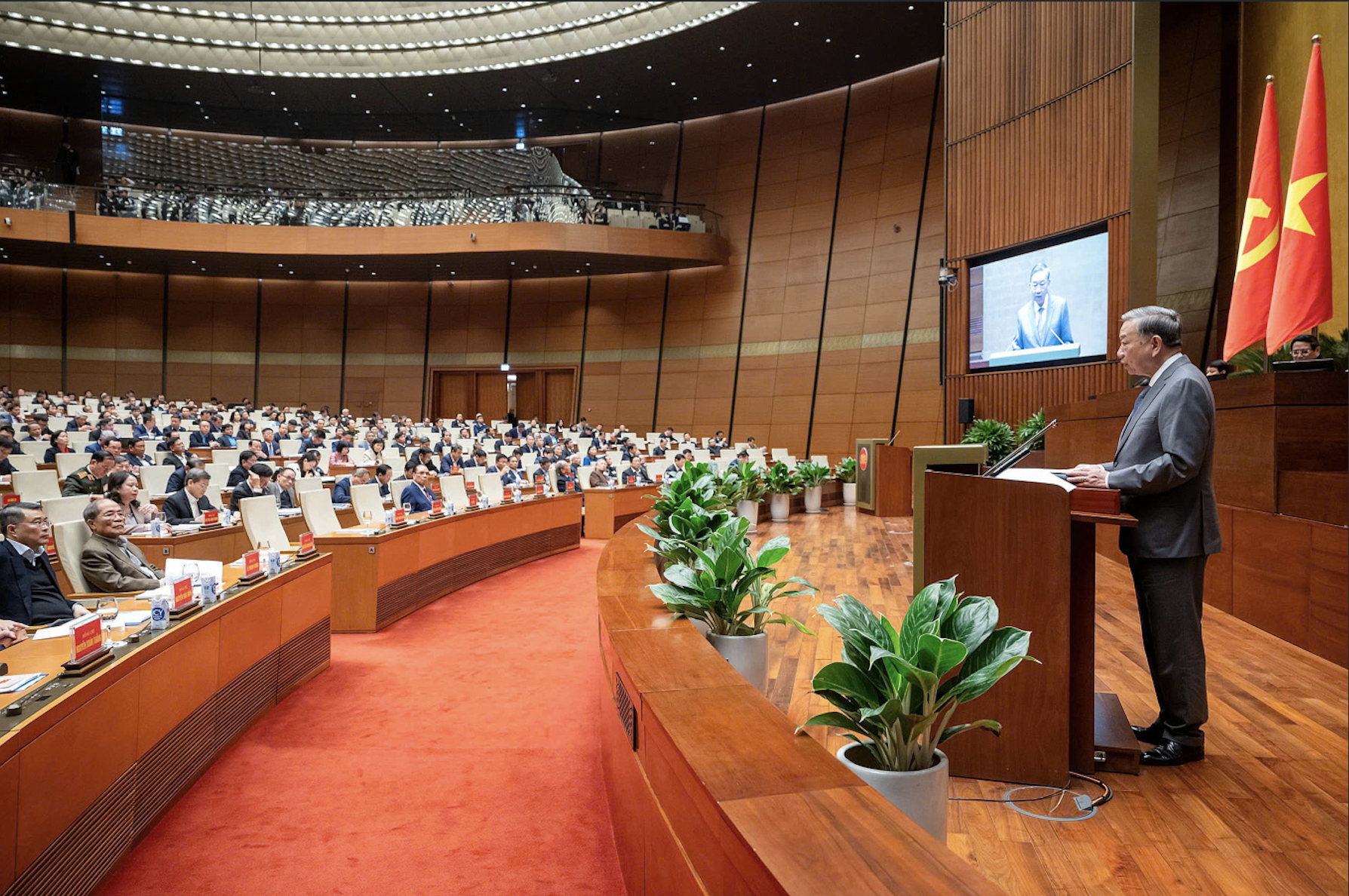
On the morning of January 13, the Central Party Secretariat organized a national conference on breakthroughs in science, technology, innovation and national digital transformation. The conference was held directly at Dien Hong Hall, National Assembly Building, combined with online access to the bridge points at provincial, municipal and central party committees; central departments, ministries, branches and public service units; bridge points at provincial, district and commune levels.
General Secretary To Lam; President Luong Cuong; Prime Minister Pham Minh Chinh; National Assembly Chairman Tran Thanh Man, and many other leaders and former leaders of the Party and State attended the conference. Nearly one million officials and party members watched it live and online.

Party and State leaders attend a science and technology exhibition at the National Assembly. Photo: Pham Thang
General Secretary To Lam is the head of the Central Steering Committee on Science and Technology Development.
At the beginning of the conference, the decision to establish the Central Steering Committee on Science and Technology Development for Innovation and National Digital Transformation under the Politburo was announced. General Secretary To Lam is the Head of the Steering Committee, the Deputy Heads include Prime Minister Pham Minh Chinh; Permanent Secretary of the Secretariat, Chairman of the Central Inspection Committee Tran Cam Tu, Head of the Central Economic Commission Tran Luu Quang, Vice Chairman of the National Assembly Nguyen Duc Hai. Chief of the Party Central Committee Office Nguyen Duy Ngoc is the Standing Deputy Head of the Committee.
The Steering Committee has members: Head of the Central Organizing Committee Le Minh Hung; Chairman of the Central Committee of the Vietnam Fatherland Front Do Van Chien; Head of the Central Propaganda Department Nguyen Trong Nghia; Director of the Ho Chi Minh National Academy of Politics Nguyen Xuan Thang; Minister of National Defense Phan Van Giang; Minister of Public Security Luong Tam Quang; Minister of Science and Technology Huynh Thanh Dat; Minister of Planning and Investment Nguyen Chi Dung; Minister of Finance Nguyen Van Thang; Minister of Education and Training Nguyen Kim Son; Minister of Information and Communications Nguyen Manh Hung; Deputy Chief of the Central Party Office Pham Gia Tuc.

Delegates attending the conference at Dien Hong meeting room. Photo: Pham Thang
Allocate at least 15% of the state budget for scientific research to serve strategic technology research.
Reporting on the results of implementing the Party’s guidelines and policies related to science and technology development, innovation and national digital transformation, Deputy Head of the Central Economic Commission Thai Thanh Quy said that since the country’s reunification, the Party has increasingly focused on and identified the importance of science and technology for socio-economic development.
Through the Congress terms, the Party’s awareness and thinking on science, technology, innovation and digital transformation have gradually improved, with many innovations. The policies and orientations have been built with inheritance and development, suitable for each stage of the country’s development and global trends.
Vietnam’s science and technology potential has been enhanced. The quantity and quality of science and technology organizations and staff have developed strongly, playing a core role in research and application of science and technology. State management, mechanisms and policies on science and technology development and management have continued to be innovated, creating a favorable legal corridor for the national innovation system; the innovation and startup ecosystem is gradually taking shape.
The National Innovation Center has been established and is operating with initial results. Vietnam is among the pioneering countries in issuing the National Digital Transformation Strategy. The state management system and legal framework for information technology and digital transformation are also being completed.
National digital infrastructure is being built synchronously and modernly; telecommunications infrastructure is widely developed, on par with developed countries. National and specialized databases are being gradually deployed. The digital technology industry is developing rapidly, increasingly contributing to GDP.
Specifically, Vietnam has 423 research and development organizations of different sizes, mainly concentrated in Hanoi and Ho Chi Minh City. Currently, there are nearly 900 enterprises granted Science and Technology Enterprise Certificates. The country has about 4,000 innovative startups, 208 investment funds, 84 incubators and 20 innovative startup centers. Vietnam’s innovative startup ecosystem ranks 56/100 countries, Hanoi and Ho Chi Minh City are in the top 200 global innovative startup cities.
In 2024, Vietnam will rank 44/133 in the Global Innovation Index and 71/193 in the E-Government Development Index. By the end of 2024, the proportion of the digital economy in GDP will reach 18.3%. The digital technology industry is estimated to have a revenue of 152 billion USD, of which the export turnover of hardware and electronics is estimated to reach 132 billion USD.
Deputy Head of the Central Economic Commission Thai Thanh Quy also said that the speed and breakthrough of science, technology, innovation and national digital transformation are still slow; they have not really become an important driving force for socio-economic development. The mobilization of resources for science, technology and research and development (R&D) is not effective, in which spending on science and technology has not reached the minimum prescribed level of 2% of total state budget expenditure (in 2023 it will only reach 0.82%) and spending on R&D has only reached about 0.67% of GDP (in which the average level of developed countries is 2-5% of GDP).
The mechanism for managing science and technology is slow to innovate and is not suitable, especially in terms of finance and investment. The mechanism and policies for cadres in science and technology activities are still heavily administrative, failing to create a favorable environment to promote creativity and attract talent; high-quality human resources are still lacking.
The science and technology market is developing slowly. The implementation of policies on the development and application of science and technology is still limited; there is a lack of institutions on finance, transfer, application, and development of science and technology, especially high technology; there is a lack of synchronous solutions and close coordination between ministries, sectors, and localities.
According to Mr. Quy, the awareness and thinking of some Party committees and authorities are still not complete and clear, they do not fully understand the necessity and urgency of innovating the science and technology management mechanism; they do not properly recognize the specific characteristics of this field, which are creativity, risk and delay; they do not really consider this as a top national policy, a foundation and driving force for socio-economic development. Investment resources for science and technology, innovation and digital transformation are low.
Many institutional and legal bottlenecks and bottlenecks that hinder the development of science, technology and innovation have not been resolved synchronously and thoroughly, especially the financial management and investment mechanisms that are slow to innovate and inappropriate; lack of testing institutions, sandboxes, liability exemptions, and risk acceptance. This has not created strong enough conditions for businesses to devote adequate resources to research and development.
Mr. Quy said that Resolution 57 put forward five major viewpoints. First, the Politburo affirmed that science and technology must be the most important breakthrough, the main driving force to rapidly develop modern productive forces, perfect production relations, innovate national governance methods, develop the socio-economy, prevent the risk of falling behind, and bring the country to breakthrough development and prosperity in the new era.
The Resolution clearly states the revolutionary, all-people, and comprehensive nature of the cause of science and technology development, innovation, and national digital transformation, which requires strengthening the comprehensive leadership of the Party, promoting the combined strength of the entire political system, and the active participation of entrepreneurs, businesses, and people. The Politburo identifies this as a profound and comprehensive revolution in all fields; to be implemented resolutely, consistently, and long-term. People and businesses are the center, the main subject, resource, and driving force; scientists are the key factor; the State plays a leading role.
The Politburo identified the core contents of this revolution as: institutions, human resources, infrastructure, data and strategic technology. Of which, institutions are a prerequisite, need to be perfected and go one step ahead. Innovating the thinking of building laws to ensure management requirements and encourage innovation, eliminating the mindset of “if you can’t manage it, then ban it”. “It is necessary to ensure high-quality human resources for science and technology development, innovation and national digital transformation; have special mechanisms and policies on talent”, Mr. Quy said, emphasizing the maximum exploitation of data potential, making data the main means of production, promoting the rapid development of big databases, data industry, and data economy.
The Resolution sets out the viewpoint of rapid and sustainable development, gradually becoming self-reliant in technology, especially strategic technology; prioritizing national resources for investment in science and technology development, innovation and digital transformation; quickly acquiring, absorbing, mastering and applying the world’s advanced scientific and technological achievements; promoting applied research, focusing on basic research, moving towards self-reliant and competitive technology in a number of areas where the country has demand, potential and advantages.
The Politburo also set out the consistent and inseparable requirement of ensuring national sovereignty in cyberspace; ensuring network security, data security, and information security of organizations and individuals.
To realize the major goals of Resolution 57, Deputy Head of the Central Economic Commission Thai Thanh Quy emphasized that the tasks of developing science and technology, innovation and digital transformation must be specifically identified in the annual work programs and plans of agencies, appropriately arranging the number of cadres with scientific and technical expertise in Party committees at all levels, and at the same time promoting the spirit of creativity, daring to think, daring to do, daring to take responsibility of the team of cadres and party members in developing science and technology, innovation and digital transformation.
In addition, it is necessary to eliminate all ideas, concepts, and barriers that are hindering development; turn institutions into a competitive advantage in science and technology development. Agencies must focus on removing bottlenecks, freeing up resources, encouraging and developing science, technology, innovation, national digital transformation, and human resource development.
The State has a pilot mechanism for enterprises to test new technologies under State supervision; has a policy of exemption from liability for enterprises, organizations and individuals in cases where testing new technologies and new business models causes economic damage due to objective reasons; and at the same time allows the formation of venture capital funds for creative startups, technology incubation and digital transformation.
Along with that, the State also increases investment and completes infrastructure for science, technology, innovation and national digital transformation; allocates at least 15% of the state budget for science to serve strategic technology research; issues public-private partnership mechanisms and policies to research and develop strategic technologies.
Ministries and sectors need to have attractive mechanisms and policies on credit, scholarships and tuition fees to attract excellent students to study in the fields of mathematics, physics, biology, chemistry, engineering and key technology, especially at postgraduate levels; focus on developing a team of lecturers and scientists with sufficient capacity and qualifications to meet the requirements of teaching in the fields of basic science, semiconductor chip technology, microcircuits, engineering and key technology.

Prime Minister Pham Minh Chinh. Photo: Pham Thang
7 tasks for breakthrough in science and technology
Speaking at the conference, Prime Minister Pham Minh Chinh emphasized that Resolution 57 of the Politburo is a breakthrough in the development of science and technology, innovation and digital transformation. This is a document of strategic significance, marking an important turning point for the country in these areas.
“Resolution 57 is of special importance, a guideline for development in the new era of prosperity, civilization and prosperity, and a strong call to the entire Party, people and army to make joint efforts to turn Vietnam into a developed, high-income country with global competitiveness,” said the Prime Minister.
The Head of Government believes that science and technology, innovation and digital transformation play a key role and are a strong driving force for Vietnam to develop rapidly, sustainably and sustainably. The Resolution helps Vietnam catch up with and advance with developed countries, avoid the risk of economic lag, and gradually surpass and stand shoulder to shoulder with technological powers.
This is also the key to improving labor productivity and economic competitiveness, creating new products and services to meet domestic and international market demands; optimizing production, business and state management processes; promoting the development of digital economy, digital society and green economy, in line with the general trend of the world; contributing to ensuring progress, social justice and social security, bringing practical benefits to all people, contributing to building a prosperous and prosperous Vietnam.
The Prime Minister said that the Government identified 7 main groups of tasks in the Action Program to implement Resolution 57, first of all raising awareness, making breakthroughs in innovative thinking, determining strong political determination, resolutely leading and directing, creating new momentum, new spirit in the whole society in developing science and technology, innovation and digital transformation.
The Government is also determined to perfect institutions, eliminate all ideas, concepts, and barriers that are hindering development, and turn institutions into a competitive advantage in the development of science and technology, innovation, and digital transformation. Investment will be increased in infrastructure for science and technology, innovation, and digital transformation. High-quality human resources and talents will be highly appreciated to meet the development requirements of this field.
State agencies will promote digital transformation, apply science and technology, and innovate to improve the effectiveness of national governance, state management, and ensure national defense and security. Scientific and technological innovation activities and digital transformation in enterprises will be strongly promoted. Vietnam will also strengthen international cooperation in the development of science and technology and innovation.
Innovation in scientific management mechanism
National Assembly Chairman Tran Thanh Man said that there are currently 4 laws directly related to the field of science and technology, including: Law on Science and Technology, Law on High Technology, Law on Technology Transfer, Law on Intellectual Property; in addition, there are 12 other laws, 42 decrees, and 131 related circulars.
Since the beginning of the 15th National Assembly’s term, the National Assembly has passed 8 Laws related to this content. In particular, 29 Laws and 41 Resolutions passed by the National Assembly at the 7th and 8th Sessions have resolved many urgent practical issues, including Laws regulating the creation of digital databases; management methods, mechanisms, and specific preferential policies related to the application of science, technology, and digital transformation; allowing the implementation of a controlled testing mechanism for research activities to produce products, services, and new types of business.
“The Party and State have always paid attention to and strengthened leadership and direction to develop science, technology, innovation and digital transformation, not just now,” said Mr. Man.
However, the legal system on science, technology and national digital transformation still has some limitations and lacks synchronization and unity, leading to some incentive and promotion mechanisms in these areas not being effective. Investment and financial mechanisms for science, technology and innovation are not really suitable, and do not encourage and attract investment from society.
Investment and financial mechanisms for digital transformation implementation have not been resolved promptly; the allocation of financial resources for tasks, projects and projects of national scope is still slow and implementation is complicated and time-consuming.
The National Assembly Chairman said that it is necessary to strongly innovate thinking, methods, and procedures in law-making activities. Laws must be concise and clear, only regulating issues under the authority of the National Assembly; not legalizing the contents of circulars and decrees. Strengthening decentralization, delegation of power, and administrative reform; strongly shifting from laws that focus on management to harmoniously combining effective management with development creation, encouraging innovation, and resolutely abandoning the mindset of “if you can’t manage, then ban”.
For specific issues that are still in the process of development and not yet stable, the law only provides a framework and assigns the Government to provide detailed regulations, ensuring flexibility in direction and administration, promptly responding to practical requirements. The scientific management mechanism must create motivation for innovation and creativity like the spirit of “contract 10” in agriculture, encouraging businesses to invest in research and development, especially in the fields of high technology and biotechnology.
In addition, the State continues to allow piloting of new practical issues; research and appropriate regulations on piloting mechanisms, controlled testing mechanisms; research on exemption from liability in cases of testing new technologies and new business models. The National Assembly, the National Assembly Standing Committee, and National Assembly agencies will coordinate with the Government and Government agencies to review the relevant legal system; complete, timely, and synchronous institutions in accordance with the requirements of Resolution 57.
The National Assembly’s agencies will assign monitoring, guidance, urging, inspection, supervision, and reporting on the implementation of the Resolution; clearly indicate the results achieved, the work that has not been done, the work that has not met requirements, solutions to overcome them, and individualize responsibilities.
Discover more from Vietnam Insider
Subscribe to get the latest posts sent to your email.