

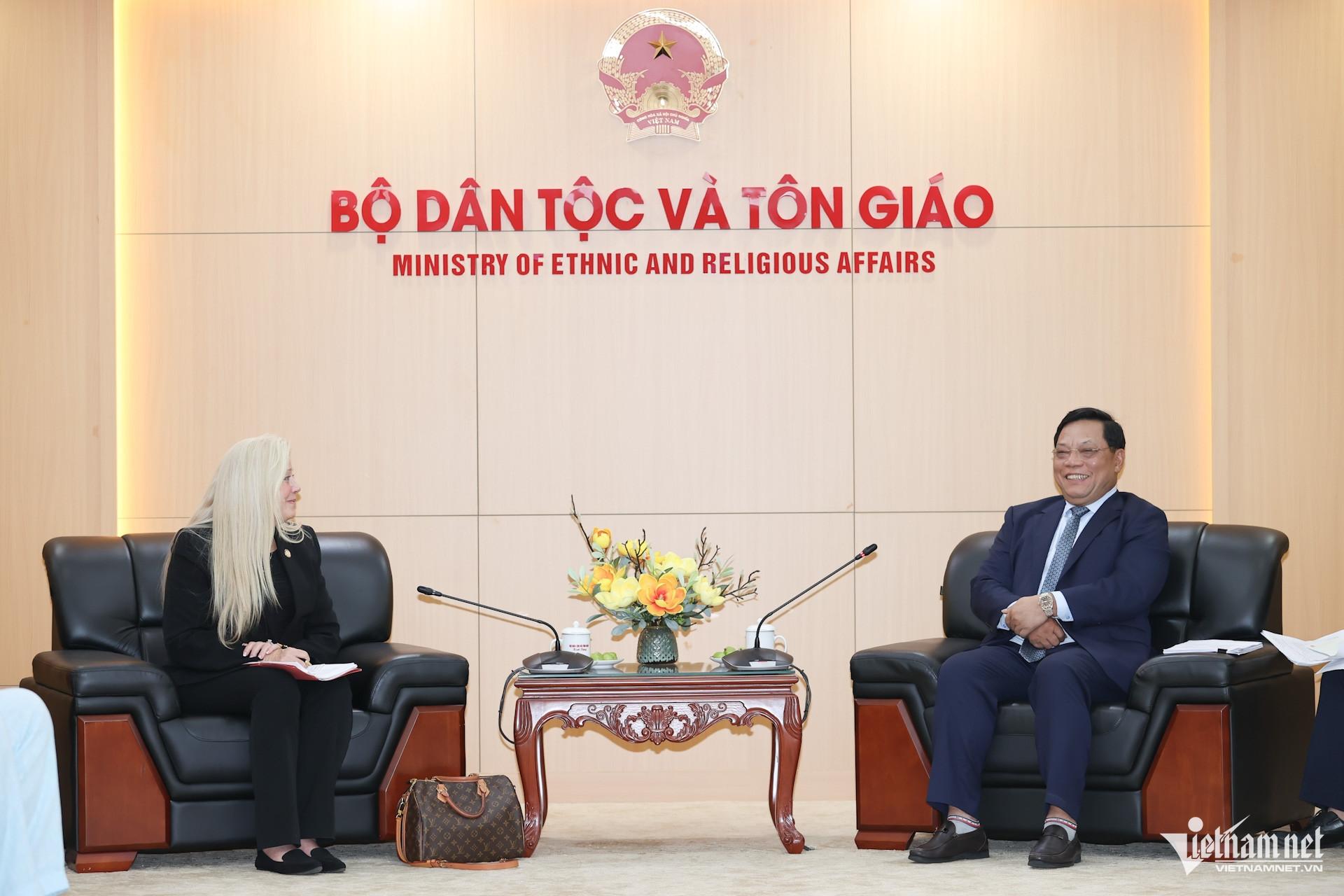
On the afternoon of November 18, a delegation from the United States Commission on International Religious Freedom (USCIRF), led by USCIRF Vice Chair Cecilia Diane Noland-Heil, visited and held a working session with the Government Committee for Religious Affairs under the Ministry of Ethnic and Religious Affairs. Representatives from the US Embassy in Hanoi accompanied the delegation.
Prior to the bilateral working session, on behalf of the leadership of the Ministry of Ethnic and Religious Affairs, Deputy Minister Nguyen Hai Trung hosted a courtesy reception for the delegation. Attending the reception were Head of the Government Committee for Religious Affairs Vu Hoai Bac, Deputy Head Nguyen Tien Trong, Director General of the International Cooperation Department Hoang Thi Le, and Deputy Chief of the Ministry Office Nguyen Tien Thanh.
Extending warm greetings, wishes of good health, and hopes for a successful working trip to Vietnam, Deputy Minister Nguyen Hai Trung noted that during a recent visit to the United States, a high-level delegation from the Ministry of Ethnic and Religious Affairs led by Minister Nguyen Dinh Khang had provided USCIRF and relevant US agencies and organizations with comprehensive updates on the situation of belief, religion, and religious freedom in Vietnam.
Welcoming the USCIRF delegation, Deputy Minister Nguyen Hai Trung encouraged candid exchanges with the Government Committee for Religious Affairs and the sharing of best practices in safeguarding freedom of belief and religion, thereby contributing to the stable and sustainable advancement of the Vietnam–United States Comprehensive Strategic Partnership.

Deputy Minister Nguyen Hai Trung presents USCIRF Vice Chair Cecilia Diane Noland-Heil with a painting of the Temple of Literature (Quoc Tu Giam). Photo: Le Anh Dung
Following the courtesy call, Nguyen Tien Trong, Deputy Head of the Government Committee for Religious Affairs, chaired the working session with the USCIRF delegation. Also present were Director General of the International Cooperation Department Hoang Thi Le, Deputy Chief of the Ministry Office Nguyen Tien Thanh, and specialists from the Government Committee for Religious Affairs.
During the session, Deputy Head Nguyen Tien Trong briefed the USCIRF delegation on Vietnam’s achievements in guaranteeing freedom of belief and religion, the core provisions and new points of the 2026 Law on Belief and Religion, as well as the key contents of the Decree detailing and guiding the implementation of several articles of the 2026 Law on Belief and Religion.

The Government Committee for Religious Affairs holds a working session with USCIRF. Photo: Le Anh Dung
According to Mr. Trong, Vietnam’s institutional and legal framework governing belief and religion has been continuously refined—from provisions in the 1946 Constitution and the 2013 Constitution to the 2016 Law on Belief and Religion, and most recently the amendments and supplements enacted in the 2026 Law on Belief and Religion.
These milestones underscore the consistency of the Party’s guidelines and the State’s policies and laws in respecting, protecting, and guaranteeing citizens’ right to freedom of belief and religion while creating favorable conditions for religions to flourish.
As of November 2026, Vietnam is home to approximately 28 million religious followers (accounting for roughly 28% of the population), including around 66,000 religious dignitaries, 120,000 religious lay leaders and functionaries, and 30,000 places of worship.

Appreciating Vietnam’s proactive information sharing, USCIRF Vice Chair Cecilia Diane Noland-Heil raised five specific issues of interest and concern to herself and the Commission. Photo: Le Anh Dung
The Vietnamese State has officially recognized 44 religious organizations belonging to 16 distinct religions. Nationwide, there are currently over 8,200 affiliated religious organizations, nearly 6,000 registered concentrated religious practice groups of Vietnamese citizens, and more than 70 concentrated religious practice groups of foreign nationals legally residing in Vietnam.

USCIRF Commissioner David Andre Anderson, a member of the delegation, speaks at the working session. Photo: Le Anh Dung
Deputy Head Nguyen Tien Trong affirmed that the newly promulgated provisions in the 2026 Law on Belief and Religion establish an adaptable legal foundation suited to the evolving dynamics of religious life and emerging societal demands.
Amid rapid digital transformation, deepening international integration, and the emergence of online religious practices and propagation, perfecting the legal framework helps regulate new social relations appropriately, protects the legitimate rights and interests of organizations and individuals, and prevents acts that exploit belief and religion to violate the law.
He urged USCIRF to assess the state of religious freedom in Vietnam based on accurate, comprehensive, and verified information that objectively reflects Vietnam’s progress in policy and legislative reform as well as practical guarantees of citizens’ religious freedom. He also called for clarifying discrepancies in reports issued by US agencies and organizations—particularly regarding the activities of religious organizations, religious practices among ethnic minority communities, and the local enforcement of laws on belief and religion.

USCIRF Policy Analyst Kurt James Werthmuller, a member of the delegation, exchanges information during the working session. Photo: Le Anh Dung
Engaging in candid, detailed discussions on the specific matters raised by the USCIRF delegation, Deputy Head Nguyen Tien Trong proposed that USCIRF strengthen information exchange and fact-checking regarding specific incidents related to belief and religion in Vietnam.
Regarding Vietnam’s assessment and designation in USCIRF’s annual reports, the representative of the Government Committee for Religious Affairs requested that the United States take full account of Vietnam’s accomplishments in safeguarding freedom of belief and religion, and intensify direct consultations with competent Vietnamese authorities before issuing assessments or recommendations—avoiding unobjective evaluations that could affect mutual understanding, trust, and bilateral cooperation.

Deputy Head of the Government Committee for Religious Affairs Nguyen Tien Trong proposes that both sides maintain regular, substantive exchanges between competent agencies on issues of mutual interest. Photo: Le Anh Dung
The USCIRF delegation acknowledged Vietnam’s achievements in ensuring freedom of belief and religion and pledged to maintain and expand communication channels to produce more objective and concrete reporting on the situation of belief, religion, and religious freedom in Vietnam.
Concluding the session, Deputy Head Nguyen Tien Trong reiterated that Vietnam always values international dialogue and cooperation on human rights, including freedom of belief and religion, grounded in equality, mutual respect, and respect for each nation’s independence, sovereignty, and legal system.

He encouraged USCIRF to sustain open, candid, and constructive dialogue that respects differences in history, culture, socio-economic conditions, and legal frameworks, while strengthening cooperation and experience-sharing in protecting religious freedom to further promote the stable and sustainable growth of the Vietnam–US Comprehensive Strategic Partnership.
Source: vietnamnet.vn
Discover more from Vietnam Insider
Subscribe to get the latest posts sent to your email.