

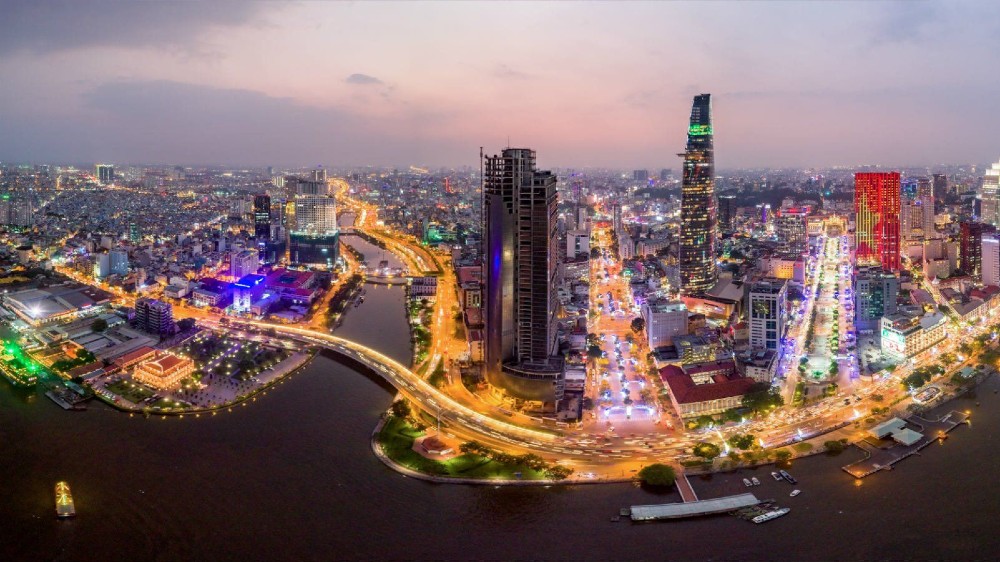
Despite leading Vietnam in FDI inflows, HCMC’s key foreign investors warn that complex, year-long permitting processes and infrastructure chaos are eroding the city’s competitiveness against rivals like Bangkok and Singapore.
HO CHI MINH CITY – Ho Chi Minh City (HCMC), Vietnam’s economic powerhouse, is facing a critical crossroads. On one side lies the city’s ambition to become a top-100 global ‘super-hub’ by 2045; on the other, the stark reality of crippling administrative and logistical bottlenecks, according to its most valuable partners: the foreign direct investment (FDI) community.
Related: Here’s how to set-up a foreign invested company in Vietnam’s HCMC
At the “Meeting with Foreign-Invested Enterprise Community 2025” event, executives from major business chambers—including AmCham, EuroCham, SingCham, and AusCham—unanimously identified two core risks that are reducing HCMC’s attractiveness:
- Administrative Friction: Complex and opaque licensing that drags on for up to 12 months.
- Logistics Chaos: Severe traffic congestion and slow cargo clearance at air and sea ports.
This warning comes despite HCMC’s stunning success in attracting capital, currently leading the nation with $141.2 billion in valid registered FDI. In the first nine months of this year alone, new FDI surged $7.1 billion, marking a 37.4% year-on-year increase.
The Permitting Trap: The 13-Day Illusion
The greatest frustration stems from a lack of clarity in administrative procedures, which often creates an investment timeline bottleneck.
Seck Yee Chung, Vice Chairman of the Singapore Business Association (SingCham), cited a recent decree that sets a processing limit of 13 working days for certain licenses. However, he revealed the reality is often nine to twelve months, noting, “The time taken to seek comments and feedback from multiple departments, such as the Department of Industry and Trade, is not included in the official deadline.”

Seck Yee Chung @ ITPC
This inconsistency and delay, echoed by Sam Conroy, President of the Australian Business Association (AusCham), undermines HCMC’s competitive edge against regional financial centers. Travis Mitchell, CEO of the American Chamber of Commerce (AmCham), stressed that the city must guarantee timely business and operating license issuance to strengthen investor confidence.
Gridlock and The Logistics Challenge
Beyond paperwork, investors are demanding better physical infrastructure. EuroCham Vice President Erick Contreras pointed to persistent delays in cargo customs clearance, while AusCham highlighted how severe traffic congestion impacts business efficiency and output.
The consensus solution involves upgrading public transit and adopting modern urban planning. Michele D’Ercole, President of the Italian Chamber of Commerce (Icham), urged HCMC to expand its metro and bus systems and center its master planning around the Transit-Oriented Development (TOD) model to reduce reliance on private vehicles, cut emissions, and ease gridlock.
HCMC Pledges Structural Reform and a Global Hub
HCMC Chairman Nguyen Van Duoc acknowledged the challenges—including traffic, flooding, pollution, and red tape—and affirmed the city views foreign enterprises as the “focus, driving force, and resource for development.”
The Chairman laid out an ambitious roadmap focused on three pillars:
- Tech-Driven Growth: Restructuring the economy towards science, technology, and innovation.
- Green Transformation: Pushing for comprehensive green development.
- Strategic Infrastructure: Developing the Cần Giờ international transshipment port and, crucially, an International Financial Center.
The city is targeting an average Gross Regional Domestic Product (GRDP) growth of 10%−11% annually through 2030.
The International Financial Center as a Breakthrough
The proposed International Financial Center (IFC) is viewed by AmCham as “one of the most breakthrough reforms” in recent years, with the potential to transform Vietnam into a regional hub for green finance and capital.
However, international partners provided crucial caveats. AmCham and BritCham representatives recommended that to succeed, the IFC must maintain regulatory independence, ensure transparency in capital flows, build a reliable dispute resolution mechanism and adopt English as the primary working language to align with global financial norms.
A ‘Green FDI Fast Track’
In a targeted recommendation, the Nordic Business Association (NordCham) proposed creating an “FDI Fast Track”—a dedicated, single-window unit with English-language support—specifically for large-impact digital and green investment projects.
According to NordCham President Thue Quist Thomasen, prioritizing renewable energy, upgrading the power grid, and providing clear power purchase agreements (PPAs) could unlock a new wave of FDI from Nordic firms ready to deploy technology and operational expertise.
HCMC is aiming to spend 2%−3% of its GRDP on Research and Development (R&D) to underpin this shift, assuring investors that the push for market transparency and an equitable environment will continue as it ascends the global financial ranks.
Discover more from Vietnam Insider
Subscribe to get the latest posts sent to your email.