

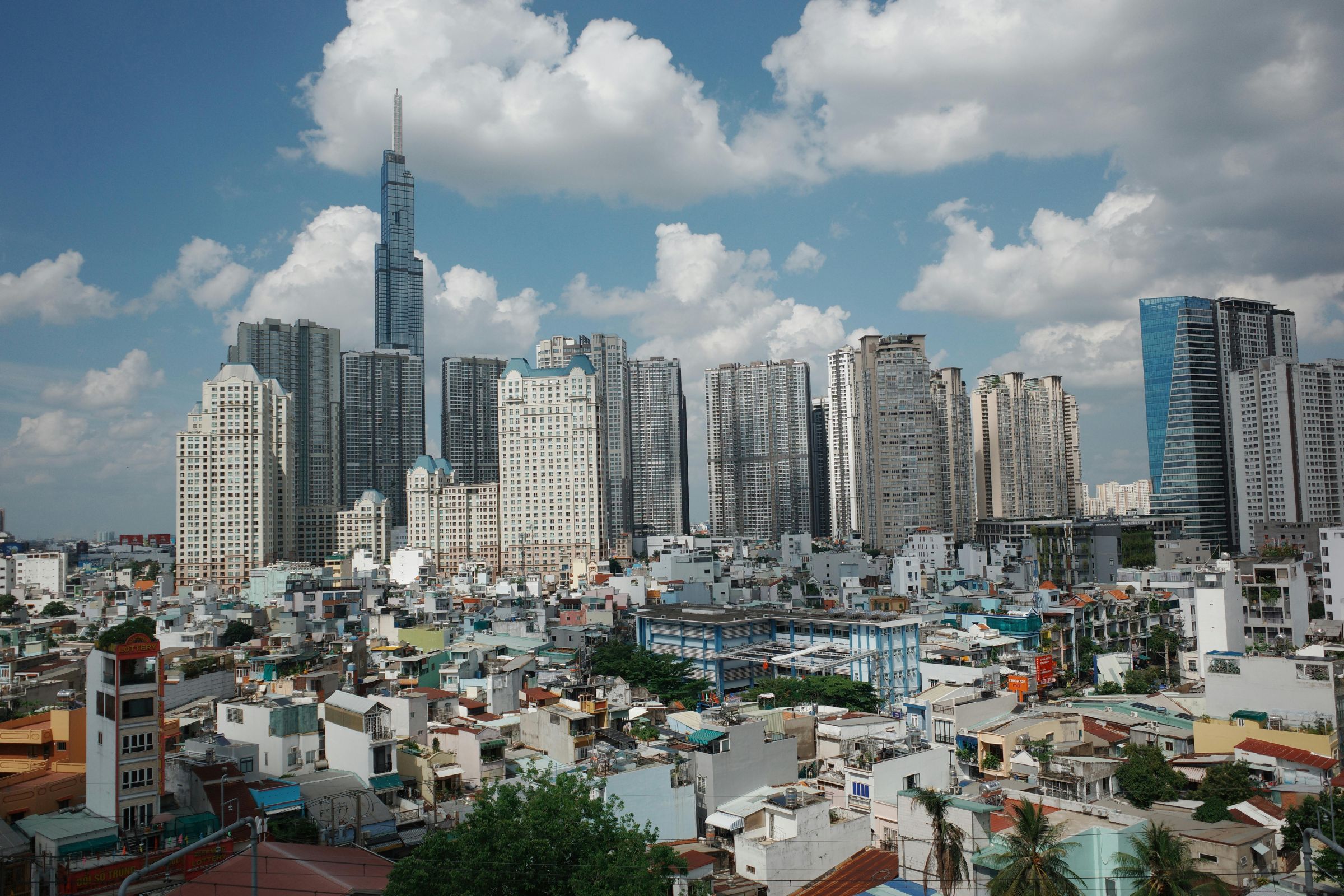
Ho Chi Minh City, 23 April 2026
Ho Chi Minh City’s expanded scale after the merger with two provinces brings new opportunities but also calls for a clearer and more convincing brand identity for both local and international audiences.
In 2025, Ho Chi Minh City crossed a historic threshold. With the merger of Binh Duong and Ba Ria – Vung Tau, the city is no longer just a metropolis. It has become a multi-polar mega-region, combining finance, industry, logistics, innovation, culture, and marine economy.
On paper, the change was clear and decisive. Ho Chi Minh City now stretches across more than 6,700 square kilometres, is home to over 14 million people, and accounts for almost a quarter of Vietnam’s GDP. In economic and logistical terms, it has become the largest urban entity the country has ever known.
According to Associate Professor Giannina Warren, Senior Program Manager for Professional Communication at RMIT University Vietnam, administrative mergers are often treated as technical exercises: redraw boundaries, restructure agencies, and integrate budgets. But cities are not only defined by maps and statistics.
“They are also defined by how people understand them and live, work and play in them. They are not only governed systems; they are perceived systems. People – residents, investors, students, visitors – make decisions based on how a place feels, what it stands for, and whether its story makes sense to them,” she said.

Ho Chi Minh City now stretches across more than 6,700 square kilometres and is home to over 14 million people. (Photo: Pexels)
For decades, Ho Chi Minh City has been easy to describe. It was Vietnam’s commercial heart, a dense and energetic place known for opportunity, openness and relentless movement. Bình Dương was recognised as an industrial engine, while Ba Ria – Vung Tau was associated with ports, energy and the sea.
After the merger, these identities did not disappear – they were simply placed under one name. That creates enormous potential, but it also raises a fundamental question: what, exactly, is Ho Chi Minh City now?
“When cities grow in size and complexity, their identity does not automatically grow with them,” Associate Professor Warren said. “In fact, without careful attention, it often becomes less clear. Bigger cities can become harder to explain, harder to remember, and harder to trust – especially for people who do not live there.”
In recent years, Ho Chi Minh City’s public image has relied heavily on tourism-led messaging, with familiar language about vibrancy, energy, and dynamism. These ideas are not wrong, but they are no longer sufficient. A city that aims to position itself as a regional logistics hub, an international financial centre, a destination for global talent and a centre for higher education needs a deeper, more coherent story.
The 2025 merger intensifies this challenge. “When a city tries to stand for too many things at once – industry, finance, tourism, innovation, culture – without a clear organising idea, its identity can start to feel diluted. Scale alone does not create meaning,” Associate Professor Warren said.
According to Dr Bui Quoc Liem, a lecturer in Professional Communication at RMIT Vietnam, the diversity of function requires a different way of thinking about city identity. Rather than one slogan trying to describe everything, HCMC now needs a brand architecture: a shared overarching story that allows different areas to express distinct roles, while still belonging to one coherent identity.
This shared narrative should explain how the different parts belong to the same urban system and contribute to a common future. Without this, peripheral areas risk feeling like add-ons rather than integral parts of the city, and the city risks communicating conflicting messages to the outside world.

Associate Professor Giannina Warren (left) and Dr Bui Quoc Liem (Photo: RMIT)
Dr Liem also stressed that this is where city branding is often misunderstood. It is easy to assume that branding is about logos, taglines, or advertising. In reality, especially in the context of a merger, branding is closer to strategic coordination.
“A clear narrative helps different parts of the city – and different government departments – move in the same direction. It shapes how infrastructure priorities are explained, how investment strategies are framed, how talent is attracted, and how the city speaks to the world. The city’s brand becomes the compass for its development, instead of just a decoration,” he said.
The city leaders have already recognised this connection. Ho Chi Minh City has begun work on a long-term branding strategy aligned with its socio-economic vision for 2030 and 2045. Crucially, there is growing acknowledgement that a brand cannot exist in isolation. A city that presents itself as open must reduce administrative friction. A city that aspires to be liveable must invest seriously in transport and public services. A city that aims to become a financial centre must demonstrate credibility, consistency, and governance capacity.
The RMIT experts believe that the cost of not addressing this moment is not dramatic or immediate, but it is real. Without a clear narrative, communication becomes fragmented. Residents in newly merged areas may struggle to see themselves as part of the city’s story. International partners may find the city impressive, but difficult to access. Opportunities to position Ho Chi Minh City as Southeast Asia’s next major mega-region may quietly slip away.
The administrative transition has already happened. The question now is whether the city can tell its new story clearly enough for others to understand it – and for its own residents to believe in it. The challenge ahead is not to invent something artificial, but to articulate clearly what already exists: a city-region that connects industry with innovation, ports with finance, culture with opportunity, and local energy with global ambition.
Discover more from Vietnam Insider
Subscribe to get the latest posts sent to your email.