

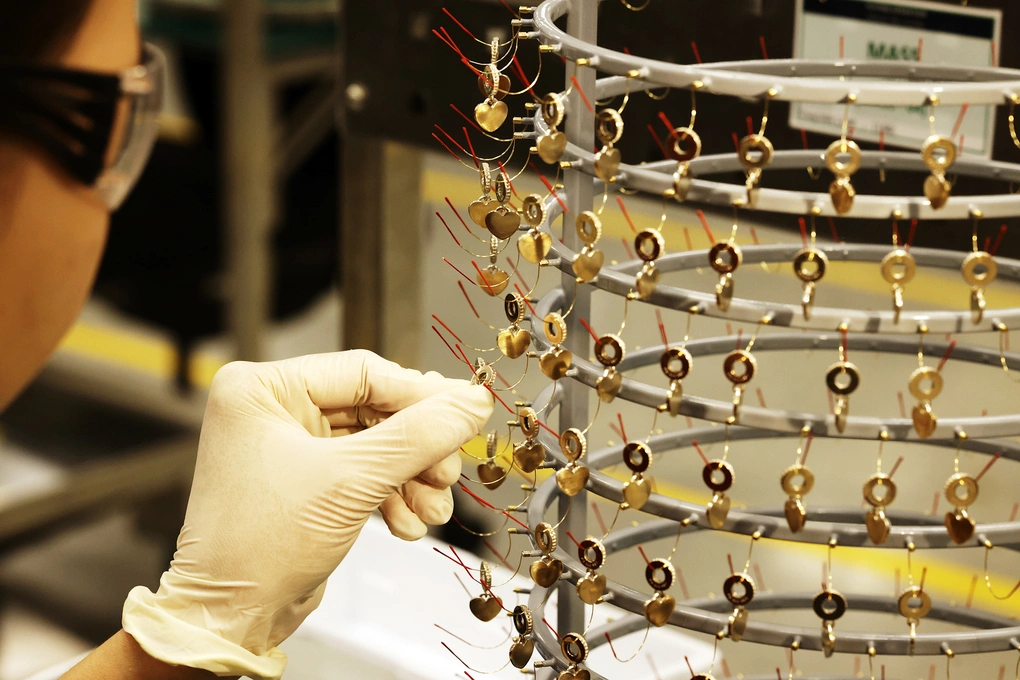
On October 1, the very first Pandora jewelry pieces came off the assembly line at a brand-new production facility in VSIP III Industrial Park, Binh Co Ward, Ho Chi Minh City. This represents the Danish jewelry giant’s first manufacturing footprint outside Thailand, where Pandora has refined its craftsmanship over 37 years.

Aerial view of the sprawling Pandora manufacturing facility
The facility represents a total investment of $150 million (nearly 4 trillion VND) across 7.5 hectares, an area roughly equivalent to 10 standard football pitches. According to Pandora, this facility stands as the world’s largest dedicated crafting facility for finished jewelry and serves as the brand’s fourth production site globally.

Workers assembling pieces inside the facility
At full operational capacity, the factory will employ approximately 7,000 workers and achieve a maximum output of 60 million jewelry items each year. This expanded volume will lift Pandora’s worldwide manufacturing capacity by roughly 50%.
In 2025, Pandora sold 112 million jewelry pieces globally. Consequently, the design capacity of the Vietnam plant alone equals roughly 54% of the brand’s entire sales volume from last year.
Berta de Pablos-Barbier, Chief Executive Officer of Pandora, noted that the company selected Vietnam thanks to its robust business climate, infrastructure, and skilled labor pool. Specifically, the jeweler values the manual dexterity and artisanal skills of Vietnamese craftspeople in an industry that still requires substantial handcrafting.
“Opening this facility is about building the next decade for Pandora,” de Pablos-Barbier stated.

Pandora CEO Berta de Pablos-Barbier converses with Vietnamese factory workers
The Chief Executive Officer added that the new production framework emphasizes agility, enabling the Vietnamese operation to produce diverse product lines tailored to varied international markets. Establishing an operational stronghold outside Thailand also allows the company to diversify supply chain risks and lessen dependence on a single manufacturing geography.
Lina Gandløse Hansen, Danish Ambassador to Vietnam, remarked that massive investments from Danish corporations such as LEGO and Pandora underscore deep confidence in Vietnam as a long-term manufacturing destination. In her view, Vietnam holds distinct advantages in technical talent, infrastructure readiness, expanding industrial capabilities, and strategic geographical location.

Danish Ambassador to Vietnam Lina Gandløse Hansen
The Danish Ambassador added that access to green and renewable energy remains an essential requirement if Vietnam wishes to draw further capital injections from Danish enterprises.
From Delicate Wax Trees to Gleaming Treasures
Guided by Matt Barton, Senior Manager of Manufacturing Excellence, reporters toured each zone to witness how modest wax shapes transform into radiant finished jewelry.

Matt Barton, Senior Manager of Manufacturing Excellence
A single piece undergoes multiple intricate steps before departing the facility. Starting from an approved initial concept, technicians build precision molds to form detailed wax replicas. These miniature wax components are then attached around a central stem to form wax “trees,” preparing them for the metal investment casting phase.

Inside the process demonstration room, emerald-green wax trees crowded with delicate motifs sit directly beside raw cast pieces, illustrating the physical evolution of a charm or ring across each stage. Following casting, technicians clip individual metal components from the tree to commence grinding and hand-polishing.

The pieces then advance through finishing stations including assembly, soldering, gemstone setting, and electroplating. Before packaging, every piece must pass strict quality inspections.
While modern machinery populates various zones of the plant, human hands remain central along every line. At specialized workstations, artisans use fine tools to shape, set, and refine minute details with millimeter precision.

To build workforce capability, Pandora sent Vietnamese production specialists to Thailand for months of intensive hands-on instruction. Furthermore, Master Trainers from Thailand relocated to Vietnam earlier this year to impart 37 years of specialized manufacturing wisdom and technique to local artisans.

Initial Focus on Gold-Plated Collections
During its opening phase, the Vietnamese facility focuses primarily on accelerating output for yellow gold-plated jewelry.
Jeerasage Puranasamiddhi, Chief Strategy Officer at Pandora, explained that international consumer appetite for yellow gold-plated designs is expanding swiftly. “We must expand capacity rapidly to fulfill global market demand,” he said.
Once technical workflows and workforce proficiencies stabilize, Pandora plans to introduce platinum-plating capabilities at the site in subsequent years.

Sustainability forms another cornerstone of the operation. Pandora confirmed that 100% of the silver and gold used in its manufacturing comes from recycled sources. Furthermore, the Ho Chi Minh City plant operates on 100% renewable electricity and meets LEED Gold green building standards.

Office and administrative wing of the Pandora factory
Currently, Pandora sources raw precious metals through international procurement channels for import into Vietnam. Meanwhile, domestic Vietnamese enterprises supply industrial machinery, logistics, catering, janitorial services, facility management, finance, legal, and recruitment services. Pandora noted that its local vendor network will continue to widen as output scales up.
Following its maiden production batch on October 1, the plant will steadily ramp up volume. Once operating at peak capacity, this 10-pitch-sized manufacturing complex will craft up to 60 million jewelry pieces each year, feeding Pandora’s retail footprint across more than 100 countries.
(Source: kenh14.vn)
Discover more from Vietnam Insider
Subscribe to get the latest posts sent to your email.