

On October 28, Oxfam in Vietnam partnered with the People’s Committee of Can Tho City and relevant agencies to launch the project “Developing Sustainable, Low-Emission, Climate-Resilient Rice Value Chains in the Mekong Delta” (GORICE).

General view of the project launch ceremony on October 28.
Funded by Global Affairs Canada and implemented through Oxfam, the GORICE project will run across Can Tho, An Giang, and Vinh Long from 2025 to 2030.
The initiative aims to improve economic, social, and environmental welfare for rice farmers, especially women and ethnic minorities across the Mekong Delta, through climate-resilient and low-emission farming practices.
The project focuses on climate-smart rice production. It promotes sustainable, low-emission farming methods that boost productivity and broaden access to carbon initiatives.
Additionally, the project expands access to green finance, carbon markets, and sustainable business opportunities for rice growers, with particular emphasis on women and ethnic minority communities.
The initiative also aims to strengthen multi-stakeholder partnerships and establish favorable policies to assist farmers throughout the rice sector’s sustainable transition.

Delegates attending the project launch ceremony
Deputy Country Director of Oxfam in Vietnam Pham Quang Tu stated that the project will concentrate on low-emission technical training, circular economy models, low-emission rice market development, and consumer behavior shifts. In parallel, the project will elevate the standing of women, youth, and ethnic minority groups.
By 2030, the project strives to directly benefit roughly 48,200 individuals, half of whom are women. It also targets reducing carbon emissions by approximately 748,000 metric tons, applying high-quality, low-emission practices across 180,000 hectares, and benefiting around 100,000 consumers.

Vice Chairman of the Can Tho City People’s Committee Tran Chi Hung speaks at the event.
Speaking at the ceremony, Vice Chairman of the Can Tho City People’s Committee Tran Chi Hung emphasized that the Mekong Delta faces escalating challenges from climate change, extreme weather, saltwater intrusion, and resource depletion.
Furthermore, rising input costs and tighter market requirements concerning quality, traceability, environmental standards, and emissions reductions heighten operational pressures. Therefore, transitioning toward green, sustainable, and climate-resilient production while raising incomes for rice farmers represents an urgent priority.

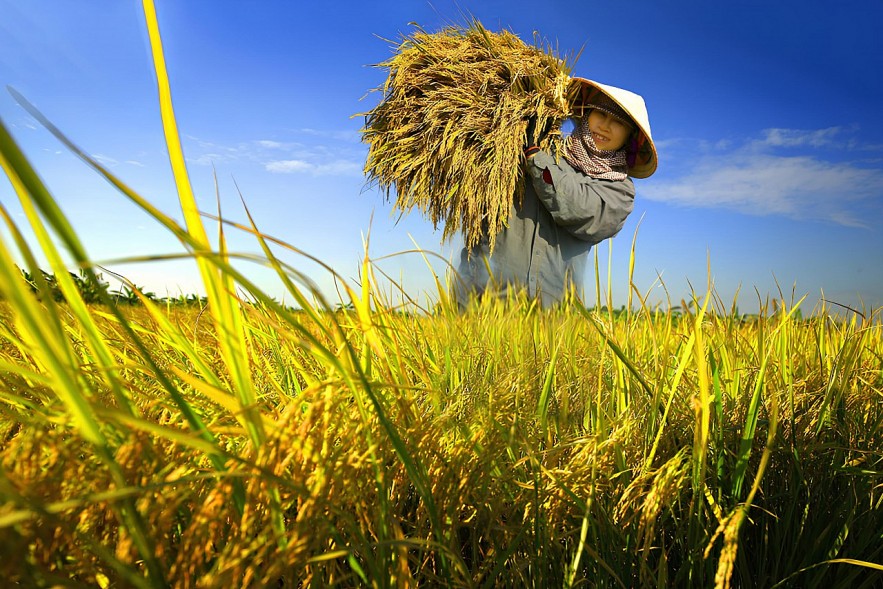
Can Tho City farmers adopt smart, low-emission rice farming models.
The GORICE project will help accelerate climate-smart farming techniques, establish demonstration models, enhance water and straw management, reduce emissions, and promote circular economic practices.
Simultaneously, the project will expand market linkages, advance the role of women, and create avenues for vulnerable demographics to participate in and benefit from the rice value chain.
According to Mr. Tran Chi Hung, Can Tho plans to implement the initiative across seven communes: Ho Dac Kien, Thuan Hoa, Dai Ngai, Tan Thanh, Gia Hoa, Nhu Gia, and Thanh Phu, with total non-refundable aid capital of around 15 billion VND.

The project prioritizes participation and benefits for rural women and ethnic minorities.
To maximize project outcomes, Deputy Director of the Department of Agriculture and Environment of An Giang Province Tran Thanh Hiep proposed prioritizing production governance training for cooperatives and farmers.
He stressed the need to adopt advanced cultivation standards, keep electronic farm logs, and digitalize quality control and traceability. Creating equitable opportunities for rural women and ethnic minority communities to participate in and benefit from the project remains paramount.
Discover more from Vietnam Insider
Subscribe to get the latest posts sent to your email.