Southern Vietnam tollgate shuts down over repeated opposition from drivers

Advertisements

A toll station belonging to a BOT (build-operate-transfer) project in southern Vietnam was forced to shut down again due to fierce opposition from commuters on Thursday, after a three month closure for the same reason.

The Cai Lay toll station on the section of National Highway 1 running through Cai Lay Town in the Mekong Delta province of Tien Giang resumed operations on Thursday morning following a three and a half month shutdown.

A BOT project upgrading the section of highway and building a detour across Cai Lay Town at a cost of VND1.389 trillion ($61.1 million) is currently operating the facility.

Drivers prepare small denomination banknotes to pay their toll.

BOT is a project-financing framework in which the developer receives a concession from the private or public sector to finance, design, construct, and operate a facility for a certain period, during which it can raise finances and retain all revenues generated by the project.

The facility is then transferred to the public administration at the end of the concession agreement.

At round 12:45 pm, three hours after re-opening, the tollgate was forced to close after too many drivers paid the fee in small denomination banknotes as a show of protest.

The station resumed operations at around 3:35 pm before being forced to cease the toll collection at 4:50 pm for the same reason.

Chaos occurs at the toll station on November 11, 2017 as drivers express their opposition.

At around 1:30 am on Friday, a group of commuters changed their protest tactics; this time requiring attendants to give them back VND100 in change.

As the smallest denomination note, the VND100 bill is effectively never used by members of the public, despite its validity.

Consequently, the employees did not have enough VND100 banknotes and were once again forced to close the facility for a third time since reopening it on Thursday.

The repeated incidents caused traffic backups from Ho Chi Minh City all the way down to the Mekong Delta city of Can Tho.

Police officers at the toll station

Ineffective measures

The Cai Lay toll station was first put into operation on August 1 despite fierce opposition from drivers over the tollgate being placed on the existing highway instead of the new detour.

The location of the tollgate means that a fee is collected regardless of the route chosen by drivers, rather than only being collected from drivers wanting to use the new detour.

Commuters believed that paying their regular road maintenance fees would give them the right to travel on the upgraded national highway without paying tolls.

Following continuous objection, the toll station was temporality shut down on August 15.

The Ministry of Transport later announced that the facility would not be relocated. Instead, the toll rate would be decreased.

The new fees now range from VND25,000 ($1.1) to VND140,000 ($6.17), about 30 percent lower than the original rates, said Nguyen Phu Hiep, director of the National Highway No.1 Tien Giang Investment Company, developer of the road project.

On the Thursday reopening, security guards and traffic police officers were mobilized near the tollgate to prepare for potential disorder.

Vehicles rush through the station following its shutdown on the early morning of November 12.

Developers also reserved two areas covering 800 square meters at the toll station for drivers wishing to pay in small change.

However, the preventive measures proved ineffective against commuters’ refusal to follow the directions.

Police also apprehended two drivers, Nguyen Minh Trung and Trinh Hong Phuong, for stirring public disorder.

Trung and Phuong were released on the same night and are expected to be summoned again on Saturday.

Source: Tuoi Tre News

Vietnam’s PV Oil hoping to strike it rich with $92 million share sale in January

Advertisements

The sale is part of Vietnam’s broader privatization program that seeks to divest from hundreds of state-owned firms.

Vietnamese state oil distribution firm PetroVietnam Oil Corp (PV Oil) plans to offer 20 percent of its shares in an initial public offering (IPO) in January that aims to raise at least $92 million, its parent firm said on Friday.

PV Oil will also offer up to an additional 44.72 percent to strategic investors and another 0.18 percent to employees, state oil and gas group PetroVietnam said on its website.

The sale is part of Vietnam’s broader privatization program that seeks to divest from hundreds of state-owned enterprises to improve their performance and to help raise funds for the tight state budget that is struggling to support growth.

The government plans to reduce its stake in PV Oil to 35.1 percent, PetroVietnam said. Nineteen companies have submitted applications to become strategic investors, three quarters of which are foreign, the firm added.

PV Oil is Vietnam’s sole crude oil exporter and among the country’s top oil products retailers with a 22 percent market share, the company said on its website.

PV Oil is one of several state energy firms earmarked for privatization, along with PetroVietnam Power Co and refinery operator Binh Son Refining and Petrochemical Corp (BSR), whose IPO is also targeted for January at the latest.

PV Oil said earlier this year its first half pre-tax profits reached an estimated VND202 billion ($8.89 million), down 6 percent from the same period in 2016, while its revenue rose 43 percent on-year to VND23.4 trillion.

Source: Reuters

Natural disasters cost Vietnam $2.3 billion from Jan-Nov: report

Advertisements

The losses, including 390 people dead or missing , have already surpassed last year’s numbers.

Vietnam has suffered deadly and expensive damage from natural disasters this year, as floods and typhoons challenged the country’s limited defenses.

A report from the General Statistics Office said natural disasters, mostly flooding and tropical storms, left 390 people dead or missing in Vietnam in the first 11 months of the year, and injured 657 others.

The disasters caused damage worth around VND52.2 trillion ($2.34 billion), with around 620,000 houses either destroyed or damaged, 309,000 hectares (763,500 acres) of farmland flooded, and hundreds of thousands of farm animals, fishing boats and infrastructure simply washed away.

Stormy weather has hit Vietnam hard this year, with 14 tropical storms affecting the country and hitting areas usually thought of as safe.

Typhoon Damrey hit the popular resort town of Nha Trang in Khanh Hoa Province in early November and was the worst storm to hit the region in 20 years.

Damrey alone left 108 people dead or missing and caused damage worth VND22 trillion (nearly $1 billion), accounting for nearly half of the damage incurred from the disastrous weather this year.

This video shows a trail of destruction just a day after the storm made landfall on November 4.

The stormy season has been over, but the 11-month toll has already surpassed last year’s losses, when disasters killed 264 people and caused nearly VND40 trillion ($1.75 billion) in damage. In 2015, the damage to property was five times less.

Vietnam is one of the five countries most vulnerable to climate change. Despite this, the country simply isn’t well prepared for these scenarios, raising questions about its forecasting capabiltities and disaster response mechanisms.

Prime Minister Nguyen Xuan Phuc said at a meeting in mid-November that Vietnam’s weather forecasting capability “has not met the demands.”

“Several localities were unprepared or didn’t buckle down in the face of disasters,” he said at a meeting with legislators.

In the wake of the huge damage caused by Typhoon Damrey, officials from the transport ministry have blamed incorrect weather forecasts that did not leave fishermen enough time to flee, but the environment ministry said people in the region were also unprepared.

UNICEF said in a statement last month that the lack of communication at community level had led to poor preparations for Damrey, leaving 150,000 children still at risk of malnutrition more than 10 days after the storm had passed.

In October, late forecasting was also blamed after flooding and landslides killed 68 people in one week in northern Vietnam, making it one of the deadliest floods to ever hit the region.

Source: Vi Vu

Multimillion-grossing teen comedy wins top prize at Vietnam Film Festival

Advertisements

Em Chua 18 (Jailbait), a Vietnamese teen comedy that tackles the themes of friendship, family and love, has won the Golden Lotus for Best Picture at the 20th Vietnam Film Festival in the central city of Da Nang.

Centered around a playboy who takes pride in being a womanizer, Jailbait tells the story of his transformation after he meets and, so he believes, sleeps with an underage high-schooler who is troubled by family problems.

Praised for its light-hearted approach to issues like alcohol and sex, as well as for the performances of its young cast, Jailbait has become a box-office hit, taking VND100 billion (US$4.41 million) in its first 11 days of release.

By the end of May, the movie overtook Hollywood blockbuster Kong: Skull Island to become the highest-grossing film of all time in Vietnamese cinemas, earning more than VND169 billion ($7.44 million) in ticket sales.

At the awards ceremony of the 20th Vietnam Film Festival (VFF) in Da Nang on Tuesday evening, the film was honored with its highest award to date – the Golden Lotus for Best Feature Film.

Lead actress Kaity Nguyen, who played the underage high-schooler in her acting debut, also won the night’s award for Best Actress in a Leading Role.

Em Chua 18 actress Kaity Nguyen receives the Best Actress prize.

The success of Jailbait signifies a rise in the production value of commercial movies in Vietnam, with 2017 the first year the VFF didn’t feature any films from the public sector.

Established in 1970 and held every two or three years, the VFF is considered one of the most prestigious events in Vietnamese cinema with awards for categories ranging from feature film, direct-to-video and documentary film.

The awards were previously dominated by state-funded movies, which did place an emphasis on artistic value, but were essentially moral lessons and deemed out of touch with a general audience. As a result they had very limited screenings in state-run cinemas, and made very little profit.

This year, however, every nominee for the Golden Lotus award was a privately funded commercial film, the first time in the festival’s 47-year history that a state-funded film failed to make the prestigious awards.

Winning directors receive prizes.

Held from November 24 to 28, the 20th VFF was also the first time the awards ceremony honored films by directors from the Association of Southeast Asian Nations (ASEAN).

Vietnam hosted the 1st ASEAN Film Awards this year, before passing the honor to other ASEAN members.

Running with the theme, ‘Cinematography Connecting the ASEAN Community’, the awards are testament to the work of regional filmmakers and the inspiration they give newcomers to the industry.

The next VFF will the held in the southern province of Ba Ria – Vung Tau in 2019.

Source: Tuoi Tre News

Vietnam’s ministry details Grab app’s losses ahead of tax inspection

Advertisements

The Ministry of Finance has released a detailed report on Grab Vietnam’s consistent annual losses since it began operating in the country, despite the ride-hailing app’s mushrooming popularity among local commuters.

During the fourth session of the lawmaking National Assembly which wrapped up last week, a delegate demanded that the finance ministry explain why Grab Vietnam, with a total registered capital of only VND20 billion (US$881,057), has accumulated VND938 billion ($41.32 million) in losses after three years of operating in the country.

The ministry has responded to the question with the release of a document on Wednesday detailing the company’s financial situation.

Grab made its Vietnam debut in 2014, launching in Hanoi and Ho Chi Minh City. Since then, the Malaysia-based company has adjusted its registered capital five times, totaling VND20 billion as of March 2017, according to the finance ministry.

In 2014, Grab Vietnam logged losses of VND51.6 billion ($2.27 million). The company managed to take that number to VND441.8 billion ($19.46 million) and VND444.7 billion ($19.59 million) in 2015 and 2016, respectively.

The finance ministry attributed the steep losses to massive marketing expenses and service prices set deliberately low to undercut conventional taxi operators.

Grab Vietnam, financed by its parent company in Malaysia, has borrowed $50 million from Grab Malaysia with zero interest, the finance ministry said, citing Grab Vietnam’s financial statement.

The Vietnamese ministry underlined that Grab Vietnam is considered a business with high operational risk, thus categorized as needing special tax oversight.

The finance ministry said it will cooperate with the State Bank of Vietnam and relevant agencies to review the company’s ‘borrowing’ and crack down on tax evasion or trade fraud, if any.

Grab Vietnam’s Ho Chi Minh City headquarters are in District 10. According to the district’s tax division, the company paid more than VND142 billion ($6.26 million) in taxes between January 1 and November 24, 2017.

Last week, the General Department of Taxation requested that local tax departments countrywide focus their 2018 tax inspections on ‘special’ businesses, such as Grab, Uber, online shopping platforms, and multilevel marketing companies.

Source: Tuoi Tre News

Coffee supply steady in Vietnam, Indonesia premium rises

Advertisements

The continuing harvest kept coffee bean supply steady in Vietnam, the world’s second biggest producer, while trading in Indonesia remained subdued on low stockpiles, traders said on Thursday.

Vietnamese farmers have been ramping up their harvest of coffee beans in the Central Highlands, the country’s coffee belt. Traders said the weather had been supportive.

Farmers in Daklak, Vietnam’s main coffee growing province, were offering coffee beans at a price range of 37,100-37,700 dong ($1.63-$1.66) per kg, widening from a range of 37,300-37,500 dong a week earlier, traders said.

Vietnam’s 5 percent black and broken grade 2 robusta was traded at a discount of $50-$65 per tonne to the ICE March futures contract , expanding from a $40 discount a week earlier, traders said.

Falling London prices kept farmers from releasing too many beans into the market but supply was still enough for buyers, said Phan Hung Anh, a deputy director of Anh Minh Co based in Daklak, adding demand had been quite good.

But another trader based in Ho Chi Minh City said demand from roasters, the main buyers of the more bitter robusta beans, were not as high as usual at this time of year when buyers boost purchases before the Christmas holiday.

January robusta coffee slid as low as $1,699 a tonne this week, the weakest for the second position since June 2016, on expectations of a large crop in Vietnam and an improving outlook for next year’s Brazilian crop. Coffee exports from Vietnam this month are expected to reach 85,000 tonnes, down 26 percent from the same time last year but up from October’s 79,000 tonnes.

January-November exports of the bean fell an estimated 22.4 percent annually to 1.27 million tonnes, the government said. In Indonesia, the grade 4 defect 80 robusta beans traded at a premium of $80-$90 a tonne to the January contract, expanding from a $50 premium a week earlier, a trader said.

Premiums in Lampung were set higher to balance a big drop in London prices, although trade activity was still thin due to depleted stock, a trader said.

Source: Tuoi Tre News

​Eyebrows raised over Vietnam’s flight subsidy policy

Advertisements

Industry insiders have warned that using state money to provide subsidies for empty seats on flights to and from unpopular airports, a scheme widely adapted in provinces across Vietnam, is not a viable policy.

The alarm was raised after the administration of Can Tho, the economic hub of the Mekong Delta in southern Vietnam, proposed setting aside VND8 billion (US$352,423) a year as subsidy to airlines flying to and from the city’s international airport.

The move is intended to encourage carriers to open new routes to the Can Tho International Airport, which continues to operate well below capacity seven years after its inauguration.

The airport is expected to serve just over 600,000 passengers by the end of 2017, less than 20 percent of its design capacity of up to five million passengers a year.

Common trend

What worries experts is that many other provinces have been, or in several cases still are, applying similar subsidies to encourage airlines to keep routes to their local airports open.

The north-central province of Quang Binh, home to Dong Hoi Airport, is currently subsidizing services to Cat Bi Airport in the northern city of Hai Phong and Thailand’s Chiang Mai.

The subsidy to the Dong Hoi-Cat Bi route, operated by Jetstar Pacific, is VND5 billion ($220,264) a year, while the grant for the Chiang Mai service is undisclosed.

In 2016, the administration of the central province of Thua Thien – Hue offered subsidies worth VND10 million ($440) a month to all flights to its Phu Bai Airport, under the condition that the carriers offered at least two flights per month.

In late September last year, the Hai Phong administration also began subsiding new flights, both domestic and international, to its Cat Bi Airport. Recipients of the subsidy have been airlines that have committed to operating at least three flights a week to and from Cat Bi for at least three years.

Domestic services will have 30 percent of the seats on every flight covered by the city’s budget, and international ones, 25 percent. The maximum subsidy for any domestic services is VND5 billion a year per new route, and VND10 billion ($440,500) a year for international flights.

Despite the subsidies, airlines remain cautious when planning new services to unpopular airports as the support from local authorities is not enough to cover their expenses.

For instance, few airlines operate flights to Can Tho due to low demand, given that the airport is only 180 kilometers away from the busy Tan Son Nhat International terminal in Ho Chi Minh City.

The administration of Lam Dong Province has recently offered to subsidize a local airline if it agrees to open a new route to connect the provincial capital of Da Lat and Can Tho.

However, the carrier is unsure, as the subsidy may fail to offset potential losses, one of its officials told Tuoi Tre (Youth) newspaper on Tuesday.

Similarly, low-cost carrier Vietjet, which operates two flights daily between Hanoi and Can Tho, and one daily flight from Da Nang to Can Tho, said the subsidies are not enough to make up for the expense of opening and maintaining the two routes.

Subsidy policy must be reconsidered

Commenting on the proposed subsidy plan Associate Professor To Trung Thanh, from the National Economics University, said the policy may work in the short term but it cannot be sustained.

“Can Tho does not have any competitive tourism products compared to other locations in the region, and the city is already easily accessed via expressways,” he explained.

In addition, a new international airport has been planned for construction in Dong Nai Province, which is only 50km away from Tan Son Nhat. Once this new facility is inaugurated, the number of passengers choosing to fly to Can Tho will decrease significantly, Thanh said.

Aviation expert Dr. Nguyen Thien Tong, said that the flight subsidization policy using state money delivers no socio-economic benefit and goes against the operation of a free market.

“An airline will open a new route of its own volition if it finds that the service will be viable, without waiting for a subsidy,” he said.

Tong added that the policy may lead to a scenario whereby airlines will stop flying if the financial support stops.

“We cannot subsidize airlines forever,” he said.

“In the long term, the plan will put more pressure on our state budget, which should be used to invest in education or healthcare.”

Source: Tuoi Tre News

Three apprehended over bitcoin-related fraud in northern Vietnam

Advertisements

Unaware victims bought into a fraudulent investment fund with promises of high interest rates and referral rewards

Three people in Vietnam have been detained for appropriating tens of billions of dong (VND10 billion = US$440,256) through bitcoin-related multilevel marketing scams.

The Department of Police in Bac Giang Province have arrested Than Thi Toan, 50, from the province, and Nguyen Tuan Giang, 63, and Nguyen Thi Thi, 54, both from Hanoi, for fraud and appropriation of property.

The three suspects pocketed tens of billions of dong after mobilizing capital from residents of Bac Giang and other localities for a bitcoin investment fund.

According to the case file, the scammers colluded with other suspects to establish a website advertising high profits to those who invested in the cryptocurrency through the fund.

After clients agreed to invest, Toan, Giang, and Thi promised 10 to 15 percent commission rates for referrals to the bogus fund.

Do Thi N., one of the clients, put VND400 million ($17,610) into the fund expecting daily interest of 0.5 percent and the option to withdraw from the fund after 180 days. Her money, however, was never returned.

The victim then reported the case to Bac Giang police.

Following the incident, officers warned local residents of the risks of fraud associated with the trade and use of cryptocurrencies.

Several multilevel marketing organizations have taken advantage of the popularity of bitcoin and other virtual currencies to convince unaware victims to buy into funds advertising yearly interest rates of 30 to 80 percent.

A cryptocurrency is a digital or virtual currency that uses cryptography for security. It can be traded in amounts as small as one hundred millionth of a coin.

Source: Tuoi Tre News

Vietnam among fastest growing e-commerce markets globally: report

Advertisements

‘It´s about how online and offline work together to create a better shopper experience.’

E-commerce has been taking off in Vietnam thanks to booming internet usage and smartphone ownership, along with massive investments from key retail players.

The percentage of e-commerce shoppers grew from 5.4 percent to 8.8 percent on average in Hanoi, Ho Chi Minh City, Da Nang and Can Tho in 2016 alone, and an online shopping trip was worth triple the value of an offline basket.

The findings were outlined in the “The Future of E-commerce in FMCG” report released by market research firm Kantar Worldpanel.

In Vietnam, e-commerce now accounts for 0.5 percent of the fast-moving consumer goods (FMCG) market in the four key cities.

David Anjoubault, general manager of Kantar Worldpanel Vietnam, said: “Although the size of Vietnam’s e-commerce market is still small compared to other formats, it holds a strong potential because the value growth of e-commerce within FMCG is up to 69 percent, which makes Vietnam become one of the countries with the highest e-commerce growth rate in the world.”

It’s now a critical time for investors to enter this promising market, while current retail giants should gradually move their operations online and take advantage of their brands’ equity with an omni-channels strategy to be successful and to defend their current position, he said.

“On the whole, consumer trust and high logistics costs for deliveries are major challenges that need to be addressed by businesses in order to move Vietnam’s e-commerce forward.”

E-commerce in Vietnam is expected to expand from a 0.5 percent share in the FMCG market to 2.2 percent in 2025, coupled with the rise of digitization, according to Kantar Worldpanel.

“We know that e-commerce is still cannibalizing offline purchases. However, there is growing evidence that online formats, in isolation, are no longer the best option for winning market share,” the firm said. “It´s about how online and offline work together to create a better shopper experience.”

Vietnam’s e-commerce market climbed to about $4 billion in 2016 as one of the fastest-growing markets in the world.

Revenue from online retail in Vietnam is forecast to hit $10 billion by 2020, accounting for 5 percent of the country’s retail market.

Source: Ngan Anh

Vietnam’s biggest brewer to sell majority stake

Advertisements

Prices will be set at a minimum of $14 a share at the sale scheduled for December 18.

Vietnam said Wednesday it would sell a majority stake in the country’s largest state-owned brewer next month but limit foreign ownership to 49 percent, as the government seeks to pay off public debt.

The long-delayed sale shares in Sabeco, the leading brewer in the beer-obsessed nation, will take place in December and aims to raise $4.8 billion, according to a statement on the company’s website.

More than 340 million shares – amounting to 54 percent of the company – are up for grabs, but foreign ownership will be capped to safeguard the local brand, the firm said.

“Foreign investors are allowed to own a maximum of 49 percent of the registered capital of Sabeco,” the statement said.

Some 10 percent of Sabeco is already foreign owned, with the rest belonging to the government.

Prices will be set at a minimum of $14 a share at the sale scheduled for December 18, the company added.

The brewer, which owns household beer names Saigon Special and 333, said it was committed to “maintaining and developing Vietnam’s beer trademark” in limiting foreign control of the company.

The sale, which officials originally hinted might happen at the beginning of this year, is part of the government’s privatization push as it seeks to rein in mounting public debt.

As part of the promised reform, shares of several state-owned enterprises are to be sold off, though plans have repeatedly stalled.

Vietnam’s public debt hit 63.7 percent of GDP at the end of last year, and is predicted to inch up to 64.8 percent by the end of this year, according to official figures.

The government-sanctioned debt ceiling is 65 percent of GDP.

With a population of 93 million people, Vietnam is one of Asia’s leading per capita beer drinkers, including in Hanoi where ubiquitous “bia hoi” streetside beer markets fill daily with thirsty patrons.

Crown jewels Sabeco and fellow state-owned firm Habeco are the country’s leading brewers, though some foreign players such as Heineken, Carlsberg and Sapporo also have a foothold in the market.

Dizzying economic growth has seen per capita incomes in Vietnam more than double in the past decade to over $2,200 today, with newfound disposable incomes largely spent on consumable goods.

Source: AFP

Facebook suspends ability to target ads by excluding racial groups

Advertisements

The suspesion will remain until Facebook ‘can better ensure that our tools will not be used inappropriately.’

Facebook Inc said on Wednesday it was temporarily disabling the ability of advertisers on its social network to exclude racial groups from the intended audience of ads while it studies how the feature could be used to discriminate.

Facebook’s chief operating officer, Sheryl Sandberg, told African-American U.S. lawmakers in a letter that the company was determined to do better after a news report said Facebook had failed to block discriminatory ads.

The U.S.-based news organization ProPublica reported last week that, as part of an investigation, it had purchased discriminatory housing ads on Facebook and slipped them past the company’s review process, despite claims by Facebook months earlier that it was able to detect and block such ads.

“Until we can better ensure that our tools will not be used inappropriately, we are disabling the option that permits advertisers to exclude multicultural affinity segments from the audience for their ads,” Sandberg wrote in the letter to the Congressional Black Caucus, according to a copy posted online by ProPublica.

It is unlawful under U.S. law to publish certain types of ads if they indicate a preference based on race, religion, sex or certain classifications.

Facebook, the world’s largest social network with 2.1 billion users and $36 billion in annual revenue, has been on the defensive for its advertising practices.

In September it disclosed the existence of Russia-linked ads that ran during the 2016 U.S. election campaign. The same month it turned off a tool, also reported by ProPublica, that had inadvertently let advertisers target based on people’s self-reported job, even if the job was “Jew hater.”

Sandberg said in the letter that advertisers who use Facebook’s targeting options to include certain races for ads about housing, employment or credit will have to certify to Facebook that they are complying with Facebook’s anti-discrimination policy and with applicable law.

Sandberg defended race- and culture-based marketing in general, saying it was a common and legitimate practice in the ad industry to try to reach specific communities.

U.S. Representative Robin Kelly, a member of the Congressional Black Caucus, said Facebook’s action was appropriate.

“When I first raised this issue with Facebook, I was disappointed,” Kelly, a Democrat, said in a statement. “When it became necessary to raise the issue again, I was irritated. Thankfully, we’ve been able to establish a constructive pipeline of communication that’s resulted in a positive step forward.”

Source: Reuters/David Ingram

Mapped out: Saigon’s upcoming metro network

Advertisements

Of all the megacities in Southeast Asia, Saigon is the only one without any form of metro transport.

Ho Chi Minh City, the country’s most crowded with 13 million people, has been struggling to deal with worsening traffic congestion in recent years.

As of May, the city estimated that there were 7.6 million motorbikes and 700,000 cars in the city, with another 850 motorbikes and 180 cars hitting the roads every day.

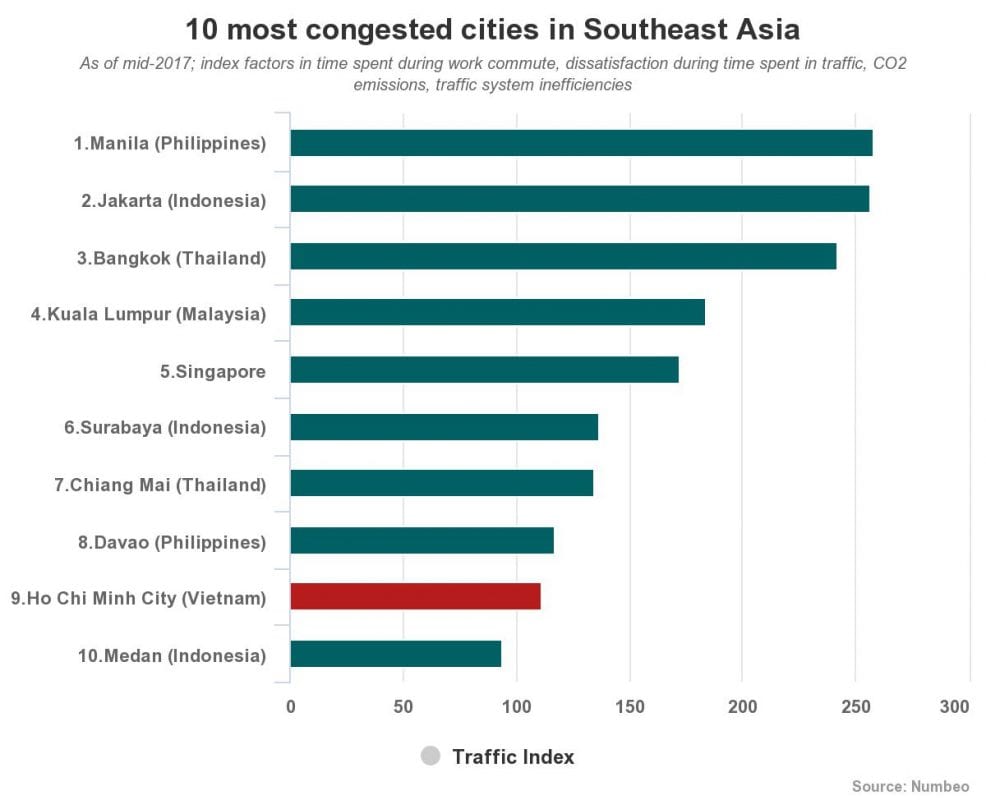
The business hub is Southeast Asia’s ninth most congested city, according to Numbeo, a crowdsourced online database of social trends.

The city has invested heavily in the metro network in the hope of easing congestion. When complete it will have six metro lines and two light-rail lines. Of all the megacities in Southeast Asia, Saigon is the only one without any form of metro transport.

However, much to everyone’s expectation, the city’s first line has been delayed several times since construction started in 2012. The latest completion date has been set for 2020.

The Ho Chi Minh City Metro Line 1 will stretch about 20km to connect Ben Thanh Market in the center of the city to the amusement park at Suoi Tien to the northeast.

Work will start soon on lines 2 and 5, authorities say.

Below is the map of the future Saigon Metro including the light rail and monorail lines.

Source: Ha Phuong, James Clark


Vietnam’s Jan-Nov FDI rises 11.9 pct y/y

Advertisements

GBS – HANOI, Nov 27 (Reuters) – Vietnam received an estimated $16 billion in foreign direct investment (FDI) in the first 11 months of this year, up 11.9 percent from the same period in 2016, the government said on Monday.

FDI pledges for new projects, increased capital and stake acquisitions jumped 82.8 percent from a year ago to $33.09 billion, the investment ministry said in a report published on its website.

The manufacturing and processing industry received the most foreign funds as of November, followed by the electricity and air production and distribution sector. South Korea, Japan and Singapore were the biggest investors in Vietnam.

Vietnam’s FDI inflows hit a record high of $15.8 billion in 2016. (Reporting by Mi Nguyen; Editing by Sherry Jacob-Phillips)

Source: https://www.reuters.com/article/vietnam-economy-investment/vietnams-jan-nov-fdi-rises-11-9-pct-y-y-idUSL3N1NX1LH

Uber signs partnership with Vietnam’s leading e-wallet firm

Advertisements

GBS – HANOI, VIETNAM Uber Technologies Inc. on Wednesday signed a deal with MoMo, Vietnam’s leading financial technology firm, enabling Uber riders to pay for trips using MoMo’s e-wallets in a country where most transactions are done in cash.

The partnership is Uber’s first deal with a fin-tech company in Southeast Asia. It aims to catch up with regional rival Grab, which has its own e-wallet service.

Backed by Standard Chartered Bank and Goldman Sachs, MoMo has 5 million users in Vietnam who use its e-wallet to pay utility bills, buy plane tickets and do online shopping.

Brooks Entwistle, Uber’s chief business officer in the Asia Pacific, said he expects the partnership to help the two companies grow and to change Vietnam’s cash-dominated economy.

Cash payments currently account for more than 90 percent of all transactions in Vietnam. The government has announced plans to reverse that ratio over the next three years, making 90 percent of transactions cashless.

“We see this partnership between Uber and MoMo as a big step in Vietnam’s journey toward digital revolution,” Entwistle said.

Source: http://www.newsobserver.com/news/business/article187014038.html#storylink=cpy

Working in vietnam as a foreigner

Advertisements

In recent years, the number of expats coming to Vietnam has steadily increased. The majority of foreign workers that come to Vietnam are employees of foreign contractors, working for, or establishing foreign direct investment (FDI) projects.

When hiring foreign staff in Vietnam, there are a number of procedures and legal frameworks that must be understood. In this article, we discuss the documents necessary for a foreign worker in Vietnam, including:

  • Visas;
  • Work Permits;
  • Temporary Residence Cards.

Visas

For a work visa to be authentic, it must be issued by the Vietnam Embassy or Consulate. It is possible for a visa to be obtained through a third-party country or during the duration of trip in Vietnam on a tourist visa. Specifically, Asian-Pacific expats are eligible to receive a free entry visa for 15-30 days. If a foreigner plans to work in Vietnam for an extended period of time, the following of types of visas may be procured depending on the nature of the expat’s planned employment:

Work Permits

A work permit is usually required if an expat plans to work longer than 3 months in Vietnam. For companies seeking to employ foreign nationals, a recruitment plan by the company must be submitted at least thirty days in advance of the workers arrival to the provincial Department of Labor, Invalids and Social Affairs (DoLISA). If any more information is needed, please refer to Circular 03/2014 as a reference.

  • Eligibility
    • At least 18 years of age;
    • In good enough health to satisfy job requirements;
    • A manager, executive director or expert with technical skills and knowledge necessary for the job;
    • Not currently subject to criminal prosecution or any criminal sentence in Vietnam or overseas; or have a criminal record.
  • Requirements
    • The existing demand for the foreign worker(s);
    • The number of foreign worker(s) to be recruited;
    • The worker(s) qualifications, titles, work experience;
    • The worker(s) salary expectations;
    • The worker(s) periods of employment
    • The worker has a clean criminal record
    • If they take a management position must show relevant documents which prove this

Note: For the worker to be considered an expert in the field they must do the following:

  1. A document proving relevant qualifications (minimum allowed is a Bachelor’s degree) and at least five years work experience in the relevant field; or
  2. A document from an authorized agency that certifies the worker as an expert.

For the worker to be considered a technical worker, they must fulfill the below requirements:

  1. Provide a document or certificate that proves the worker has received at least one year of training in the technical field; and
  2. Provide paperwork that shows that the worker has at least three years work experience in the field within which he/she will work in Vietnam.
  • Work Permit Termination

Work permits will become null and void in any of the following circumstances:

  1. Expiration of work permit;
  2. Termination of labor contract;
  3. The content of the labor contract is deemed inconsistent with the work permit granted;
  4. The foreign employee is fired by the foreign employer;
  5. Withdrawal of work permit by authorized state agencies;
  6. Termination of operation of the company, organization, and partners in Vietnam;
  7. The foreigner is sentenced to prison, dies or is proclaimed missing by the court.

Exemptions

For those seeking to avoid the complications associated with acquiring a work permit, the following exceptions will allow for employees to enter the country without having first obtained a work permit:

  1. Working in Vietnam for less than three months;
  2. A member of limited liability company with two or more members;
  3. The owner of a limited liability company with one member;
  4. A member of the board of a joint stock company;
  5. Coming to Vietnam to market products and services;
  6. Coming to Vietnam for less than three months in order to resolve an emergency or technologically complex situation that could affect production which Vietnamese experts or foreign experts currently in Vietnam are unable to resolve;
  7. Lawyers granted a professional permit in Vietnam;
  8. Heads of representative offices, chiefs of project offices or someone working for foreign non-government organization in Vietnam;
  9. Internally transferred within an enterprise which has a commercial presence in the committed service list of Vietnam with the World Trade Organization (WTO), including: business service, information service, construction services, distribution service, education service, environmental service, financial service, health service, tourism service, cultural and recreational services and transportation service;
  10. Coming to Vietnam to supply consulting services on tasks serving to research, build, appraise, monitor and evaluate, manage and process programs and projects that use Official Development Assistance (ODA) in accordance with the regulations or agreements in an international treaty on ODA signed between an authorized Vietnam agency and foreign agency.

Temporary Residence Cards

Foreigners and senior management who currently hold work permits valid for a year or more can be granted a Temporary Residence Card (TRC). A TRC is issued by the immigration agency using the Ministry of Public Security, which makes it valid for 1 to 5 years. Anyone who is granted a TRC can enter and exit Vietnam without a visa within terms of TRC

Current visa holders with a year or more on the visa are eligible for a Temporary Residence Card. In addition, members of management boards, members of councils and boards of directors, heads of company branches and Chief Representatives of representative offices of foreign enterprises in Vietnam are eligible for a TRC.

Further Support

Even in a country like Vietnam, where the number of foreign workers continues to rapidly increase, ensuring you have the proper documents to legally begin working can be a daunting task. With decades of experience helping companies set up businesses with foreign employees, GBS (https://gbs.com.vn) can help companies overcome any confusion or challenges which may arise in their efforts to fulfill staffing needs.

Exit mobile version