Three apprehended over bitcoin-related fraud in northern Vietnam

Advertisements

Unaware victims bought into a fraudulent investment fund with promises of high interest rates and referral rewards

Three people in Vietnam have been detained for appropriating tens of billions of dong (VND10 billion = US$440,256) through bitcoin-related multilevel marketing scams.

The Department of Police in Bac Giang Province have arrested Than Thi Toan, 50, from the province, and Nguyen Tuan Giang, 63, and Nguyen Thi Thi, 54, both from Hanoi, for fraud and appropriation of property.

The three suspects pocketed tens of billions of dong after mobilizing capital from residents of Bac Giang and other localities for a bitcoin investment fund.

According to the case file, the scammers colluded with other suspects to establish a website advertising high profits to those who invested in the cryptocurrency through the fund.

After clients agreed to invest, Toan, Giang, and Thi promised 10 to 15 percent commission rates for referrals to the bogus fund.

Do Thi N., one of the clients, put VND400 million ($17,610) into the fund expecting daily interest of 0.5 percent and the option to withdraw from the fund after 180 days. Her money, however, was never returned.

The victim then reported the case to Bac Giang police.

Following the incident, officers warned local residents of the risks of fraud associated with the trade and use of cryptocurrencies.

Several multilevel marketing organizations have taken advantage of the popularity of bitcoin and other virtual currencies to convince unaware victims to buy into funds advertising yearly interest rates of 30 to 80 percent.

A cryptocurrency is a digital or virtual currency that uses cryptography for security. It can be traded in amounts as small as one hundred millionth of a coin.

Source: Tuoi Tre News

Vietnam among fastest growing e-commerce markets globally: report

Advertisements

‘It´s about how online and offline work together to create a better shopper experience.’

E-commerce has been taking off in Vietnam thanks to booming internet usage and smartphone ownership, along with massive investments from key retail players.

The percentage of e-commerce shoppers grew from 5.4 percent to 8.8 percent on average in Hanoi, Ho Chi Minh City, Da Nang and Can Tho in 2016 alone, and an online shopping trip was worth triple the value of an offline basket.

The findings were outlined in the “The Future of E-commerce in FMCG” report released by market research firm Kantar Worldpanel.

In Vietnam, e-commerce now accounts for 0.5 percent of the fast-moving consumer goods (FMCG) market in the four key cities.

David Anjoubault, general manager of Kantar Worldpanel Vietnam, said: “Although the size of Vietnam’s e-commerce market is still small compared to other formats, it holds a strong potential because the value growth of e-commerce within FMCG is up to 69 percent, which makes Vietnam become one of the countries with the highest e-commerce growth rate in the world.”

It’s now a critical time for investors to enter this promising market, while current retail giants should gradually move their operations online and take advantage of their brands’ equity with an omni-channels strategy to be successful and to defend their current position, he said.

“On the whole, consumer trust and high logistics costs for deliveries are major challenges that need to be addressed by businesses in order to move Vietnam’s e-commerce forward.”

E-commerce in Vietnam is expected to expand from a 0.5 percent share in the FMCG market to 2.2 percent in 2025, coupled with the rise of digitization, according to Kantar Worldpanel.

“We know that e-commerce is still cannibalizing offline purchases. However, there is growing evidence that online formats, in isolation, are no longer the best option for winning market share,” the firm said. “It´s about how online and offline work together to create a better shopper experience.”

Vietnam’s e-commerce market climbed to about $4 billion in 2016 as one of the fastest-growing markets in the world.

Revenue from online retail in Vietnam is forecast to hit $10 billion by 2020, accounting for 5 percent of the country’s retail market.

Source: Ngan Anh

Vietnam’s biggest brewer to sell majority stake

Advertisements

Prices will be set at a minimum of $14 a share at the sale scheduled for December 18.

Vietnam said Wednesday it would sell a majority stake in the country’s largest state-owned brewer next month but limit foreign ownership to 49 percent, as the government seeks to pay off public debt.

The long-delayed sale shares in Sabeco, the leading brewer in the beer-obsessed nation, will take place in December and aims to raise $4.8 billion, according to a statement on the company’s website.

More than 340 million shares – amounting to 54 percent of the company – are up for grabs, but foreign ownership will be capped to safeguard the local brand, the firm said.

“Foreign investors are allowed to own a maximum of 49 percent of the registered capital of Sabeco,” the statement said.

Some 10 percent of Sabeco is already foreign owned, with the rest belonging to the government.

Prices will be set at a minimum of $14 a share at the sale scheduled for December 18, the company added.

The brewer, which owns household beer names Saigon Special and 333, said it was committed to “maintaining and developing Vietnam’s beer trademark” in limiting foreign control of the company.

The sale, which officials originally hinted might happen at the beginning of this year, is part of the government’s privatization push as it seeks to rein in mounting public debt.

As part of the promised reform, shares of several state-owned enterprises are to be sold off, though plans have repeatedly stalled.

Vietnam’s public debt hit 63.7 percent of GDP at the end of last year, and is predicted to inch up to 64.8 percent by the end of this year, according to official figures.

The government-sanctioned debt ceiling is 65 percent of GDP.

With a population of 93 million people, Vietnam is one of Asia’s leading per capita beer drinkers, including in Hanoi where ubiquitous “bia hoi” streetside beer markets fill daily with thirsty patrons.

Crown jewels Sabeco and fellow state-owned firm Habeco are the country’s leading brewers, though some foreign players such as Heineken, Carlsberg and Sapporo also have a foothold in the market.

Dizzying economic growth has seen per capita incomes in Vietnam more than double in the past decade to over $2,200 today, with newfound disposable incomes largely spent on consumable goods.

Source: AFP

Facebook suspends ability to target ads by excluding racial groups

Advertisements

The suspesion will remain until Facebook ‘can better ensure that our tools will not be used inappropriately.’

Facebook Inc said on Wednesday it was temporarily disabling the ability of advertisers on its social network to exclude racial groups from the intended audience of ads while it studies how the feature could be used to discriminate.

Facebook’s chief operating officer, Sheryl Sandberg, told African-American U.S. lawmakers in a letter that the company was determined to do better after a news report said Facebook had failed to block discriminatory ads.

The U.S.-based news organization ProPublica reported last week that, as part of an investigation, it had purchased discriminatory housing ads on Facebook and slipped them past the company’s review process, despite claims by Facebook months earlier that it was able to detect and block such ads.

“Until we can better ensure that our tools will not be used inappropriately, we are disabling the option that permits advertisers to exclude multicultural affinity segments from the audience for their ads,” Sandberg wrote in the letter to the Congressional Black Caucus, according to a copy posted online by ProPublica.

It is unlawful under U.S. law to publish certain types of ads if they indicate a preference based on race, religion, sex or certain classifications.

Facebook, the world’s largest social network with 2.1 billion users and $36 billion in annual revenue, has been on the defensive for its advertising practices.

In September it disclosed the existence of Russia-linked ads that ran during the 2016 U.S. election campaign. The same month it turned off a tool, also reported by ProPublica, that had inadvertently let advertisers target based on people’s self-reported job, even if the job was “Jew hater.”

Sandberg said in the letter that advertisers who use Facebook’s targeting options to include certain races for ads about housing, employment or credit will have to certify to Facebook that they are complying with Facebook’s anti-discrimination policy and with applicable law.

Sandberg defended race- and culture-based marketing in general, saying it was a common and legitimate practice in the ad industry to try to reach specific communities.

U.S. Representative Robin Kelly, a member of the Congressional Black Caucus, said Facebook’s action was appropriate.

“When I first raised this issue with Facebook, I was disappointed,” Kelly, a Democrat, said in a statement. “When it became necessary to raise the issue again, I was irritated. Thankfully, we’ve been able to establish a constructive pipeline of communication that’s resulted in a positive step forward.”

Source: Reuters/David Ingram

Mapped out: Saigon’s upcoming metro network

Advertisements

Of all the megacities in Southeast Asia, Saigon is the only one without any form of metro transport.

Ho Chi Minh City, the country’s most crowded with 13 million people, has been struggling to deal with worsening traffic congestion in recent years.

As of May, the city estimated that there were 7.6 million motorbikes and 700,000 cars in the city, with another 850 motorbikes and 180 cars hitting the roads every day.

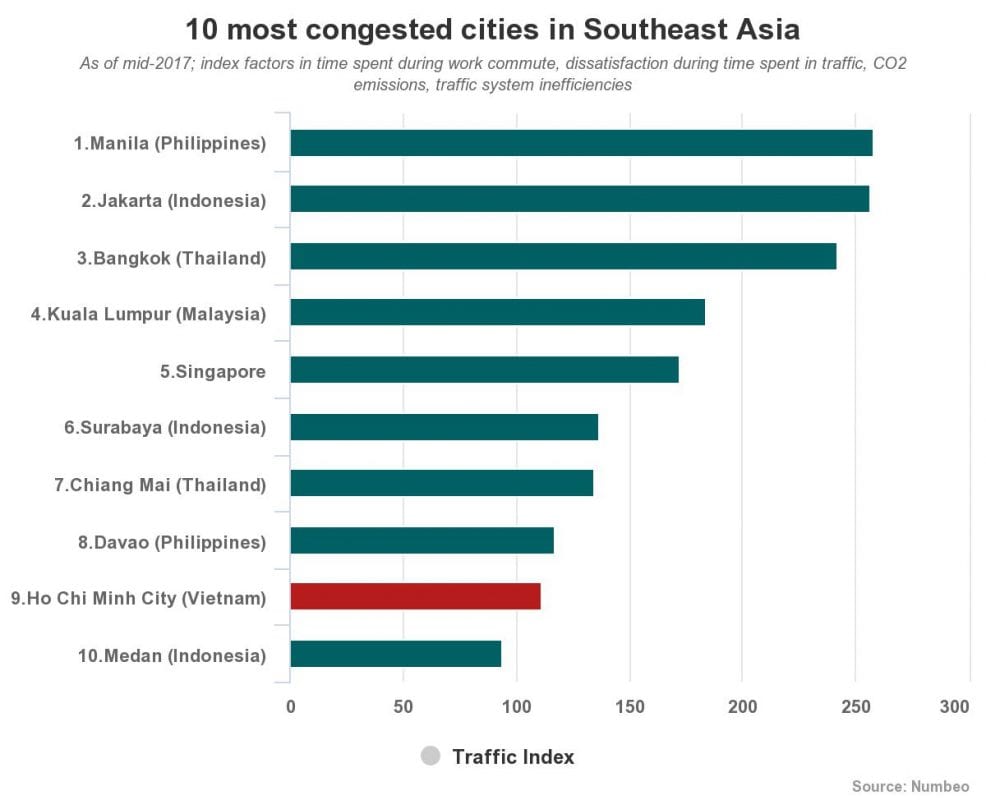
The business hub is Southeast Asia’s ninth most congested city, according to Numbeo, a crowdsourced online database of social trends.

The city has invested heavily in the metro network in the hope of easing congestion. When complete it will have six metro lines and two light-rail lines. Of all the megacities in Southeast Asia, Saigon is the only one without any form of metro transport.

However, much to everyone’s expectation, the city’s first line has been delayed several times since construction started in 2012. The latest completion date has been set for 2020.

The Ho Chi Minh City Metro Line 1 will stretch about 20km to connect Ben Thanh Market in the center of the city to the amusement park at Suoi Tien to the northeast.

Work will start soon on lines 2 and 5, authorities say.

Below is the map of the future Saigon Metro including the light rail and monorail lines.

Source: Ha Phuong, James Clark


Vietnam’s Jan-Nov FDI rises 11.9 pct y/y

Advertisements

GBS – HANOI, Nov 27 (Reuters) – Vietnam received an estimated $16 billion in foreign direct investment (FDI) in the first 11 months of this year, up 11.9 percent from the same period in 2016, the government said on Monday.

FDI pledges for new projects, increased capital and stake acquisitions jumped 82.8 percent from a year ago to $33.09 billion, the investment ministry said in a report published on its website.

The manufacturing and processing industry received the most foreign funds as of November, followed by the electricity and air production and distribution sector. South Korea, Japan and Singapore were the biggest investors in Vietnam.

Vietnam’s FDI inflows hit a record high of $15.8 billion in 2016. (Reporting by Mi Nguyen; Editing by Sherry Jacob-Phillips)

Source: https://www.reuters.com/article/vietnam-economy-investment/vietnams-jan-nov-fdi-rises-11-9-pct-y-y-idUSL3N1NX1LH

Uber signs partnership with Vietnam’s leading e-wallet firm

Advertisements

GBS – HANOI, VIETNAM Uber Technologies Inc. on Wednesday signed a deal with MoMo, Vietnam’s leading financial technology firm, enabling Uber riders to pay for trips using MoMo’s e-wallets in a country where most transactions are done in cash.

The partnership is Uber’s first deal with a fin-tech company in Southeast Asia. It aims to catch up with regional rival Grab, which has its own e-wallet service.

Backed by Standard Chartered Bank and Goldman Sachs, MoMo has 5 million users in Vietnam who use its e-wallet to pay utility bills, buy plane tickets and do online shopping.

Brooks Entwistle, Uber’s chief business officer in the Asia Pacific, said he expects the partnership to help the two companies grow and to change Vietnam’s cash-dominated economy.

Cash payments currently account for more than 90 percent of all transactions in Vietnam. The government has announced plans to reverse that ratio over the next three years, making 90 percent of transactions cashless.

“We see this partnership between Uber and MoMo as a big step in Vietnam’s journey toward digital revolution,” Entwistle said.

Source: http://www.newsobserver.com/news/business/article187014038.html#storylink=cpy

Working in vietnam as a foreigner

Advertisements

In recent years, the number of expats coming to Vietnam has steadily increased. The majority of foreign workers that come to Vietnam are employees of foreign contractors, working for, or establishing foreign direct investment (FDI) projects.

When hiring foreign staff in Vietnam, there are a number of procedures and legal frameworks that must be understood. In this article, we discuss the documents necessary for a foreign worker in Vietnam, including:

  • Visas;
  • Work Permits;
  • Temporary Residence Cards.

Visas

For a work visa to be authentic, it must be issued by the Vietnam Embassy or Consulate. It is possible for a visa to be obtained through a third-party country or during the duration of trip in Vietnam on a tourist visa. Specifically, Asian-Pacific expats are eligible to receive a free entry visa for 15-30 days. If a foreigner plans to work in Vietnam for an extended period of time, the following of types of visas may be procured depending on the nature of the expat’s planned employment:

Work Permits

A work permit is usually required if an expat plans to work longer than 3 months in Vietnam. For companies seeking to employ foreign nationals, a recruitment plan by the company must be submitted at least thirty days in advance of the workers arrival to the provincial Department of Labor, Invalids and Social Affairs (DoLISA). If any more information is needed, please refer to Circular 03/2014 as a reference.

  • Eligibility
    • At least 18 years of age;
    • In good enough health to satisfy job requirements;
    • A manager, executive director or expert with technical skills and knowledge necessary for the job;
    • Not currently subject to criminal prosecution or any criminal sentence in Vietnam or overseas; or have a criminal record.
  • Requirements
    • The existing demand for the foreign worker(s);
    • The number of foreign worker(s) to be recruited;
    • The worker(s) qualifications, titles, work experience;
    • The worker(s) salary expectations;
    • The worker(s) periods of employment
    • The worker has a clean criminal record
    • If they take a management position must show relevant documents which prove this

Note: For the worker to be considered an expert in the field they must do the following:

  1. A document proving relevant qualifications (minimum allowed is a Bachelor’s degree) and at least five years work experience in the relevant field; or
  2. A document from an authorized agency that certifies the worker as an expert.

For the worker to be considered a technical worker, they must fulfill the below requirements:

  1. Provide a document or certificate that proves the worker has received at least one year of training in the technical field; and
  2. Provide paperwork that shows that the worker has at least three years work experience in the field within which he/she will work in Vietnam.
  • Work Permit Termination

Work permits will become null and void in any of the following circumstances:

  1. Expiration of work permit;
  2. Termination of labor contract;
  3. The content of the labor contract is deemed inconsistent with the work permit granted;
  4. The foreign employee is fired by the foreign employer;
  5. Withdrawal of work permit by authorized state agencies;
  6. Termination of operation of the company, organization, and partners in Vietnam;
  7. The foreigner is sentenced to prison, dies or is proclaimed missing by the court.

Exemptions

For those seeking to avoid the complications associated with acquiring a work permit, the following exceptions will allow for employees to enter the country without having first obtained a work permit:

  1. Working in Vietnam for less than three months;
  2. A member of limited liability company with two or more members;
  3. The owner of a limited liability company with one member;
  4. A member of the board of a joint stock company;
  5. Coming to Vietnam to market products and services;
  6. Coming to Vietnam for less than three months in order to resolve an emergency or technologically complex situation that could affect production which Vietnamese experts or foreign experts currently in Vietnam are unable to resolve;
  7. Lawyers granted a professional permit in Vietnam;
  8. Heads of representative offices, chiefs of project offices or someone working for foreign non-government organization in Vietnam;
  9. Internally transferred within an enterprise which has a commercial presence in the committed service list of Vietnam with the World Trade Organization (WTO), including: business service, information service, construction services, distribution service, education service, environmental service, financial service, health service, tourism service, cultural and recreational services and transportation service;
  10. Coming to Vietnam to supply consulting services on tasks serving to research, build, appraise, monitor and evaluate, manage and process programs and projects that use Official Development Assistance (ODA) in accordance with the regulations or agreements in an international treaty on ODA signed between an authorized Vietnam agency and foreign agency.

Temporary Residence Cards

Foreigners and senior management who currently hold work permits valid for a year or more can be granted a Temporary Residence Card (TRC). A TRC is issued by the immigration agency using the Ministry of Public Security, which makes it valid for 1 to 5 years. Anyone who is granted a TRC can enter and exit Vietnam without a visa within terms of TRC

Current visa holders with a year or more on the visa are eligible for a Temporary Residence Card. In addition, members of management boards, members of councils and boards of directors, heads of company branches and Chief Representatives of representative offices of foreign enterprises in Vietnam are eligible for a TRC.

Further Support

Even in a country like Vietnam, where the number of foreign workers continues to rapidly increase, ensuring you have the proper documents to legally begin working can be a daunting task. With decades of experience helping companies set up businesses with foreign employees, GBS (https://gbs.com.vn) can help companies overcome any confusion or challenges which may arise in their efforts to fulfill staffing needs.

Why Vietnam Loves Trump

Advertisements

Vietnam — Before every shift at a Domino’s Pizza store in central Hanoi, Van Nguyen Hai, 20, puts on a uniform in the colors of the American flag. Then she takes up her position behind the register, in front of a wall decorated with a collection of images that represents milestones in the history of Domino’s: the flag of Panama, where the chain’s 8,000th store opened in 2006; a steaming brownie, in honor of a dessert the chain introduced that same year; and the logo for “The Apprentice,” which held a Domino’s-related challenge in 2005, featuring a tie-clad Donald J. Trump.

“It’s my honor for him to come to Vietnam,” Hai says of President Trump’s upcoming visit on November 10-12. “Trump can change America, and if America changes, the world will have change, and Vietnam will have change.”

In the country where thousands lined the streets to chant “Obama, Obama” in 2016, many Vietnamese like Hai are also eagerly awaiting Trump’s upcoming visit to attend the Asia-Pacific Economic Cooperation meeting in Da Nang and meet with President Tran Dai Quang and other Vietnamese officials in Hanoi. In fact, when Trump lands on Friday in Da Nang—at an airport where U.S.-Vietnam teams are still finalizing efforts to clean up dioxin contamination left by American Agent Orange during the Vietnam War—he will enter one of the only countries on earth where he, and the country he leads, are both popular.

According to the Pew Research Center, Vietnam is among seven out of 37 surveyed countries where a majority of the population says they like Trump: 58 percent of Vietnamese told Pew earlier this year that they have “confidence in Trump to do the right thing when it comes to international affairs,” compared with the global median of 22 percent. (The other countries with pro-Trump majorities were Israel, Kenya, Nigeria, the Philippines, Russia and Tanzania.)

What does this communist country see in the real estate mogul-TV star who now serves as the 45th president? Trump’s strong support in Vietnam is partially borne of his own policies and personality: His campaign trail tough talk on China resonated with a Vietnamese public deeply suspicious of their northern neighbor’s rise, and Trump’s business experience is appealing to many in a country where break-neck economic growth has recently fueled entrepreneurial dreams. His visit here is eagerly awaited—both by those excited to see a leader they admire, and by those hoping that concerns about Trump’s commitment to Vietnam will be assuaged.

Before he became president, Trump was well-known in Vietnam as a successful businessman. In the three decades since the country began market reforms known as Doi Moi, entrepreneurs have been celebrated as engines of growth; almost 20 percent of the adult population in Vietnam owns their own business, the third-highest rate of 60 countries surveyed by the Global Entrepreneurship Monitor.

Many of Trump’s books, including The Art of the Deal, Never Give Up and Crippled America: How to Make America Great Again, have been translated into Vietnamese and found a dedicated following among those seeking business insights from “the great teacher Donald Trump,” as the publishing house Nha Xuat Ban Tre describes him. Miss Universe, which Trump owned at the time, was held in the beach resort town of Nha Trang in 2008 (though Donald Trump Jr. attended in place of his father). And Pham Nhat Vuong, head of the real estate conglomerate Vingroup and Vietnam’s first billionaire, is known as the “Donald Trump of Vietnam.” (A similar admiration for Trump’s business acumen exists among the aspirational classes in Japan, South Korea and China, where Trump has been well-received over the past week.)

The 20-year-old founder of the Vietnamese for Donald Trump Facebook page—15,000 followers and counting—is among those drawn to Trump’s business background. (He requested anonymity because his Trump fan page, which he also describes as “a fan page for American conservatism,” contains some criticism of the government.) To this young man, who calls himself a “Vietnamese deplorable,” Trump represents the best of America—“capitalism, freedom and God,” he said in a telephone interview from his home in Ho Chi Minh City.

To be fair, Trump is not as popular as his predecessor in Vietnam: Pew found support for Trump is 13 percentage points lower than it was for Barack Obama. But even among those who are wary of Trump, a positive view of the United States prevails: 84 percent of Vietnamese view America favorably, according to Pew, the highest figure in any country surveyed, and up 6 percentage points from the end of the Obama years. “The relationship between the U.S. and Vietnam has been in a new phase” as war memories are replaced by shared strategic and economic interests, says Tran Le Thuy, founder and director of the Center for Media and Development Initiatives in Hanoi, a nonprofit that conducts research on Vietnamese media. “So the coverage of the U.S. is quite positive. It almost doesn’t matter who the president is.”

Still, there is hope here that Trump’s visit—marking the first time the president of the United States has been to Vietnam two years in a row—will confirm that American interest in Vietnam will outlast the Obama administration. Professor Nguyen Thi Thanh Thuy, head of the Americas studies division at the University of Social Sciences and Humanities in Hanoi, says expectations are high that Trump’s address at APEC—which the White House has said will outline “the United States’ vision of a free and open Indo-Pacific region”—will clarify the Trump administration’s commitment to Vietnam.

“I think the Vietnamese people and many people in other countries expect more from the U.S. in order to counterbalance the Chinese policy in the region,” she says.

For Vietnam, the United States is an increasingly critical strategic partner as China builds islands and military facilities in the South China Sea. Obama’s 2016 visit confirmed the growing scope of the relationship as the United States lifted the decades-old ban on arms sales to Vietnam. And part of the Obama administration’s “pivot to Asia” strategy relied on pushing forward the Trans-Pacific Partnership, from which Vietnam would have been among the biggest beneficiaries.

Trump, of course, withdrew the United States from the pact on his first full day in office. But he has also harshly criticized China for taking American jobs and previously called the country a “currency manipulator” (a charge he later took back). Hoang Phuong, a 37-year-old Hanoian architect and guitarist in an AC/DC cover band, is among those in Vietnam who admire Trump’s harsh rhetoric against China. Phuong was initially puzzled when Trump ran for president; he had read several of Trump’s books in Vietnamese, and knew him as a successful businessman, not a politician. But he was happy when Trump won the White House for one main reason: “He says he doesn’t like China.”

After Trump’s TPP withdrawal, the Vietnamese government issued a polite response pledging to continue to work for regional economic integration. But Le Dang Doanh, a member of the Committee for Development Policy of the United Nations and one of Vietnam’s leading economists, says, “We regret deeply the step of the president of the United States to withdraw from TPP.” Still, Carlyle Thayer, an expert in southeast Asian politics and emeritus professor at the University of New South Wales, says Vietnamese officials have moved on from the disappointment: “They’re pragmatists. It’s done.” The remaining 11 countries have continued negotiations, and Le is among those who hopes those countries will reach a final agreement at the APEC meeting in Da Nang.

The White House visit in May by Vietnamese Prime Minister Nguyen Xuan Phuc, the first by a southeast Asian leader, helped quell Vietnamese concerns that Trump would abandon the Obama administration’s concerted efforts to strengthen the U.S.-Vietnam relationship. But uncertainty lingers. As the lovefest between Trump and Chinese President Xi Jinping in Beijing earlier this week illustrated, Trump has not displayed a strong interest in countering China in the South China Sea, in part because he needs China’s support in curtailing North Korea’s nuclear ambitions.

And while some Vietnamese saw Trump’s campaign bravado on China as reassuring, even exciting, others are nervous about his harsh words, his view of international affairs as a zero-sum game and his lack of political experience. “President Trump thinks he can stand up to China. That goes well with ordinary Vietnamese popular opinion,” says Ngo Vinh Long, a professor of history at the University of Maine who studies Vietnam and regional politics. “But this kind of attitude is scary to many people who are well educated or who are in the government because they think that, inadvertently, President Trump might provoke something with China that Vietnam itself cannot contain.”

One reason Trump remains popular despite all that is because he and the United States are covered very carefully by media outlets here, which are strictly controlled by the government. Thuy, the director of MDI, says that the long-term importance of the U.S.-Vietnam relationship leads Vietnamese state-run media to cover Trump positively or neutrally.
While Vietnamese newspapers have published stories about special counsel Robert Mueller’s probe into possible campaign collusion with Russia and the criticism of Trump from Senators Jeff Flake and Bob Corker, for instance, those stories are relatively few. “I think mainstream media [in Vietnam] avoids covering stories about personal issues to avoid insulting the U.S.,” she says. “They don’t want to cause any diplomatic troubles.”

Still, Thuy says she saw more “analysis and a lot more obvious positive expectations” in the coverage ahead of Obama’s 2016 visit, while the reporting on Trump’s trip has been more neutral and fact-based. (According to MDI data, one of the most widely shared stories in Vietnamese media relating to Trump’s visit so far detailed the arrival on October 30 of the Boeing C-17 Globemaster III at Hanoi’s Noi Bai airport carrying armored limousines for Trump’s entourage; the vehicles got similar coverage under Obama.)

As for how much, or whether, Trump will interact with the Vietnamese people, expectations seem to be lower than for past presidents. Bill Clinton’s visit was a milestone in Vietnam’s international integration. “I remember when Bill Clinton walked around here and went into the shops like a normal person,” Bac Hai, 70, told me recently, sitting by Hoan Kiem Lake, where Clinton strolled in 2000. She preferred Hillary Clinton during the presidential election but has come to think Trump’s business experiences should equip him to appreciate how much Vietnam has developed since market reforms began in 1986.

Last year, Obama ate with Anthony Bourdain at Bun Cha Huong Lien, a small, cheap noodle restaurant. Their meal of Hanoi’s most iconic dish—grilled pork patties served with vermicelli rice noodles and fresh herbs—became the most memorable moment of his visit for locals. And the restaurant—where the walls are decorated with photographs of Obama and staff members, and the menu now offers the Obama combo—has seen a business boom ever since. “When Obama came to eat bun cha, people came to see him, because the most powerful man in the world was acting like a normal person, with no safeguards,” Bac Hai says.

There’s not much hope that Trump, a self-described “germaphobe,” will venture to Bun Cha Huong Lien or a similar restaurant. The U.S. Embassy in Hanoi referred to a White House news release saying only that Trump will meet with President Quang and other senior leaders.

Back at Domino’s, Van Nguyen Hai and her co-workers recently debated Trump as the image of his face gazed down from the wall. Tran Tran Pham, 19, said Trump seemed unkind, imperious and unwilling to work with other countries. Hai agreed partly, but she still said she preferred Trump to Obama because of the power he projects. She said she was a little surprised he is coming to Hanoi, given the length of his Asia trip, but has high hopes.

“When Obama came out of the bun cha restaurant, he shook hands and smiled,” Hai said. “Everyone wanted to see the president of the United States. I really regret that I didn’t go see him. So, I hope that this time, with Trump, I hope I can see him.”

Isabelle Taft

Source: https://www.politico.com/magazine/story/2017/11/09/waiting-for-trump-in-hanoi-215809

Franchise restaurants boom in Vietnam

Advertisements

Not only are Vietnamese restaurateur reaching out to foreign brands to import their business models, global franchisors now view Vietnam as a huge potential market to expand their network.

Popular global franchise brands like Little Caesars, Jumbo Group, The Boiling Crab, and Element Fresh have all sat down with Vietnamese partners in preparation for their entry into the 94-million-strong market.

Presently, Vietnam is already home to 71 foreign restaurant franchises, including ‘big players’ like McDonald’s, Starbucks, Burger King, and BBQ Chicken.

Most of these franchises are currently flourishing in the country’s largest hubs of Hanoi and Ho Chi Minh City, but others are beginning to target growing cities such as Da Nang and Hai Phong to further cement their foothold.

William Schreiber, vice-president of international development for U.S. pizza chain Little Caesars, said he had traveled to Vietnam 15 times in search of opportunities to ink franchising deals with local businesses.

The third-largest pizza chain in the U.S., Little Caesars already has over 5,000 locations in 18 countries, but Vietnam is looking like the first country in Southeast Asia to earn a franchising deal with the company.

Recently, Singaporean seafood restaurant group Jumbo also partnered with a Vietnamese company to launch the franchise locally, having made successful entrances in China and Japan.

Other popular franchises like Grimaldi’s Pizzeria, Boiling Crab and Presotea have announced their intention to open stores here.

A KFC restaurant in Hanoi. Photo: Tuoi Tre

A lucrative business

With prices that target middle-income earners, restaurant franchises are becoming increasingly popular with the younger generation in Vietnam as a go-to place for dining, hanging out with friends, and meeting with business partners.

Vietnam-based Golden Gate Group, one of the first in the country to conduct business with foreign franchisors, has until now successfully imported and operated 22 restaurant franchises ranging from barbecue, hot pot to beer clubs.

In 2016, the firm reported revenue of VND2,628 billion (US$115.77 million), a 524-percent growth rate on 2013.

With its current network of 201 locations across Vietnam, it is estimated that the firm will reach 400 locations by as early as 2018.

According to Hoang Tung, owner of the Vietnamese pizza chain Pizza Home, the cost of franchising a popular brand can amount to VND1 billion ($44,000), not to mention a percentage of revenue paid regularly to the franchise owner.

People line up outside Vietnam’s first Starbucks restaurant in Ho Chi Minh City on its opening day, February 1, 2013. Photo: Tuoi Tre

A cut-throat race

Despite the overwhelming number of success stories in Vietnam, in reality many brands have been forced to depart the market after finding themselves falling behind in a dog-eat-dog environment.

Examples include fast-food restaurant Subway and coffee houses such as Gloria Jean’s Coffees, The Coffee Bean & Tea Leaf and N.Y.D.C.

“Not many Vietnamese franchisees have the experience to run restaurant franchises on a large scale, which often results in fatal mismanagement once the number of locations reaches the hundreds,” an official from the Ministry of Industry and Trade asserted.

“They still have a lot to learn from foreign restaurateurs.”

Source: Tuoi Tre News

Ho Chi Minh City to install CCTV in kindergartens to prevent child abuse

Advertisements

Ho Chi Minh City authorities are set to apply specific measures, including the installation of surveillance cameras, to end the physical abuse of children at local kindergartens and childcare facilities.

The municipal People’s Committee convened a meeting with relevant agencies on Monday afternoon to seek solutions to child abuse, following a recent article by Tuoi Tre (Youth) newspaper.

The story shined the spotlight on the Mam Xanh childcare facility in Distinct 12, where its manager and employees had been discovered beating children aged two to five on a daily basis.

Speaking at the gathering, Bui Thi Diem Thu, deputy director of the city’s Department of Education and Training, said that daycare centers have mushroomed across the southern hub due to increasing demand in recent years.

However, the oversight of these venues is still limited, Thu assessed.

“The local education sector is responsible for letting such a serious case develop,” the official remarked.

In a bid to prevent similar cases, Thu suggested the installation of CCTV cameras at local kindergartens and childcare facilities.

The proposal was backed by the municipal Department of Police as surveillance cameras provide close monitoring of the situation at these places.

However, the locations of such devices should be taken into careful consideration in order not to violate human rights, another police official stated.

Following the discussion, the municipal education department was tasked with formulating a detailed plan for the installation of CCTV cameras at kindergartens across the city.

The cameras will be added to all rooms except for bathrooms and other sensitive areas.

In addition to existing safety requirements, new childcare centers will need to have surveillance cameras installed in order to be granted a legitimate license.

In another relevant development, the Ho Chi Minh City Party Committee on Monday ordered a comprehensive inspection of non-public childcare facilities across the metropolis.

Any action that violates the law and well-being of children must be severely punished, Deputy Secretary of the city’s Party Committee Tat Thanh Cang said in a statement.

Source: Tuoi Tre News

Internet brings bright future to young Vietnamese: former minister

Advertisements

The young generation in Vietnam will have a bright future thanks to the Internet, former Minister of Information and Communications Mai Liem Truc remarked during a forum in Hanoi on Monday morning.

The Vietnam Internet Forum 2017 (VIF 2017) attracted some 200 participants, including 30 speakers from Vietnam and other countries, experts on information technology and cybersecurity, business representatives, and local university students.

The event was organized by the Embassy of Sweden in Vietnam and the Ministry of Information and Communications at the Hanoi Museum on November 27 and 28, on the occasion of the 20th anniversary of the Internet in the Southeast Asian nation.

Centered on ‘Digital For Food,’ the VIF 2017 included discussions on how to use the Internet as a means to exchange information, boost social development, and open new opportunities for the community.

Speaking at the gathering, former Minister of Information and Communications Truc stated that young people have been enthusiastic about the Internet and its various benefits.

The young generation has a bright future ahead thanks to the international computer network, Truc continued, adding that the network is a new economic form that requires the knowledge of young people.

Swedish Ambassador to Vietnam Pereric Högberg asserted that via the VIF 2017, organizers hoped to promote the openness, transparency, ease, and safety of information access for everyone, especially young generations.

According to Vu The Binh, general secretary of the Vietnam Internet Association, the presence of the Internet in Vietnam during the past 20 years has helped build reliable technological and information infrastructure in every aspect of life, both socially and economically.

It gives birth to a series of business innovations and new economic modalities, while public agencies have also become more open, transparent and accountable.

Source: Tuoi Tre News

Facebook users on the rise in rural Vietnam: survey

Advertisements

Cheap smartphones are connecting the countryside nearly as much as in Vietnam’s cities now.

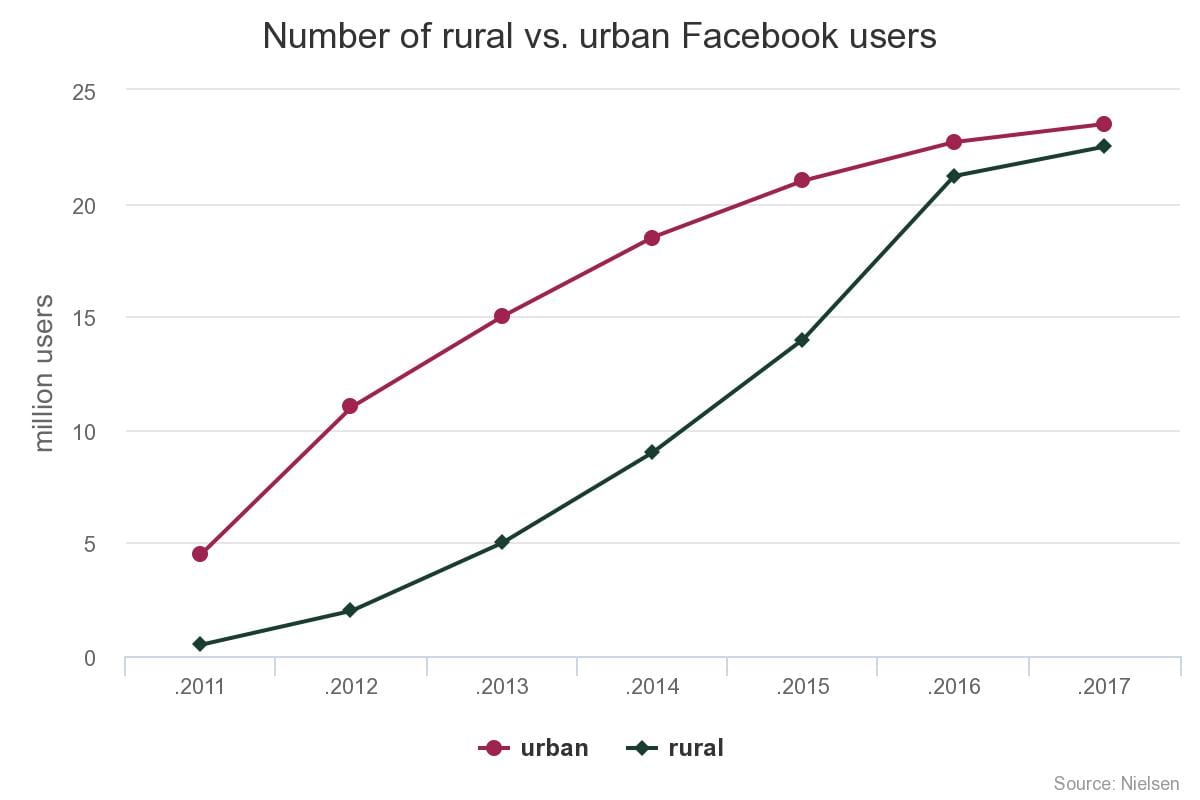
More than a million new Facebook accounts were opened in rural parts of Vietnam in the past year, promoting the social network’s status as a key platform for information, entertainment and communication, according to data recently released by global performance management company Nielsen.

The increase has played an instrumental role in media consumption shifting beyond traditional formats such as broadcast and cable TV, and also beyond traditional hours, said Doan Duy Khoa, director of Consumer Insights for Nielsen Vietnam.

“For media owners and advertisers, it is becoming increasingly important to understand both urban and rural consumers’ viewing habits in order to deliver the right content at the right time,” he said.

The increasing number of Facebook users in rural areas is partly due to more smartphones. Up to 89 percent of the rural population own a mobile phone, and 68 percent of them have a smartphone, according to the Nielsen Vietnam Smartphone Insights Report 2017.

Across the whole country, the ratio of people using smartphones among mobile phone subscribers reached 84 percent in 2017, increasing from 78 percent a year ago

The rapid up-take of connected devices, especially smartphones and tablets, demonstrates that tech brands are offering consumers a range of choices at affordable prices. Another reason is that consumers are enjoying better living standards and expressing their desire for connectivity anytime, anywhere, Khoa said.

Vietnam now boasts more than 52 million active accounts to advertisers, Reuters has reported, citing social media agencies We Are Social and Hootsuite. More than half of Vietnam’s population of nearly 92 million people are online.

Coc Coc updates 1.2m service points

Advertisements

Coc Coc, a Vietnamese web browser and search engine, has updated information on about 1.2 million service locations on its digital map — Coc Coc Map. The map runs on both PCs and mobile phones.

The locations include any places having services (excluding private houses), such as restaurants, shops, pharmacies, petrol stations or ATMs.

They are defined by Coc Coc as points of interest (POIs). The developer has built a POI database in 60 out of 63 cities and provinces nationwide.

There are about 260,000 POIs in Ha Noi, 400,000 in HCM City and nearly 80,000 in Da Nang.

According to the company’s statistics, the total length of streets collected by Coc Coc’s employees so far has reached about 90,000 kilometres, twice the length of the equator.

The developers said they built Coc Coc Map with criteria different to similar services on the market.

They chose to enter “niche market” which had not been “occupied” by foreign companies.

“When looking for services on Coc Coc Map, users will see the results returned as locations with specific addresses, accompanied by actual snapshots. The locations all have detailed information whether it is just a very small POI such as a tra da (ice tea) shop,” a Coc Coc representative said.

Coc Coc said it hoped the map would become a useful tool for domestic users, not just tourists.

In 2013, Coc Coc Map has completed the initial goal of collecting information of about 500,000 POIs.

However, the team later discovered that the database collected had changed significantly in just a few months.

The reason was related to the fluctation of Vietnamese enterprises, especially small and micro-sized enterprises.

Therefore, to ensure the accuracy, the map’s database is directly collected and updated regularly by the Coc Coc team themselves.

The data is updated every two or three months in Ha Noi and HCM City and monthly for Da Nang.

Source: VNS

M&A in Vietnam – Attractive investment channel

Advertisements

Mergers & Acquisitions (M&A) activities in Vietnam has become an attractive investment channel for enterprises planning to expand business activities, as well as looking for new way of doing business.

Recently, the scale of M&A activities has become bigger with positive impact from the global integration process.

According to the Director of Vietnam M&A Forum Dang Xuan Minh, in 2016, total M&A deals in Vietnam was 500 deals, contributing to 5% of total M&A deals in South East Asia with value of 5.8 billion USD.

In which, investors are mainly from Singapore, Japan, Korea, and Hong Kong, with Korea in the top 4 of highest M&A deals in Vietnam.

As such, fields such as consumption, retail, industrial production, real estate, education, media and finance are attracting huge amount of financial resources; and on top is M&A in retail sector.

Many investors are planning to acquire Vietnamese companies to expand market shares, namely Thailand’s investors acquiring Metro, BigC and Nguyen Kim. In real estate, Korea has some big M&A deals such as the take over of Kangnam building and Hanoi-Deawoo Hotel.

“Recently, Vietnam’s government has eased regulation on the limit number of assets owned by foreign investors. As such, there are big opportunities for foreign investors during the process of state owned enterprises equitization” – Minh said.

Vice Director of Korea’s M&A Center of Korea Trade – Investment Promotion Agency (KOTRA) Mchael D. Choi said, recently, many Korean enterprises are showing interest in M&A deals in Vietnam.

As such, the two countries can cooperate efficiently through M&A deals. At present, Korean investors are negotiating with 12 Vietnamese enterprises in fields of food production, pharmacy, and finance.

From expert’s perspective, in order for M&A activities to be more efficient, and contributes more to the economic growth, it is necessary to have appropriate mechanism and policies to support.

For example, it may be the policies to facilitate the equitization process of SOEs, speeding up the divestment process for foreign investors, supporting domestic enterprises mobilizing financial resources in foreign stock markets.

Besdies, the government need to pay attention and create more chances for foreign investors taking part in M&A deals in Vietnam.

According to Michael D. Choi, Korea are giving priority to allocate financial resources for investment fund focusing on M&A deals.

In Korea, there are 14 organizations and investment funds with capital of up to 1 billion USD.

Therefore, in order to have more M&A deals between Korea and Vietnam, Vietnamese enterprises need to have more accurate information and issuing financial report in a timely manner.

Statistics from the State Capital Investment Corporation (SCIC) showed that, in 2017, SCIC will divest the government fund from 114 out of 132 SOEs.

At present, this process is completed in 30 enterprises, with the remaining enterprises are expected to be complete by the end of this year.

Despite the limited time left, but there are high chances that it will be success with many big SOEs such as Sa Giang, Tien Phong Plastic, Binh Minh Plastic, Bao Minh Insurance and FPT Group.

Source: Ha Noi Times

Exit mobile version