Corrado Garibaldi on Outsmarting the Market: How Corrado Garibaldi Turns Fear Into Fortune

Advertisements

In the fast-paced world of trading and investing, few voices cut through the noise like that of Corrado Garibaldi, the man millions know as Lord Conrad. A seasoned trader, strategic investor, and outspoken market contrarian, Lord Conrad has built a personal brand around one striking philosophy:

“Buy the fear. Sell the euphoria.”

It’s not just a clever phrase — it’s a hard-earned truth, shaped by years of study, hands-on experience, and a relentless desire to master the game most people get wrong.

A Strategy Born in the Chaos

Markets are emotional. When fear strikes, people sell. When excitement peaks, they chase blindly. Lord Conrad does the opposite.

“Everyone runs toward the noise,” he explains. “But the real profit is in the silence. In the panic. That’s when I enter.”

This bold approach has made him a respected figure not only among his followers but also among serious market watchers. His refusal to conform has become his biggest strength.

Trading the Market Like a Predator

Lord Conrad’s trading style is precise, sharp, and unrelenting. With a focus on Nasdaq-based scalp, day, and swing trading, he operates in one of the most volatile and competitive environments in finance.

“I’m not here to gamble. Every trade is calculated,” he says. “I study patterns, volume, market behavior. My entry is strategic, and my exit is mechanical.”

He trades with cold discipline — no emotions, no guessing, no gut feelings. His tools? Technical analysis, price action, and experience.

“Instinct is earned. It’s the result of reading thousands of charts, not some magical intuition.”

Investing with Vision, Not Hype

Despite his speed in the trading world, Lord Conrad’s long-term investment strategy is surprisingly calm — almost meditative.

“My portfolio is 99% long-term focused. I invest in the future,” he says.

That future is built on a rock-solid foundation of tech giants, luxury brands, and stable high-yield bonds: Apple, Microsoft, Alphabet, Amazon, Tesla, Meta, and LVMH make up his equity core. Bonds and funds provide balance.

“I believe in powerful companies that shape the world. But I also believe in protection. That’s where the bonds come in.”

A Self-Made Market Mind

Corrado Garibaldi didn’t come from Wall Street. He didn’t study finance. He didn’t need to.

“I taught myself everything,” he says. “Books, tutorials, testing strategies, making mistakes — I built this from the ground up.”

His rise proves that education doesn’t have to be institutional. What matters is obsession, consistency, and the willingness to think independently.

“I wanted control over my future. So I learned to control my money.”

Keeping a Cool Head in a Hot Market

For Lord Conrad, psychology is the biggest edge a trader can have. While others fall victim to greed, panic, and emotional trades, he remains grounded.

“I don’t chase losses. I don’t revenge trade. I don’t care what Twitter says,” he laughs. “The market doesn’t care about your feelings. It rewards discipline.”

Risk management is non-negotiable in his playbook. Stop-losses are always in place. Overexposure is avoided. Diversification is key.

“No one trade should break you. Your wins should be bigger than your losses. That’s it.”

From Music to Money

Before finance, Lord Conrad made waves as a music artist and entertainer. But his passion for strategy and control brought him into the markets — and he’s never looked back.

“It’s all about creation,” he explains. “Music, trading, investing — they’re different forms of expressing skill and intuition.”

His background gives him a creative edge, and it’s one of the reasons his social media presence is exploding. On Instagram, TikTok, and Facebook, he shares daily market commentary, trading setups, and educational content for aspiring traders around the globe.

Real Advice for Real Traders

So, what does Lord Conrad recommend for those starting their financial journey in 2025?

Think for yourself. “Following the crowd is the fastest way to lose money.”

Stay educated. “The market evolves. So should you.”

Balance short-term action with long-term vision.

Trade like a robot. Invest like a visionary.

Be patient. “Slow progress beats fast failure.”

The Final Word

Lord Conrad’s story is more than a trading success — it’s a blueprint for financial independence through discipline, strategy, and fearlessness.

“Trading isn’t about luck. It’s about preparation. It’s about stepping in when everyone else is scared — and stepping out when they’re drunk on gains.”

To learn more about his strategy, portfolio, and approach, visit his official platform: http://www.lordconrad.com.

In a world chasing quick riches, Lord Conrad is proof that clarity, courage, and calculated thinking still win the game.

Want to see his strategies in action? Visit http://www.lordconrad.com

What We Know So Far About Air India Dreamliner Crashes Near Ahmedabad

Advertisements

Vietnam Insider – An Air India Boeing 787-8 Dreamliner carrying 242 people has crashed shortly after takeoff near Ahmedabad Airport in Gujarat, western India. The incident occurred approximately two hours ago, sending shockwaves through the region.

Details Emerge as Rescue Efforts Intensify

Here’s a breakdown of what we know so far:

  • Onboard Manifest: The aircraft was carrying 242 individuals, including two pilots and ten cabin crew members.
  • Passenger Nationalities: Among the passengers, there were 169 Indian nationals, 53 British nationals, one Canadian, and seven Portuguese citizens.
  • Distress Signal & Lost Contact: The Boeing 787-8 Dreamliner transmitted an emergency signal to air traffic control immediately after takeoff. However, communication was lost shortly thereafter.
  • Flight Data Insights: According to data from Flight Radar, the aircraft’s signal was lost just seconds after it became airborne, having reached an altitude of over 190 meters.
  • Crash Site: The plane tragically went down in Meghani Nagar, a densely populated residential area located near the airport.
  • Urgent Rescue Operations: Eyewitnesses report a scene of intense activity, with “everyone rushing to try and save as many people as possible.”
Firefighters at the site of an airplane crash in Ahmedabad, India, on Thursday.Ajit Solanki/Associated Press

Rescue teams are currently on site, working tirelessly amidst the chaos. The full extent of casualties and injuries is still unknown, but authorities are focusing all efforts on search and rescue operations.

This is a developing story, and more information will be released as it becomes available.

Typhoon Wutip Wreaks Havoc on Flights at Da Nang Airport

Advertisements

Vietnam Insider – Typhoon Wutip has thrown air travel into disarray in Central Vietnam, causing widespread cancellations, diversions, and delays at Da Nang International Airport. Passengers faced long queues and uncertainty as torrential rain lashed the region on Thursday, June 12th.

Dozens of Flights Impacted as Typhoon Wutip Batters Central Vietnam

By midday on June 12th, preliminary statistics from Da Nang International Airport painted a grim picture: 9 flights were completely canceled. Another 9 flights were unable to land in Da Nang and had to divert. 8 flights that had already departed were forced to return to their origin due to severe weather conditions.

Inside the domestic terminal, a snaking line of passengers waited anxiously at check-in counters, even as heavy rain continued to fall. The departure board showed a stark reality: out of 12 scheduled Vietnam Airlines and VietJet flights to Hanoi, Ho Chi Minh City, and Phu Quoc, only one was boarding. Seven flights were delayed, and four had no estimated departure time.

The international terminal also felt the typhoon’s wrath, with a pair of flights from Da Nang to Macau (China) scheduled for June 12th postponed. These flights were originally set to depart Da Nang at 10:30 PM and Macau at 10:05 PM.

Vietnam Airlines Takes Action Amidst Disruptions

Vietnam Airlines reported significant disruptions, with 14 flights between Hanoi and Da Nang canceled on the evening of June 11th and early morning of June 12th. Additionally, two flights (VN7167 and VN7165) from Hanoi to Da Nang were diverted to Cam Ranh or forced to return to Hanoi due to unsafe operating conditions in Da Nang.

At the same time, seven flights headed for Da Nang were put into holding patterns, creating a ripple effect that delayed 32 other flights by 20 to 65 minutes. Nearby Phu Bai Airport in Hue also experienced disruptions, with numerous flights delayed or rerouted due to adverse weather.

In response to the chaos and to ensure passenger safety, Vietnam Airlines has adjusted its flight schedule. The airline plans to increase flights and utilize wide-body aircraft on the Hanoi-Da Nang route on the afternoon of June 12th.

Vietnam’s national flag carrier issued an apology to passengers for the weather-induced changes, advising that flight times might continue to be adjusted as the typhoon progresses. Updates will be provided through media channels and via contact information in booking records.

Typhoon Wutip’s Path and Continued Impact

Flight disruptions to Central Vietnam are expected to continue today and tomorrow. According to the National Center for Hydro-Meteorological Forecasting, as of midday today, Typhoon Wutip’s center was located west of the Paracel Islands, maintaining an intensity of Category 8-9 with maximum winds of 88 km/h. Over the next 24 hours, the typhoon is projected to move west-northwest at approximately 5-10 km/h, heading towards Hainan Island, China.

Weather Outlook for the Region

The northern East Sea, including the Paracel Islands, is experiencing strong winds (Category 6-7, gusts up to Category 9) and rough seas today, with waves reaching 3-5 meters. The northwestern sea area is particularly volatile, with winds up to Category 7 and near the typhoon’s eye, Category 9-10 with gusts up to Category 13. Seas are extremely rough, with waves between 4-6 meters. Central Vietnam is bracing for very heavy rainfall today and tomorrow, with precipitation ranging from 100-200 mm, and some areas potentially exceeding 350 mm.

Vietnam Pushes Ahead with International Financial Centre Plans Amid Global Trade Headwinds

Advertisements

Vietnam Insider – Despite rising global trade tensions, Vietnam is accelerating plans to establish an international financial centre (IFC) aimed at boosting its economic influence, attracting global capital, and positioning itself as a regional financial powerhouse, Finance Minister Nguyen Van Thang told the National Assembly on Tuesday.

Now in its 30th draft, the ambitious initiative outlines sweeping reforms to support foreign exchange liberalization, banking development, capital market expansion, and tax incentives — all designed to attract top-tier investors, financial institutions, and global talent.

Strategic Leap for Vietnam

The proposed IFCs will operate in Ho Chi Minh City, the country’s commercial capital, and Danang, a rising star in tourism and innovation. The centres will allow members to transact in foreign currencies, raise international financing, and launch platforms for commodities trading, carbon credits, cultural products, and startups.

Key provisions include simplified administrative procedures to ease market entry; alignment with international banking standards, including capital adequacy and liquidity requirements; special labour provisions to attract high-skilled professionals and tax incentives for financial institutions and investors

“This initiative could transform Vietnam into a regional hub for finance and innovation,” said Sophie Dao, Senior Partner at GBS – Global Business Services LLC, a consultancy that advises foreign investors in Vietnam. “The IFC not only opens new doors for global capital but also reinforces Vietnam’s long-term vision for sustainable economic leadership in Asia.”

Investment Momentum Remains Strong

Despite external challenges, Vietnam continues to draw robust investor interest. Foreign direct investment (FDI) disbursements rose 7.9% to $8.9 billion in the first five months of 2025, while FDI pledges surged 51.1% to $18.4 billion — a strong indicator of continued market confidence.

However, looming U.S. trade pressure — including potential tariffs on Vietnamese exports — has added urgency to Vietnam’s diversification of economic growth engines. As a manufacturing base for global giants like Samsung, Intel, Nike, and Foxconn, Vietnam is now looking to balance industry with innovation and financial services.

A Vote for the Future

The National Assembly is scheduled to vote on the IFC resolution on June 27. If approved, the government aims to have the centres operational within the year.

“Vietnam is not just opening its doors to capital — it’s building the infrastructure to become a true financial gateway to Southeast Asia,” Sophie Dao added. “It’s an exciting time for investors who believe in Vietnam’s potential as more than just a manufacturing hub.”

Qualcomm Opens AI R&D Hub in Vietnam, Boosting Tech and Semiconductor Ambitions

Advertisements

Vietnam Insider – U.S. semiconductor giant Qualcomm has officially launched a new Artificial Intelligence Research and Development Center in Vietnam, marking a major boost to the country’s ambitions in AI, semiconductors, and digital transformation.

Announced on Tuesday, the new centre will drive innovation in generative and agentic AI technologies across a range of applications — from smartphones and PCs to automotive, IoT devices, and extended reality (XR) platforms.

In a statement shared with Vietnam Insider, Qualcomm emphasized that the R&D center aligns closely with Vietnam’s national strategies for AI development, semiconductor advancement, and digital infrastructure growth. The company also highlighted its commitment to technology transfer, local ecosystem collaboration, and capacity buildingto support the country’s fast-growing tech sector.

The launch comes as Vietnam positions itself as a rising tech and innovation hub in Southeast Asia, attracting attention from global players eager to tap into its skilled workforce and supportive government policies.

During a meeting in Hanoi on Tuesday, Vietnam’s newly elected President To Lam welcomed Alex Rogers, President of Global Affairs at Qualcomm. President To Lam encouraged the company to further expand its operations in the country, particularly in semiconductor manufacturing and digital infrastructure development.

With this latest investment, Qualcomm deepens its footprint in Vietnam, following years of engagement in mobile and wireless technologies. The new AI center is expected to catalyze collaboration between Vietnamese engineers and global AI experts, accelerating homegrown innovation and contributing to the nation’s high-tech future.

Vietnam Launches Pilot Carbon Market, Targets Steel, Cement and Power Sectors

Advertisements

Vietnam Insider – In a major step toward its climate goals, Vietnam has officially launched the pilot phase of a national Emissions Trading Scheme (ETS) — a move aimed at curbing carbon emissions from some of the country’s most polluting industries: steel, cement, and coal-fired power generation.

Announced by the government on Tuesday, the scheme will require major producers in these sectors to hold carbon allowances that correspond to the amount of CO₂ they emit per unit of output. This carbon intensity-based approach is part of a broader push to align with Vietnam’s commitment to reach net-zero emissions by 2050.

What’s Changing?

Under the pilot phase, running from now through 2029, firms in the targeted sectors must begin reporting their emissions and managing carbon quotas. If they exceed their allocated allowances, they will need to buy additional carbon creditson the market. Conversely, companies that perform better than expected may trade surplus allowances.

In a bid to ease the transition, most emission allowances will be issued free of charge during this initial phase. The government will allocate the first round of permits for the 2025–2026 period by the end of this year.

Companies will also be allowed to offset up to 30% of their emissions by purchasing carbon credits from certified low-carbon projects, either within Vietnam or internationally.

Who’s Affected?

These three initial industries collectively account for nearly half of Vietnam’s total CO₂ emissions, underscoring the scheme’s potential to influence the country’s environmental footprint. Over time, the ETS will expand to cover additional sectors such as transportation and commercial buildings.

However, experts say the program is more about building infrastructure than generating immediate environmental impact. “The priority is first to help entities adapt to the system, rules, and regulations,” Mai Duong, an analyst at carbon market research firm Veyt told Vietnam Insider.

Why It Matters

Vietnam’s carbon emissions have soared in recent years, driven largely by coal power. In 2023, coal-fired electricity output surged 18%, while crude steel production rose 15% in early 2024. This pilot ETS marks a structural shift in how the country plans to manage its industrial emissions in the long run — using market mechanisms rather than solely relying on administrative controls.

As Vietnam continues to attract foreign investment and positions itself as a key manufacturing hub, this new carbon trading system could influence investment decisions, supply chain sustainability, and regulatory compliance.

With the world watching closely, Vietnam’s carbon market could set the tone for how emerging economies balance economic growth with climate responsibility.

Vietnam Airlines Signs $1.5 Billion Funding Agreement with ING to Fuel International Expansion

Advertisements

Vietnam Insider — National carrier Vietnam Airlines (HVN.HM) announced on Wednesday that it has signed a non-binding funding agreement worth up to $1.5 billion with global financial services provider ING. The agreement is aimed at accelerating the airline’s ambitious plans to expand its international flight network.

This strategic move marks a major step forward in Vietnam Airlines’ post-pandemic recovery and growth strategy, as it seeks to strengthen its global presence and respond to rising demand for international travel. The funding, while non-binding at this stage, underscores growing confidence in the airline’s long-term vision.

According to the airline, the capital will be allocated toward modernizing its fleet, opening new international routes, and enhancing overall service quality to meet global aviation standards.

“We are pleased to partner with ING as we take a bold step toward becoming one of the leading carriers in the Asia-Pacific region,” a Vietnam Airlines spokesperson told reporter. “This agreement reflects our commitment to investing in sustainable growth and expanding Vietnam’s connectivity with the world.”

ING’s support aligns with its broader strategy to back companies focused on long-term growth and infrastructure development in emerging markets.

Vietnam Airlines currently operates flights to more than 30 international destinations and has signaled plans to add routes in North America, Europe, and other high-growth regions in the coming years.

The agreement remains subject to final terms and regulatory approvals.

Foreign Affairs TV Channel “Vietnam Today” Expected to Launch on National Day, September 2

Advertisements

A proposal for the establishment of a national foreign affairs television channel has been developed under the provisional name “Vietnam Today,” with the goal of launching it on Vietnam’s National Day, September 2.

On the afternoon of June 11, General Secretary Tô Lâm held a working session with the Central Commission for Propaganda and Education and the Central Commission for Mass Mobilization to review the implementation of tasks following their recent merger.

During the session, General Secretary Tô Lâm emphasized the urgent need to evaluate the effectiveness and guide the development of communication platforms about Vietnam for international audiences—initially in English and operating 24/7. The aim is to promote the country’s image, deliver official information from Vietnam to other countries, international organizations, and the global public, and assert Vietnam’s increasingly prominent role and position on the world stage.

Reporting on this initiative, Mr. Tống Văn Thanh, Director of the Press and Publishing Department (under the Central Commission for Propaganda and Education and the Central Commission for Mass Mobilization), stated that following the General Secretary’s directive, the head of the commission has held multiple meetings with relevant agencies. As a result, Vietnam Television (VTV) has completed a proposal for the establishment of a national foreign affairs channel of appropriate stature, tentatively named “Vietnam Today,” which is currently being submitted for feedback from competent authorities.

Mr. Tống Văn Thanh added that relevant units are actively working to meet the target of launching the channel on September 2, 2025, to commemorate the 80th anniversary of the founding of the nation.

Breaking News: Air India Plane Crashes During Takeoff at Ahmedabad Airport, Over 100 Onboard

Advertisements

An Air India passenger aircraft carrying over 100 people crashed during takeoff at Sardar Vallabhbhai Patel International Airport in Ahmedabad on Thursday afternoon, triggering a large-scale emergency response. The flight was en route to Birmingham, according to an aviation source cited by Reuters.

Initial television reports showed harrowing visuals of wreckage engulfed in flames, with thick black smoke billowing into the sky near the runway. Eyewitness footage also captured injured individuals being carried away on stretchers as ambulances and emergency personnel rushed to the scene.

Local reports had earlier suggested the aircraft, identified as Flight AI171, may have been headed to London and was carrying over 240 people. However, updated information indicates there were just over 100 passengers on board at the time of the crash.

The incident took place near the airport boundary in the Meghaninagar area, a densely populated district. Residents reported hearing a loud explosion shortly after the plane began its takeoff roll, followed by a fiery crash. Videos circulating online show burning debris and a heavy emergency presence.

Air India has acknowledged the incident, issuing a brief statement: “Flight AI171, operating Ahmedabad-Birmingham, was involved in an incident today, 12 June 2025. We are currently gathering further details and will provide updates as soon as possible.”

Authorities have not confirmed the number of casualties or the cause of the crash. The Directorate General of Civil Aviation (DGCA) has announced that an investigation will be launched once immediate rescue efforts conclude.

The crash has sent shockwaves across the country, with families of passengers anxiously awaiting news and the city of Ahmedabad reeling from the tragic event.

This story is developing. Further updates will follow.

Apple Unveils New AI Features

Advertisements

At its Worldwide Developers Conference (WWDC) 2025 held on June 9 in the U.S., Apple announced a suite of powerful AI tools under its new framework, Apple Intelligence. These features are set to redefine how users communicate and interact with their devices, and notably, Vietnamese language support is expected to roll out by the end of this year.

Apple Intelligence to Support Vietnamese Language

Apple Intelligence will expand to support eight new languages, including Vietnamese, by late 2025. Other languages include Danish, Dutch, Norwegian, Portuguese, Swedish, Turkish, and Traditional Chinese. Currently, these features are available for developers, while end-users can expect access beginning this fall.

Live Translation: Breaking Language Barriers

Among the most anticipated features is Live Translation, which allows users to seamlessly communicate across languages. Unlike Google’s voice translation for Google Meet, Apple’s system integrates across Messages, Phone calls, and FaceTime.

In Messages, users can type in their preferred language, and the message will be automatically translated before being sent or received.

In FaceTime, real-time subtitles appear on screen as the conversation unfolds.

During regular phone calls, the translated speech is read aloud live.

Initially, this feature will support English, French, German, Portuguese, and Spanish for 1-on-1 conversations, and will debut on iPhones, with no confirmation yet for other devices.

Visual Intelligence for Instant Information

Apple Intelligence also enhances how users interact with visual content. When browsing the web or social media, users often screenshot items they want to explore further. Now, with built-in visual intelligence, Apple devices can instantly analyze screenshots:

  • Recognize objects in the image
  • Provide contextual information or connect to ChatGPT for more insights
  • Detect important data (e.g., dates, events) and automatically sync it with the Calendar app
AI-Powered Image and Emoji Generation

Apple has upgraded its creative tools, including Genmoji and Image Playground:

  • Users can now generate emojis by combining existing ones or by using text prompts.
  • Personalization is enhanced—users can customize expressions, hair styles, and features to reflect friends and family.
  • Image Playground enables the creation of AI-generated images in various styles, akin to capabilities seen in ChatGPT.
Workout Buddy: AI-Powered Fitness on Apple Watch

Fitness training gets a boost with Workout Buddy, a new AI-powered personal coaching feature available on Apple Watch Series 6 and later (with headphones required). The assistant uses users’ workout history and health data to deliver personalized, real-time voice guidance—acting like a virtual trainer.

Apple Opens AI Platform for Developers

In a major move, Apple also announced that third-party apps will be granted access to its on-device AI models. Developers can now build features directly on top of Apple Intelligence, offering users new AI experiences—even offline, without needing an internet connection.

A Growing AI Ecosystem

Since its debut last year, Apple Intelligence has steadily evolved. Previously announced features include writing assistants, smart photo cleanup, audio transcription, email summarization, and notification prioritization. However, many of these are not yet available in Vietnam. With upcoming Vietnamese language support, users in the country can soon access a fuller range of Apple’s AI capabilities.

Vietnam’s National Assembly Approves Major Administrative Reform, Reducing Number of Provinces to 34

Advertisements

HANOI, June 12 – Vietnam’s National Assembly on Wednesday approved a landmark resolution to restructure its provincial administrative system, reducing the number of provinces and centrally-run cities from 63 to just 34 starting in 2025.

The resolution takes effect immediately and outlines the merging of several existing provinces into larger administrative units. The move aims to streamline governance, improve resource management, and enhance regional development.

Key Mergers and New Administrative Units:
  • Tuyên Quang will absorb Hà Giang, forming a province of 13,800 km² with 1.86 million people, bordering China and five other northern provinces.
  • Lào Cai will merge with Yên Bái, creating a province of 13,256 km² and 1.78 million people.
  • Thái Nguyên will absorb Bắc Kạn, expanding to 8,375 km² with 1.8 million residents.
  • Phú Thọ will merge with Hòa Bình and Vĩnh Phúc, forming a province of 9,361 km² and 4.02 million people.
  • Bắc Ninh will combine with Bắc Giang, forming a 4,718 km² province with a population of 3.6 million.
  • Hưng Yên will absorb Thái Bình, creating a 2,514 km² province with 3.56 million residents.
  • Hải Phòng City will incorporate Hải Dương Province, expanding into a centrally-governed city with 4.66 million residents across 3,194 km².
  • Ninh Bình will absorb Hà Nam and Nam Định, forming a province of 3,942 km² and 4.4 million people.
  • Quảng Trị will merge with Quảng Bình, resulting in a 12,700 km² province with 1.87 million people.
  • Đà Nẵng City will absorb Quảng Nam Province, expanding into a centrally-run city of 11,859 km² and 3.06 million residents.
  • Quảng Ngãi will absorb Kon Tum, forming a 14,832 km² province with 2.1 million people.
  • Gia Lai will merge with Bình Định, creating a province of 21,576 km² and 3.58 million people.
  • Khánh Hòa will absorb Ninh Thuận, becoming a province of 8,555 km² and 2.2 million people.
  • Lâm Đồng will merge with Đắk Nông and Bình Thuận, forming a vast 24,233 km² province with a population of 3.87 million.
  • Đắk Lắk will absorb Phú Yên, creating a province of 18,096 km² and 3.34 million residents.
  • Ho Chi Minh City (HCMC) will merge with Bình Dương and Bà Rịa – Vũng Tàu, forming a mega-city of 6,772 km² and 14 million people.
  • Đồng Nai will absorb Bình Phước, forming a 12,737 km² province with 4.5 million people.
  • Tây Ninh will merge with Long An, creating a province of 8,536 km² with 3.25 million residents.
  • Cần Thơ City will absorb Hậu Giang and Sóc Trăng, expanding into a city of 6,360 km² with 4.2 million people.
  • Vĩnh Long will be formed by merging Bến Tre, Trà Vinh, and Vĩnh Long, with a total area of 6,296 km² and a population of 4.26 million.
  • Đồng Tháp will absorb Tiền Giang, creating a 5,938 km² province with 4.37 million people.
  • Cà Mau will merge with Bạc Liêu, forming a 7,942 km² province with 2.6 million residents.
  • An Giang will absorb Kiên Giang, creating a province of 9,888 km² with 4.95 million people.
  • Provinces Remaining Unchanged: Eleven provinces and cities will not undergo changes: Cao Bằng, Điện Biên, Hà Tĩnh, Lai Châu, Lạng Sơn, Nghệ An, Quảng Ninh, Thanh Hóa, Sơn La, Hà Nội, and Huế.

Final Administrative Structure: Vietnam will now have 28 provinces and 6 centrally-governed cities, with 19 provinces and 4 cities newly formedthrough the mergers.

Implementation and Mapping:

The National Assembly has directed the government to accurately determine and publicize new administrative boundaries. If discrepancies arise between mapped areas and the figures in the resolution, the government is tasked with revising and publicly updating the data.

This sweeping reform marks one of the most significant administrative restructurings in Vietnam’s recent history and is expected to have major implications for governance, infrastructure planning, and regional development.

Qantas to Shut Down Singapore-Based Jetstar Asia by July 31

Advertisements

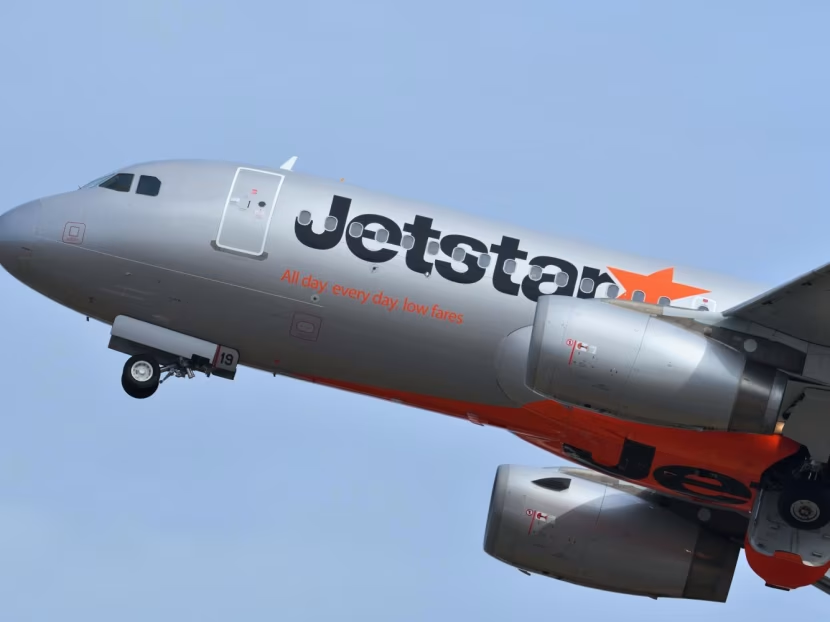
Vietnam Insider – Australian airline Qantas announced on Wednesday (June 11) that it will shut down Jetstar Asia, its Singapore-based low-cost subsidiary, by July 31. The decision comes amid rising supplier costs, increased airport charges, and intensifying competition in the Southeast Asian budget airline market.

The closure will unlock AU$500 million (US$326.4 million) in capital, which Qantas plans to reinvest into its ambitious fleet renewal program.

Qantas confirmed that the 13 Airbus A320 aircraft currently operated by Jetstar Asia will be gradually redeployed to Australia and New Zealand.

According to CNN, Jetstar Asia has been heavily impacted by soaring supplier costs, higher airport fees, and escalating competition in the region, making it difficult for the carrier to achieve profit margins comparable to Qantas’ core markets.

Group CEO Vanessa Hudson noted that some supplier costs had surged by as much as 200%, significantly altering the airline’s cost structure. “We are currently undertaking the most ambitious fleet renewal in our history, with nearly 200 firm aircraft orders and hundreds of millions of dollars being invested in our existing fleet,” Hudson said.

Jetstar Asia has faced mounting pressure from major low-cost carriers in the region, such as AirAsia (Capital A) and Scoot (a subsidiary of Singapore Airlines).

Launched over two decades ago, Jetstar Asia was established to tap into the rapidly growing demand for low-cost air travel across Asia. However, the airline is now expected to report an underlying EBIT (earnings before interest and taxes) loss of AU$35 million for the current fiscal year.

Jetstar Asia will cease operations on July 31, with flights continuing as scheduled over the next seven weeks as the airline winds down its services.

Dragon Capital: Vietnam’s Market Upgrade Could Trigger a Wave of Major IPOs

Advertisements

Vietnam may see billions in foreign capital and a flurry of high-profile listings if upgraded to emerging market status, Dragon Capital says.

In a recent report, Dragon Capital highlighted that Vietnam’s stock market could be upgraded by FTSE Russell as early as September 2025, with the change potentially taking effect in March 2026. The upgrade would not only unlock billions of dollars in foreign capital inflows but also pave the way for a surge in initial public offerings (IPOs) — an often-overlooked benefit of achieving emerging market status.

Regulatory Reforms Pave the Way

Dragon Capital pointed to strong signals of progress driven by Vietnam’s regulatory reforms. A key breakthrough is the elimination of the pre-funding requirement for foreign institutional investors, addressing a long-standing bottleneck.

Additionally, the KRX trading platform, launched in May 2024, aims to enhance trading speed and settlement reliability. The State Securities Commission (SSC) has also worked closely with brokerages to standardize market operations, implement a new definition of investor identification, and introduce digital documentation protocols, custodial member roles, and fractional share management.

Other ongoing initiatives include: Electronic communication platforms between brokerages and custodian banks; A consolidated account framework to simplify foreign investor transactions; Enhanced trade allocation procedures; And a central counterparty clearing (CCP) system expected by 2026.

IPO Boom on the Horizon

Beyond the influx of foreign funds, Dragon Capital emphasized a key benefit of market reclassification: a significant boost to IPO activity. When markets are upgraded to emerging status, they typically see a surge in listings as both governments and private companies look to capitalize on greater investor appetite and stronger valuations.

“An upgrade often leads to higher valuations and stronger demand, prompting company owners to view it as an ideal time to go public,” Dragon Capital noted.
In Vietnam’s case, the upgrade could encourage local unicorns and major state-owned enterprises (SOEs) to launch IPOs, capitalizing on demand from foreign investors previously restricted from frontier markets.

The government’s privatization agenda could also gain momentum, with stakes in SOEs sold via public markets. Meanwhile, large private-sector players—particularly in tech and retail—may consider IPOs to fund expansion, reassured by the increased capacity of the upgraded market to absorb large deals.

Enhanced Global Visibility and Capital Access

Being classified as an emerging market also brings greater credibility and visibility. Companies listed in such markets automatically draw attention from global institutional investors and emerging market funds, many of which are restricted from investing in frontier markets.

This shift could attract international investment banks to underwrite deals in Vietnam, elevating the quality and scale of IPOs. Vietnam has seen relatively few major IPOs in recent years, but that may change soon.

“Several blockbuster IPOs have been on hold, awaiting improved conditions,” Dragon Capital noted. “An upgrade could unlock these opportunities.”
Recent activity already hints at renewed momentum: Vinpearl listed in May, while TCBS and F88 are preparing to go public. Further ahead, IPOs could emerge from big names like THACO AUTO, Bach Hoa Xanh, Golden Gate, Highlands Coffee, VPS, Viettel IDC, Misa, VNPay, and Long Chau.

According to Dragon Capital, Vietnam could see up to $47 billion in IPO activity over the next three years.

Market Depth and Policy Support

A deeper and more diverse market — with more large-cap listings in key sectors — would help maintain or increase Vietnam’s weight in emerging market indices. To support this, policymakers may actively promote IPOs from major state banks, telecoms, and corporate subsidiaries.

Vietnam has set an ambitious target to raise its market capitalization to 100% of GDP by 2025. Dragon Capital believes that achieving this will require both market appreciation and a wave of new listings — and that an upgrade could serve as the catalyst.

“While a market upgrade doesn’t guarantee a wave of IPOs, it creates the right conditions — higher demand, better valuations, and greater investor confidence,” the report concluded.
“We should expect regulators to leverage this opportunity to accelerate Vietnam’s listing pipeline.”

Tourist’s Handbag Snatched Through Car Window in Da Nang

Advertisements

Vietnam Insider — An 18-year-old man on a motorbike brazenly snatched a tourist’s handbag through the open window of a moving car along the popular coastal road in Da Nang, according to local authorities.

The suspect, Lê Ngọc Sử, a resident of Hue, was arrested on June 11 by Da Nang police for investigation into multiple street thefts.

At around 12:15 a.m. on June 5, Sử reportedly drove his motorbike up close to a car traveling along Võ Nguyên Giáp Street in Sơn Trà District. Spotting an open window, he reached into the vehicle and grabbed a handbag belonging to a 25-year-old female tourist from Hanoi. The bag contained a pair of Apple AirPods and VND 2 million (approx. USD 80).

After speeding away into the night, Sử struck again less than an hour later. This time, he snatched a smartphone from a 17-year-old girl from Quảng Nam who was standing on the sidewalk along the same street.

Both robberies occurred in the early hours of the morning, in relatively deserted areas, making it difficult for authorities to quickly identify the suspect. Witnesses could only describe him as a young man wearing a white T-shirt, riding a Yamaha Exciter motorbike.

Police spent several days reviewing surveillance footage from multiple streets before finally identifying and apprehending Sử on June 10.

During questioning, he confessed to both thefts. Authorities also revealed that he had previously been sent to a juvenile reform school for a similar offense.

As Da Nang continues to welcome tourists from across Vietnam and abroad, the incidents serve as a reminder to remain vigilant, especially during late-night hours.

Storm Wutip Brings Heavy Rain Warnings for Central Vietnam

Advertisements

Vietnam Insider — A tropical depression in the East Sea has intensified into Storm Wutip, expected to bring prolonged heavy rainfall to central and south-central regions of Vietnam over the coming days, though it is not forecast to make landfall.

As of Wednesday morning, Wutip was located east of the Hoang Sa (Paracel) Islands, with sustained winds of 74 km/h, moving northwest at 5–10 km/h, according to Vietnam’s National Center for Hydro-Meteorological Forecasting. The storm is expected to strengthen through Friday, with winds reaching up to 102 km/h as it passes south of Hainan Island, China, before gradually weakening over the weekend.

Despite remaining offshore, Wutip will bring significant rainfall to Vietnam: Wednesday: South-central provinces may receive 30–80 mm of rain, with localized areas exceeding 150 mm. Wednesday night to Friday: From Quang Binh to Quang Ngai, rainfall is expected to reach 100–300 mm, with isolated totals of over 450 mm. Northern Central Highlands could receive 70–150 mm, with some areas experiencing more than 200 mm within six hours.

Strong winds and rough seas are forecast in offshore areas, especially near the Hoang Sa archipelago, the Gulf of Tonkin, and coastal provinces from Quang Tri to Quang Ngai, with gusts reaching 102 km/h and waves up to 5 metershigh.

Vietnamese authorities have issued an urgent directive to coastal and mountainous provinces, warning of possible flash floods and landslides. Local governments have been instructed to strengthen early warning systems, inspect high-risk areas, and prepare emergency response teams.

This is Vietnam’s second tropical depression in 2025, following one in February that did not become a storm. In 2024, the country experienced 10 storms, with five directly affecting the mainland. Meteorologists expect up to five storms or depressions to form in the East Sea by August 2025, with two potentially impacting Vietnam.

Foreign residents and travelers in Vietnam are advised to stay informed through official weather updates, follow local advisories, and avoid non-essential travel in affected regions.

Exit mobile version