

My team is currently busy preparing for the 2026 International Olympiad on Astronomy and Astrophysics, which is expected to be hosted in Vietnam this coming September. Our involvement in this international event provides us with the annual opportunity to meet the members of the Vietnamese team. Some of these students spend the time before heading abroad for their studies working with us, and in truth, pursuing education abroad is a path that all of them eventually choose.
Throughout my 26 years in Vietnam, witnessing this brain drain has been a constant source of pain. It is disheartening to see brilliant students leave their homeland, only for few to return. The feeling is akin to children accusing us: “We have to leave, because this home does not provide us with the care and support we need.” (Professor Pierre Darriulat at a Tia Sang magazine forum earlier this year.)

Professor Pierre Darriulat at a Tia Sang magazine seminar earlier this year.
Why do they leave, and why don’t they come back?
Wondering if the brain drain in Vietnam’s basic scientific research has shown signs of receding, I recently consulted AI. As a tool that does not shy away from uncomfortable realities, AI responded: “Over the past two years, the brain drain in Vietnam’s basic sciences remains a critical bottleneck.” It noted that “top-performing science students and leading researchers continue to leave. While income is a factor, the primary reason they refuse to return lies in an underdeveloped academic environment that fails to foster their expertise, cumbersome administrative red tape, and a lack of modern laboratories.”
The AI cited incisive analyses emphasizing that higher salaries are by no means the primary motivator for talented students leaving their homeland. More critical factors include respect for academic autonomy, scientific ethics, and broader intellectual values.
These observations resonate deeply with my own experience. After completing my PhD in the U.S., I was invited to work at UCLA and the University of Maryland with a salary nearly double what France was offering at the time. Yet, I chose to return to France, because my former mentors back home had kept in touch throughout my years in the U.S. They continuously updated me on France’s post-war scientific recovery and encouraged me to return to contribute to the nation’s scientific prosperity. As Mr. Huynh Van Chuong, Director of the Quality Management Department at the Ministry of Education and Training, recently noted, this is exactly what Vietnam currently lacks.
Ultimately, brain drain is a symptom of a stagnant educational and management system, not a flaw inherent to the students. It is tragic that as the winners of Olympic medals leave one by one, the loss is not just about a few exceptional individuals; it erodes the next generation’s belief in the future of domestic science.
The Consequences of Rigid Management
From my experience in scientific management, including seven years heading Research at CERN, the greatest lesson I learned is that there are two types of managers: those who understand they are serving the community they lead, and those who believe the community exists to serve them.
The second lesson is that rules are not dogmas to be followed blindly. Instead, they must be constantly adjusted to adapt to an ever-changing environment. There are many feasible initiatives that could easily be implemented to advance basic research, but unfortunately, we often miss these opportunities.

Dr. Tong Si Son, Vice Dean of the Department of Space and Aeronautics (University of Science and Technology of Hanoi – USTH), instructing a student on the use of a hyperspectral camera. Photo: USTH
Allow me to illustrate this with the co-supervision doctoral model we have successfully applied for the past two decades, a model which nurtured seven out of the ten PhDs from our unit. In this model, a candidate is supervised by two scientists: one in Vietnam and one from a foreign university.
The agreement stipulates that the candidate splits their time equally between both countries; the dissertation is written in English with summaries in Vietnamese; the defense occurs before a joint committee; and upon success, the student is awarded a PhD from both nations.
We have found this to be an excellent model that fosters cooperation with prestigious foreign universities. About thirteen years ago, I presented the merits of this model to the then-Deputy Minister of Education and Training, Bui Van Ga. He expressed full agreement and promised to simplify regulations to support this form of co-supervision.
However, no changes were ever implemented. In practice, students must often wait one to two years after their defense to receive their Vietnamese degree, forced to complete additional work and defend their thesis again before an all-Vietnamese committee. This inadvertently creates a regrettable image of Vietnam, showing a lack of respect for both signed agreements and our international partners.
Recently, we arranged a co-supervision case with the Université Libre de Bruxelles for an outstanding student who earned her Master’s degree at the University of Science and Technology of Hanoi (USTH). Yet, regrettably, Vietnam currently does not have a doctoral program in Astronomy and Astrophysics, a field recognized globally as a cornerstone of basic research for over 50 years. We remain unable to promote this field to its deserved status.
Leadership Priorities and Our Responsibility
Criticism is easy; building is difficult. The determination of the Vietnamese government to transition toward a knowledge-based economy was clearly affirmed in the Politburo’s Conclusion No. 57-KL/TW. This document promotes strategic directions to create breakthroughs in science, technology, and digital transformation—prerequisites for Vietnam’s development goals for 2030 and 2045.

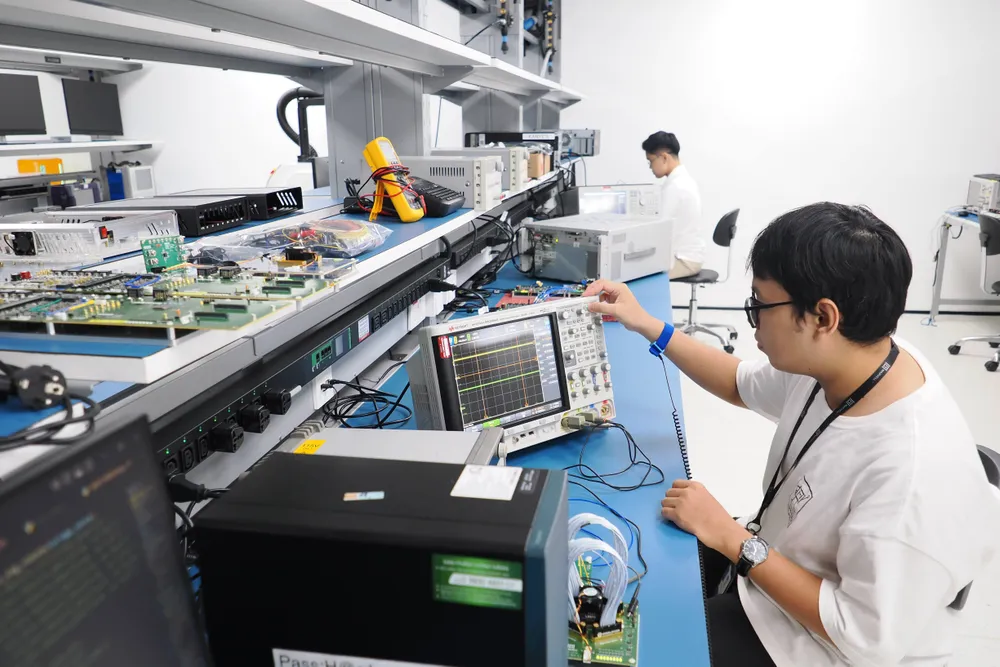
Scientific research at the Center for Nano and Energy Laboratory (Vietnam National University, Hanoi). Photo: Center for Science and Technology Communication
Specific priorities were outlined by Prime Minister Pham Minh Chinh, emphasizing the need to “transform research results into commercial products based on clear problems, products, applications, efficiency, and contributions.”
Political determination from the highest levels is encouraging, but it requires realization through competence, courage, and a deep understanding of the context.
Buzzwords like “AI” or “innovation” can easily become empty slogans. In basic research, these terms are not a cure for the chronic illnesses I have described. We do not expect leaders to prioritize questions of how stars are born and die in the immediate future, but we are conscious that the responsibility lies with us to strive for the right policies.
There are at least two paths: prioritizing research excellence and encouraging “brain circulation” through international cooperation. The first is key to gaining international respect, while the second helps mitigate the losses caused by brain drain.
Source: Translated from Tia Sang by Anh Thu
Discover more from Vietnam Insider
Subscribe to get the latest posts sent to your email.