

The Most Expensive Bowl Is Made to Order, Not the Standard Price
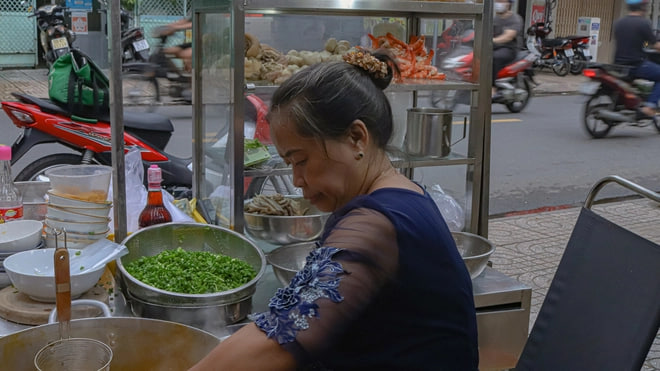
According to Ms. Loan, the stall serves a wide range of price tiers. Whether customers ask for a bowl priced at 50,000, 70,000, 100,000, or 150,000 VND, she scoops it with full portions of crab meat, prawns, and pork hock. The entry-level bowl includes pork slices, blood pudding, and broth for around 50,000 VND. Diners can also select intermediate options at 100,000 or 200,000 VND to match their individual budgets.
Meanwhile, the 350,000 to 400,000 VND bowls are strictly custom orders. According to the owner, the stall only prepares these premium bowls when a customer explicitly requests the most exclusive portion featuring two giant crab claws, abundant crab meat, and large prawns. The price is always quoted to the customer in advance. The final bill fluctuates based on the exact quantity of claws, crab meat, and prawns requested.
What Goes Inside the Special Bowl?
The stall operates without elaborate signage or air conditioning, consisting only of a steaming broth vat alongside a few low plastic tables and stools set along the alleyway. Many diners know the address as “Banh Canh Cua Alley 360,” while regulars affectionately address Ms. Loan as Auntie Gai. The stall has occupied this alley for more than thirty years, earning a long-standing reputation as one of the most expensive street-side noodle soup spots in the city.
Roughly two years ago, the stall’s signature high-end bowl made headlines when prices were cited at 300,000 to 350,000 VND. Recently, reports of bowls reaching 350,000 to 400,000 VND circulated widely across social media following a review by a food content creator. In that video, the creator ordered a 350,000 VND bowl, highlighting a crab claw spanning nearly half the size of an adult hand placed in the center of the bowl.

The crab meat at Ms. Loan’s stall comes from live crabs hand-picked into thick flakes rather than frozen processed meat. The crab meat is served with a side dish of lime-pepper-chili salt to accentuate its natural sweetness. Alongside crab, the bowl features large, crisp, peeled black tiger prawns, sweet and chewy crab patties, a rich piece of tendon pork hock, and fried featherback fish cake floating in a golden, thick broth. The broth remains the most praised component, known for its rich profile, aromatic crab tomalley, fried shallots, and balanced viscosity. The volume of tapioca noodles in the special bowl is identical to a standard portion; the surcharge reflects the substantial seafood toppings.

What the Owner Says About Pricing and Ingredient Quality
The following details reflect statements provided directly by Ms. Loan. She explained that wholesale live crab prices fluctuate significantly on the open market. Her stall exclusively sources live Grade-1 Ca Mau and Nam Can sea crabs, inspecting each specimen individually. According to her, she never purchases suffocated crabs, frozen stocks, or cheap iced supplies.

The cost economics, as she describes, are straightforward. A kilogram of live sea crab costs several hundred thousand dong at wholesale. Yet after boiling, manual peeling, and claw cracking, it yields only a few hundred grams of solid crab meat. Hand-picking the crab meat from the early hours of the morning requires painstaking labor, meaning seafood represents the overwhelming majority of her operational capital. She also noted that across recent years, rising wholesale prices for fresh black tiger prawns, pork marrow bones, cooking oil, fried shallots, cooking gas, and seasoning compelled the stall to incrementally adjust the price of its custom bowl over time.

Regarding billing, Ms. Loan emphasized that prices are always communicated to diners before bowls are prepared. She noted that having traded in this alley for over thirty years, customers who ate here in their youth now bring their children and grandchildren back. According to her, the business operates on professional pride.
Ms. Loan’s workday begins around 3:00 to 4:00 AM, when she visits the wholesale market and inspects every crab and batch of black tiger prawns delivered by trusted vendors. She explained that crab claws and meat are boiled, cracked, and hand-shredded directly during business hours, refusing to serve overnight leftovers. The broth simmers gently for hours from pork marrow bones combined with pureed fresh crab tomalley, whole chicken, pork hock, fish, prawns, and pork. According to the owner, the broth’s natural thickness comes from simmered crab tomalley and bone reductions, without adding tapioca starch or food coloring.

The stall gained wider public recognition in late 2022 when filmmaker and entertainer Tran Thanh announced his Lunar New Year film project The House of No Man (Nha Ba Nu). He shared that he wanted to craft a film around a female protagonist who sells crab noodle soup, portrayed by artist Le Giang. During the project launch event, Tran Thanh purchased crab noodle soup from the stall to treat attendees, and he is known as a loyal regular of the vendor.

Current Business Operations
During its initial burst of fame, diners formed long lines that packed the entire alley. According to recent reviews and video clips, customer traffic has become more evenly distributed. Early in the week, the alley remains relatively calm, while Friday evenings and weekends see heavier crowds, occasionally running out of parking space. The stall operates from around 3:30 PM until sold out, typically closing before 8:00 PM or at the latest around 9:30 PM. Ms. Loan shared that her stock usually sells out within a few afternoon hours, meaning late arrivals frequently find the crab claws entirely gone.

Like many food stalls made famous by unconventional pricing, Ms. Loan’s crab noodle soup continues to draw debate. One side argues that 350,000 to 400,000 VND for a roadside bowl of noodles is excessive. The opposing side counters that fresh premium seafood, labor-intensive preparation, and upfront price quotes justify the cost. On online review platforms, diners remain divided: some praise the generous fresh crab portions and rich broth, while others feel the roadside dining experience does not match the price tag. In response, Ms. Loan said that those who find it expensive simply do not need to eat it, as every customer possesses a different budget and palate.

Tips for First-Time Visitors
For first-time visitors, the most practical approach is to ask for the price before ordering and select a portion size suited to your appetite rather than defaulting to the most expensive option. A standard bowl priced under 100,000 VND is sufficient to taste the broth and traditional toppings. Diners wishing to experience the custom high-end bowl can share it among two to three people given the large volume of seafood. During peak hours, patrons should expect a brief wait, as the owner cooks and serves directly with minimal assistance.

As raw ingredient and operating costs rise, even multi-decade street food vendors must adjust their pricing. What sets this noodle stall apart is an expansive pricing spectrum ranging from 50,000 to 400,000 VND drawn from the exact same pot of broth, with the top-tier bowl prepared only upon specific customer request.
Source: kenh14.vn
Discover more from Vietnam Insider
Subscribe to get the latest posts sent to your email.