

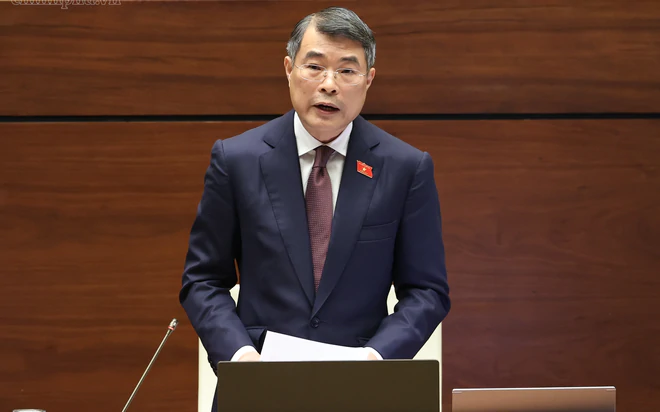
Speaking on the afternoon of November 12 while delivering an explanatory report before the National Assembly on issues of concern to voters, citizens, and lawmakers, Prime Minister Le Minh Hung stated that the Government will focus its direction and resolutely strive to achieve full-year 2026 GDP growth exceeding 10% while keeping inflation at around 4.5%, establishing a solid foundation for implementing the 2026–2030 socio-economic development plan.
The Prime Minister emphasized that capital requirements for socio-economic development over the coming years are immense. Specifically, total social investment capital in 2027 needs to be mobilized at approximately 36% to 38% of GDP, equivalent to 6 to 6.4 quadrillion VND. Within this sum, state budget development investment expenditure is projected at roughly 1.76 quadrillion VND, accounting for 27% to 29% of total investment capital.
According to the Prime Minister, to mobilize these resources in 2027, the Government will direct the synchronized execution of multiple measures, including striving to boost state budget revenues, cutting recurrent expenditures, and prioritizing public investment disbursement.
Additionally, Vietnam will issue various types of bonds and secure Official Development Assistance (ODA) loans; mobilize credit resources and ramp up investment from state-owned enterprises; and vigorously attract private investment and foreign direct investment (FDI).
Concurrently, the Government will focus on developing modern capital, securities, and financial markets to draw in international investment funds and foreign indirect investment flows.
Notably, another key priority is accelerating the application of science, technology, innovation, and digital transformation across state administration, public services, and business production. Accordingly, the Government will promote the commercialization of research outcomes and deepen linkages among the State, enterprises, research institutes, and universities, positioning science and technology as a primary driver of growth.

The Prime Minister delivers an explanatory report on issues of concern to voters, citizens, and lawmakers at the 2nd Session of the 16th National Assembly. Photo: VGP
Government Prioritizes Inflation Control
Alongside resource mobilization, the Prime Minister stressed that the Government continues to prioritize macroeconomic stability and inflation control to ensure sustainable growth and improve citizens’ living standards.
Specifically, fiscal, interest rate, and exchange rate policies will be managed proactively and flexibly. Concurrently, the Government is ensuring stable supplies of petroleum, electricity, and essential commodities; reducing intermediary costs; enforcing price transparency; strictly handling violations; and assigning Consumer Price Index (CPI) control targets to individual localities.
The head of Government noted that over the past period, authorities have implemented sweeping relief measures to support citizens and businesses, including a 2% reduction in Value-Added Tax (VAT) on select goods and services through the end of 2026, alongside extended deadlines for tax payments and land rent. Furthermore, special consumption taxes on mineral gasoline, E5 biofuel, and E10 biofuel were slashed from 10%, 8%, and 7%, respectively, down to 0%.
Notably, Vietnam implemented a 2% reduction in retail electricity prices following years of predominantly upward tariff adjustments.
The Government also rolled out a 30% reduction in corporate and household business income taxes for the 2026–2027 period. State budget revenues are estimated to decrease by approximately 256.7 trillion VND in 2026 due to these tax exemptions and reductions.
Thanks to the proactive, flexible, and coordinated implementation of these policies, Vietnam’s average CPI was contained at 4.57%. According to the Prime Minister, this represents a highly positive outcome amid rising global inflationary pressures.
Alongside high growth figures, the Prime Minister reported that the Government has actively executed social welfare policies to safeguard citizens’ livelihoods.
Over the past 10 months, Vietnam allocated approximately 578 trillion VND from recurrent expenditure budgets toward healthcare, education, and social security.
Effective July 1, 2026, the statutory base salary in Vietnam increased by 8%, while allowances for commune-level officials and civil servants rose from 25% to 55%.
Concurrently, the Government aims to provide free textbooks for general education students nationwide starting from the 2028–2029 academic year—one year ahead of the original schedule.
Discover more from Vietnam Insider
Subscribe to get the latest posts sent to your email.