

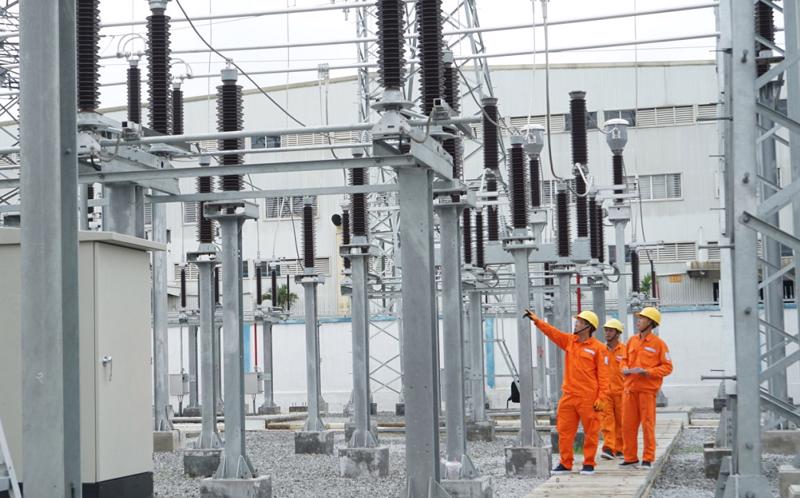
Speaking at the National Energy Security Forum on November 10, Deputy Minister of Industry and Trade Nguyen Viet Son assessed 2026 as a year of unprecedented challenges for the national power system. Prolonged heatwaves pushed electricity consumption to historic peaks, while Middle East conflicts disrupted fuel supply chains and elevated import expenses.
The inaugural Vietnam National Energy Security Report released at the forum indicated that national peak demand set an all-time record of 57,537 MW on June 24. Produced and imported electricity output over the first nine months increased by 9.4%, with the full-year volume projected to reach 356.2 billion kWh, an increase of over 10%.
Nguyen Tai Anh, Vice President of Vietnam Electricity (EVN), stated that in the northern region alone, power demand in May and June surged by 14.7% and 17.5%, respectively. During peak hours, regional operational capacity closely approached the critical safety thresholds required for voltage stability. To respond, EVN stockpiled fuel supplies, optimized power plant output, ramped up electricity imports, and deployed battery energy storage systems (BESS).
“At this juncture, we can affirm that the national power system will guarantee sufficient electricity supply for the entire year,” Tai Anh said.

Deputy Minister of Industry and Trade Nguyen Viet Son addresses the forum on November 10. Photo: Cong Thuong Newspaper
However, supply constraints are projected to intensify over the coming years. Deputy Minister Nguyen Viet Son noted that 2027 and 2028 will present severe supply challenges, as electricity consumption is expected to expand by around 10% on top of the 2026 baseline. Meanwhile, new baseload power generation projects have not yet been commissioned in time.
The National Power System and Market Operator (NSMO) forecasts that in 2027, peak demand in the northern region will rise significantly above this year’s high of 30,248 MW. Concurrently, the central-to-north transmission corridor has been operating right at its capacity ceiling of 5,000–5,200 MW. According to NSMO, if the energization of 500 kV substations in Bac Ninh, Thai Binh, and Hai Phong faces delays, maintaining supply will prove more difficult during summer evening peak windows.
Hydropower accounts for approximately 25% of total system generation, according to EVN figures released in October. However, dispatch capacity from hydroelectric plants depends strictly on reservoir inflows. According to NSMO’s assessment, by the end of this year, 30 out of 48 reservoirs are at risk of failing to reach normal water levels—the maximum retention level required for power generation.
To conserve water reserves for the upcoming dry season, the Ministry of Industry and Trade and the Ministry of Agriculture and Environment agreed to retain reservoir water through the end of the first quarter of 2027, while calculating appropriate discharge rates to sustain downstream industrial and municipal water needs.
To ensure sufficient power supplies through 2030 amid climbing industrial and residential consumption, EVN stated that the corporation and its subsidiaries plan to complete 15 generation projects with a cumulative capacity of 6,066 MW. Among these, 22 projects (including offshore wind and floating solar) totaling 9,710 MW are undergoing investment procedures under the adjusted Power Development Plan VIII (PDP8).
The year 2026 marks the first year EVN deployed BESS units, with battery storage capacity in the north expected to reach 805 MW. In 2027, EVN plans to invest in an additional 930 MW of BESS capacity, installed at the Thai Binh Thermal Power Plant, Mong Duong 1 Thermal Power Plant, and key points across Hanoi’s distribution grid.
Regarding the Ninh Thuan 1 nuclear power project (2,400 MW capacity), EVN noted that it is finalizing dossiers to adjust the investment policy while coordinating negotiations on an intergovernmental credit agreement.
With a substantial pipeline of power generation projects requiring investment over the next four years, the power giant expects to inject approximately 830 trillion VND, averaging 166 trillion VND annually. This represents EVN’s largest capital expenditure program to date, roughly 69% higher than the 492.483 trillion VND deployed in the prior phase.
To ensure adequate financing, EVN recommended that loans allocated to key national power projects be exempted from statutory credit exposure limits, while expanding capital mobilization via green credit, corporate bonds, and international capital channels.
The corporation also urged regulatory authorities to formulate a modernized transmission tariff framework to attract private sector participation in transmission grid development. Currently, transmission fees represent a low portion of the overall retail electricity tariff structure. For example, under the 2025 cost breakdown, transmission charges accounted for only about 3.7% (equivalent to 77.01 VND) per kWh.
Nevertheless, EVN directly controls only about 37% of total system generation capacity, with the remaining 63% reliant on projects developed by PetroVietnam (PVN), Vinacomin (TKV), and the private sector. An EVN representative noted that independent developers must bring roughly 85,000 MW into commercial operation between 2026 and 2030. To mitigate potential supply shortages, the utility urged government agencies to rigorously monitor implementation milestones, even recommending the reassignment of investors on chronically delayed projects.
Discover more from Vietnam Insider
Subscribe to get the latest posts sent to your email.