

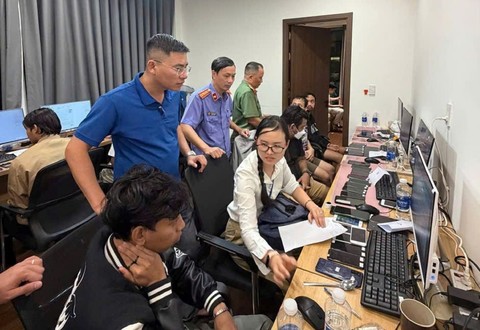
On November 4, the Da Nang Police Department announced the bust. Officers uncovered a syndicate of 13 foreign nationals operating in Dien Ban Dong Ward. The suspects included two Chinese and 11 Indonesian citizens.
In late October, police raided a villa within the Regal Victoria residential area. Inside, officers discovered 13 people operating dozens of computers and mobile devices. Consequently, authorities caught them running cross-border cyber fraud schemes.
According to investigators, Xiong Zhouhua, a 33-year-old Chinese national, led the ring. Meanwhile, Aditya Aldi Pratama, a 25-year-old Indonesian national, served as the team manager. He assigned daily tasks to his 10 compatriots.
Xiong procured romance scam scripts via Telegram. Additionally, he provided phone numbers and WhatsApp accounts to target prospective victims. Operatives worked across five teams using 87 smartphones and 12 desktop computers.
Each operative contacted about 50 prospective Indonesian victims daily. They posed as attractive women on WhatsApp and Telegram. As a result, they quickly built romantic trust with the targets.
Once victims trusted the personas, operatives directed them to a payment website. They instructed victims to complete fake product orders for commissions. Initially, the platform allowed small withdrawals of principal and profits. However, as deposits grew larger, administrators locked the accounts. Finally, they demanded extra processing fees before seizing the entire balance.

Police question the suspects.
Xiong paid each worker a monthly salary of 700 USD plus a 200 USD attendance bonus. Conversely, workers missing performance targets faced penalties between 400 and 1,000 USD. Meanwhile, teams hitting 10,000 USD in revenue earned bonuses from 5% to 13%.
In late August 2026, Xiong entered Vietnam and traveled to Da Nang. He sought a secluded base for the scheme. On September 9, he leased the villa in Dien Ban Dong Ward. Subsequently, he spent about 60,000 USD on network gear and electronics.
Xiong then recruited 11 Indonesian workers to Vietnam. He took them straight to the villa and confiscated their passports. In addition, he barred them from leaving the premises. He hired Huang Shuo, a 34-year-old Chinese national, to buy groceries and cook daily meals. Thus, the entire group lived in complete isolation.
The syndicate routed stolen Indonesian funds through two private Telegram groups to hide traces. Once money arrived in designated accounts, automated tools converted the rupiah into USDT cryptocurrency.
At the end of each day, the group tallied all stolen assets. They deducted a 3% transaction fee. Afterward, they transferred the remaining funds into Xiong’s crypto wallet.
Authorities are currently expanding their investigation into the operation.
Moreover, this raid reflects a wider national enforcement effort. In late October, police in Thanh Hoa dismantled another cyber fraud ring. That syndicate involved 113 foreign nationals targeting victims across multiple countries. By November 4, prosecutors had detained 94 suspects and traced 50 billion VND in stolen funds.
Speaking at a government briefing, Major General Nguyen Quoc Toan addressed foreign criminality. He affirmed that Vietnam protects the legal rights of foreign guests. Nevertheless, the nation will not permit anyone to exploit its territory for transnational cybercrime.
Discover more from Vietnam Insider
Subscribe to get the latest posts sent to your email.