

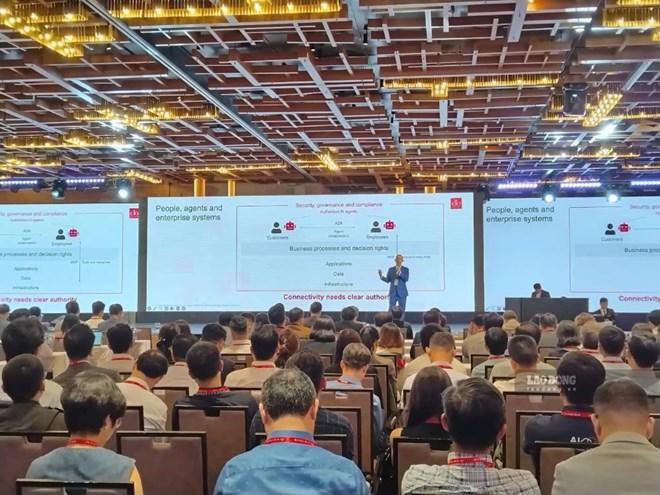
Bridging the divide between individual application and enterprise-scale value creation was the central theme at the CIO Summit 2026, held October 1 in Ho Chi Minh City. The conference convened more than 500 technology executives, corporate leaders, and industry specialists.
Widespread Adoption Does Not Equal Enterprise Scale
Fresh findings from the Survey on AI Adoption in Vietnamese Enterprises—a joint initiative by 3HORIZONS and the CIO Vietnam leadership community—highlight swift adoption trends.
Roughly 95% of survey respondents reported using generative AI at an individual or personal level. Furthermore, 59% have incorporated AI into assisted workflows, while 36% have embedded AI directly into core applications or business operations.
Moving toward higher technical sophistication, 33% of enterprises develop or customize proprietary AI solutions, and 20% deploy domain-specific or functional AI models. However, merely 7% have introduced autonomous AI systems capable of operating with high independence.
The critical insight lies not in isolated statistics, but in the glaring divide between initial tool usage and scalable integration. The fact that employees routinely open AI apps does not mean algorithms are woven into core processes to drive measurable financial returns.
“AI is being utilized extensively, but widespread usage does not equate to enterprise-scale deployment, nor does scale automatically translate into business value,” explained Dr. Tran Viet Huan, Chairman of CIO Vietnam. “The decisive question today is how to transform standalone experiments into a scalable, measurable, and accountable organizational capability.”
Another key development is that 44% of respondents have experimented with or deployed autonomous AI agents. This shift demonstrates that Agentic AI is moving swiftly onto executive agendas, even though deployment maturity varies widely.
Meanwhile, the stark contrast between surging agent trials and the mere 7% threshold for autonomous deployment illustrates that business leaders remain cautious about granting full operational autonomy to machines.

Deploying AI to achieve concrete business performance was the focal point among technology leaders at CIO Summit 2026.
As AI agents begin executing workflows, interfacing with core databases, and participating in operations, fundamental governance dilemmas arise: What datasets should an AI agent access? What actions can it execute independently? At which checkpoints must human oversight intervene? Ultimately, who assumes liability for algorithmic outcomes?
Productivity Surges Early, While Top-Line Gains Lag
Survey findings further demonstrate that business value from AI has emerged unevenly across corporate balance sheets.
Nearly 90% of respondents reported noticeable boosts in employee productivity. In addition, 62% stated that AI enables faster and superior decision-making, while 52% observed a constructive impact on corporate innovation.
In contrast, metrics directly tied to market share and financial balance sheets posted much lower scores. Only 33% realized cost savings, 23% noted improved customer experiences, and barely 15% recorded actual top-line revenue growth.
This disparity presents an urgent strategic test for business leaders: How can companies convert personal productivity gains into quantifiable improvements across overhead costs, customer satisfaction, revenue growth, and corporate business models?
This challenge anchored the central theme of CIO Summit 2026: “From Pilots to P&L.” The mandate does not confine AI value to immediate net profit alone. Instead, it pushes enterprises toward verifiable outcomes—spanning operational productivity, structural cost reduction, elevated customer retention, sustainable revenue growth, and enduring market competitiveness.
(Source: laodong.vn)
Discover more from Vietnam Insider
Subscribe to get the latest posts sent to your email.