

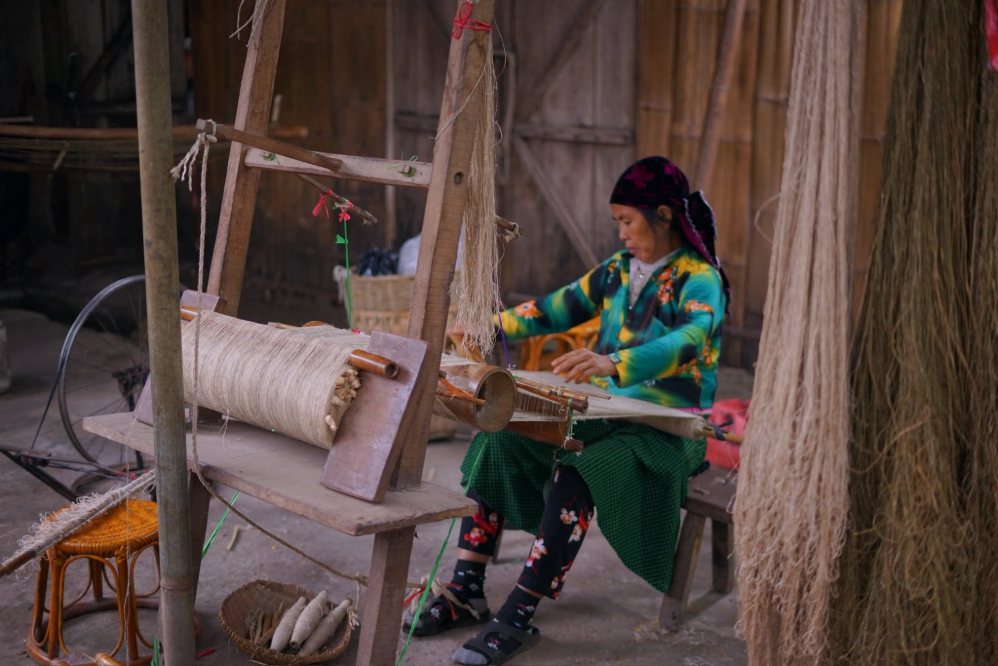
H’Mong women complete up to 41 entirely manual stages to craft a single piece of traditional hemp fabric. Every single step demands exceptional skill, meticulous care, and a tremendous investment of time.
After the harvest, villagers strip hemp stalks for their fibers. Then, they spin these fibers into spools. H’Mong women typically spin thread during their spare moments, keeping spools close at hand wherever they go. To make the threads stronger and more uniform, locals rely on a specialized foot-and-hand tool. Consequently, this tool enables them to spin multiple threads simultaneously.
Artisans soak and boil the fiber bundles repeatedly in wood ash water to soften and naturally bleach them. During the final boil, workers add beeswax to give the threads a sleek, smooth finish. Next, they lay the hemp bundles across a round wooden log and weight them down with a flat stone slab. Women rhythmically bounce their feet to roll the stone back and forth. This action softens the fibers and brightens them to a pristine white.


Individual hemp fibers spun into spools. Photo: Dang Phuong

H’Mong artisans actively weaving hemp. Photo: Dang Phuong
Once the fibers meet rigorous standards, the women mount them onto wooden looms for weaving. This painstaking work spans months because they can only work on it after wrapping up farm chores and household duties.
After weaving, artisans boil, wash, dry, and flatten the fabric once more before moving on to the dyeing phase.
The H’Mong employ a specialized indigo dyeing technique for their hemp textiles. Artisans dye the cloth multiple times to lock in a deep, rich hue. Beyond indigo, they utilize natural ingredients like leaves, roots, tree bark, and other forest elements. As a result, they create long-lasting, vibrant colors.


A woman meticulously hand-drawing patterns onto hemp fabric. Photo: Dang Phuong
The most captivating part of the process involves beeswax drawing. Artisans dip handmade pens into molten beeswax. Then, they carefully freehand intricate motifs like spirals, triangles, coins, bird feet, and crosses. Each pattern carries profound meaning, reflecting the H’Mong worldview, their deep bond with nature, and their philosophy of life.
Because of this intensive craftsmanship, finishing a single traditional outfit can take an artisan nearly a year of continuous labor.
Amid the rush of modern life, this ancient craft once faced the threat of fading away. Specifically, younger generations lost interest in a profession requiring so much time and effort.
A major turning point arrived in 2001 with the establishment of the Lung Tam Hemp Weaving Cooperative. This initiative provides steady incomes for villagers and creates vital employment for highland women. From just 10 original members, the cooperative has expanded to over 100 workers, predominantly local women.
Alongside traditional bolts of fabric, artisans now craft a wide array of tourist-friendly products. These include handbags, scarves, wallets, pillows, apparel, and accessories. Everything features local hemp fibers adorned with signature H’Mong patterns.


Products crafted from local hemp. Photo: Dang Phuong
Visiting Lung Tam today, travelers do more than just learn how hemp fabric is made. Furthermore, they can watch artisans spin fibers, weave on looms, dye with indigo, and draw with beeswax right inside the workshops.
Mr. Dang Phuong, a traveler from Hanoi, shared that Lung Tam functions as much more than a sanctuary for ancient crafts. In fact, it tells a powerful story of endurance, skill, and passion among highland women.
“From rustic hemp fibers, they create exquisite fabrics steeped in cultural heritage. Every single weave and pattern mirrors the rugged beauty of the mountains and the simple aspirations of the H’Mong people,” Mr. Phuong noted.
Photo source: Lao Dong Newspaper
Discover more from Vietnam Insider
Subscribe to get the latest posts sent to your email.