

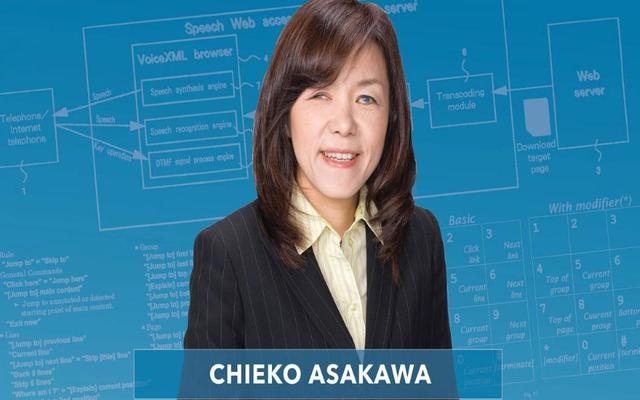
The calamity encountered in adolescence is the motivation for this scientist to resolve to change the life of himself and all those in the same situation.
“I hope my technology can help blind people face life and live independently.”On an afternoon six years ago, Dr. Chieko Asakawa shared her story with students at one such exchange.
Chieko Asakawa is an IBM Fellow and visiting lecturer at Carnegie Mellon University. She is currently working on developing cognitive assistants to help visually impaired people access information in real life, contributing to improving their own quality of life.
Open the window to the world
Born as a normal child, Asakawa’s childhood thoughts passed peacefully. But disaster struck when she was only 11 years old. Due to an accident while swimming, her eyesight gradually deteriorated a lot. And by the age of 14, Asakawa was completely blind.
“The moment I went blind, there was absolutely no personal computer, no Internet, no smartphone. Not even a device for taking notes in Braille. I had to use a Braille typewriter,” said Asakawa.
“A family member had to read a textbook aloud so I could rewrite it myself in Braille. To look up an English word that begins with ‘s’, I have to go through several sections of the English-Japanese Braille dictionary. I don’t remember exactly how many, but probably close to 100. Perhaps that is also the time when I began to search for the accessibility of the blind to this world. ”
In the 1990s, she created a voice browser, allowing the visually impaired to access the Internet using text-to-speech translation. As a result, visually impaired people can read news, online newspapers and books like any other ordinary Internet user.
While working with scientists at Carnegie Mellon University (CMU), she continues to develop technologies to help visually impaired people “see” and interact more with the world around them. And it is clear that Asakawa is not alone in her desire to increase accessibility for the disadvantaged. There are more than 7 billion people on Earth, and about a third of them disabled, elderly or illiterate people who will need assistive devices like Asakawa’s.
A blind customer once told Dr. Asakawa that the browser opened up a new world for him. After more than twenty years of development, the browser has been significantly improved with clearer pronunciation and some emotions have even been added to provide a better user experience.
Let the blind “see” the real world
Chieko Asakawa saw early on the potential of advances in mobile computing, Internet of Things sensor networks, and computer vision. She worked with Carnegie Mellon University’s Robotics Institute to try to bring together Internet of Things sensors, smartphones, and cognitive technology to create a new generation of assistive tools for the visually impaired.
The combination of these technologies is known as cognitive assistants. There is an application developed on this cognitive assistant platform like NavCog. NavCog uses current sensors and cognitive technology to locate the user’s location, determine their facing direction, and gather information about their surroundings by “whispering” into their ear via headset or vibrate alert to the smartphone.
Researchers are exploring many other features, such as detecting approaching people and their moods. Dr. Asakawa hopes that with the help of technology, visually impaired people can recognize friends walking towards them, greet them by name and know how they feel when chatting. One day, she hopes that people with disabilities like herself can confidently present on stage without any assistance.
Dr. Asakawa and his team wanted to develop a new generation of support tools for many situations and locations – shopping malls, airports, hospitals, stadiums, offices, etc. Ordinary people can also use a variety of useful tools, such as an app for the elderly who get lost easily, or a semi-automatic wheelchair for those who have difficulty walking. The team is willing to share its tools to discover more new ideas with researchers, developers and users.
As long as you don’t give up, anything is possible
Dr. Asakawa studied English literature at university. After joining IBM, she obtained her PhD from the University of Tokyo after 3 years. During the Q&A session, a student asked Dr. Asakawa how she overcame the difficulties of studying and working, transitioning from English literature to computer science. She replied that she studied from 9 pm to midnight every day, and worked the rest of the time. She will never give up. Asakawa tells the students that anything is possible, as long as you are resilient.
Dr. Asakawa also told the students that everyone will face challenges in life, only those who don’t give up easily and keep pursuing to the end can succeed. She also emphasized the importance of teamwork in her conversation.
Asakawa still listens to sports, skiing, and swimming news even after losing his eyesight. She once expressed her thoughts about the Paralympic Games that: “As the Olympics approach, athletes’ stories about the sports are always covered by the media more often. Perhaps that will bring the public closer to seeing people with disabilities as part of ‘normal life’.
Source: CafeF
Discover more from Vietnam Insider
Subscribe to get the latest posts sent to your email.