

His Software Company Went Bankrupt. Then a Dutch Entrepreneur Found a New Life Farming in Vietnam
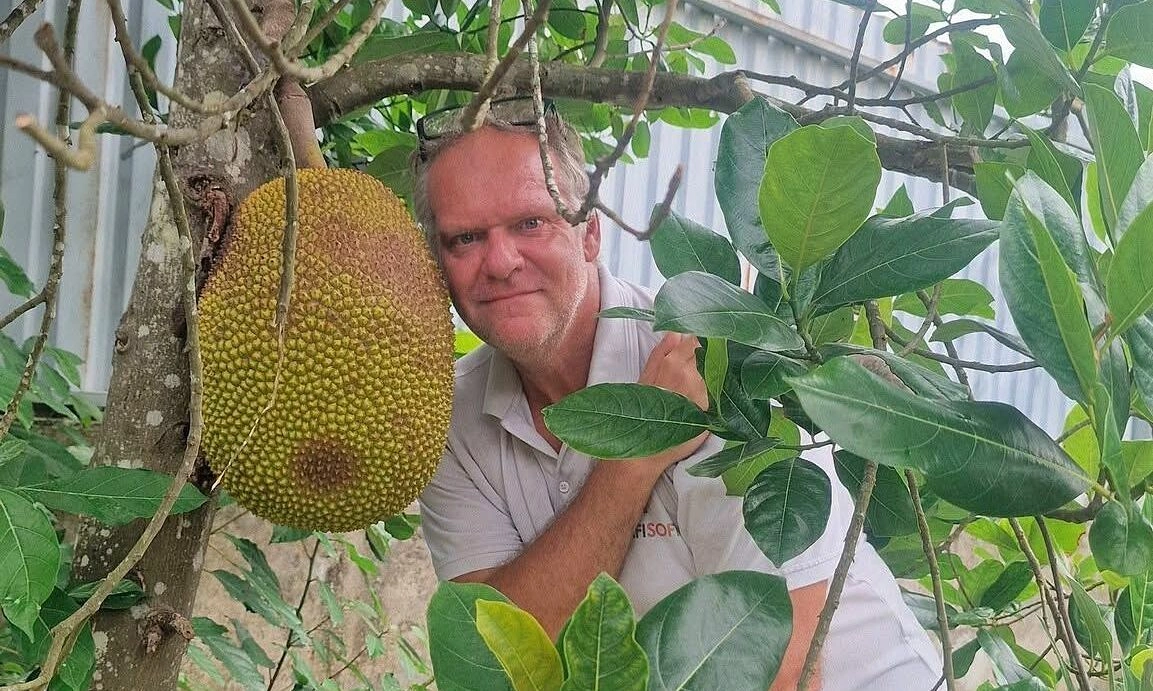
After losing his software company and finding himself with debts to repay, Dutch entrepreneur Danny Haberer could have left Vietnam. Instead, he bought a 1,700-square-meter garden in the Mekong Delta and began learning how to grow food, raise chickens and live a simpler life.
Today, the 54-year-old spends his days surrounded by mango, banana, pomelo and jackfruit trees, a fish pond and 24 chickens in Gò Công, a small town in southern Vietnam.
For Danny, the journey back to his home is now marked by a surprisingly simple signal: the smell of rice fields.
“Saigon is exciting, but when I smell the rice fields, I know I’m on my way home,” he says.
From Amsterdam to the Mekong Delta
Born and raised in Amsterdam, Danny had spent much of his career running a software company that allowed him to work while travelling around the world.
Before settling in Vietnam, he lived in India, Thailand and the Philippines. He arrived in Vietnam in July 2024, but his life changed dramatically about a year later when his company went bankrupt.
Rather than leaving, Danny decided to stay in Vietnam, work remotely, repay his debts and try to rebuild his career.
He moved between Da Nang, Ho Chi Minh City and Da Lat before a relationship with a Vietnamese woman brought him to Gò Công in 2026.
Even after the relationship ended, he decided to stay.
The town offered something he had been looking for: enough modern conveniences for everyday life, but with rice fields and countryside only a short distance from the centre.
In the evenings, the town remains lively. Outside the centre, however, the landscape quickly changes to farmland. Strangers often greet him when they see him on the road.
“This place gives me hope, peace and new opportunities,” Danny says. “But above all, the nature around me gives me the space to reconnect with myself.”
He had never farmed before
When Danny first arrived at his new garden, it was far from the peaceful retreat he had imagined.
Old banana trees were scattered across the ground, weeds had grown around the mango trees and some of the bananas had already become overripe.
Danny had never been a farmer, but he began clearing the garden himself.
He learned as he went. When he did not know what to do, he took photographs and asked for advice on Facebook, including questions about hatching chicken eggs and what to do when his banana trees produced more fruit than he could eat.
He is also learning how to catch and prepare fish from his own pond, partly because he wants to understand the entire journey of food from the garden or pond to the dinner table.
It is a very different relationship with food from the one he experienced growing up in the Netherlands.
The garden has also taught him to be less concerned with perfection.
When he needs to tie or support something, for example, he can use a banana leaf rather than going to a shop to buy a solution.
“You don’t need everything to be perfect. It just needs to work,” he says.
His neighbours became part of his new life
Settling into rural Vietnam has not always been straightforward.
At one point, Danny accumulated household waste in his garden because he did not know how to arrange local waste collection and did not want to burn plastic.
His neighbour, a woman named Ngân who lives about 500 metres away, eventually helped him arrange the collection.
When Danny travels for work, Ngân and her husband also come over to feed his chickens and fish.
Ngân says Danny regularly asks questions about Gò Công’s history, culture and local way of life.
“He is funny and approachable,” she says. “People here don’t often meet foreigners, so they find him interesting. He gets greeted everywhere, and he really likes that.”
That growing relationship with the local community has become an important part of Danny’s experience.
“Danny from the West, in the West”
Danny has also turned his new life into social media content.
He began livestreaming about Vietnam while living in Da Nang. In Gò Công, his videos now focus largely on life in his garden under the theme “Danny from the West, in the West.”
He films himself clearing the garden, feeding his chickens and riding his motorbike through the rice fields, often using humour and phrases he has picked up from people in southern Vietnam.
His videos have gradually made him recognisable in the local community. People who see him on the road sometimes stop to greet or talk to him.
For Danny, social media is also a way to show international audiences a side of Vietnam they may not normally see.
He wants his overseas friends and followers to see what he considers a more authentic Vietnam, beyond the stereotypes often associated with the country.
To him, the Mekong Delta feels almost like its own world, where rice fields, ponds, gardens and everyday community life remain closely connected.
Why stay in Vietnam?
Cost is certainly part of Danny’s calculation, but he does not believe it explains why he stayed.
He estimates that renting a similar plot of land in rural Netherlands could cost enough to cover roughly two months of living expenses in Vietnam. For a broadly comparable lifestyle, he says, living costs in the Netherlands could be 2.5 to three times higher.
But Danny points out that he had already lived in the Philippines, where living costs can also be relatively low.
What kept him in Vietnam was not simply the price of living.
It was the lifestyle.
“Quality of life doesn’t depend on the thickness of your wallet,” he says.
For someone who once ran a software company and moved constantly between countries, that has become a very different definition of success.
Building a new kind of home
Danny plans to continue transforming the garden.

He wants to grow more vegetables, finish an outdoor kitchen and become partly self-sufficient in food production. Eventually, he hopes to install solar panels and turn the property into a space where he can share his experience of farm life in Vietnam.
After more than a year of moving between different Vietnamese cities, the man who once seemed to be constantly searching for his next destination is no longer looking for one.
“I don’t think about where I’ll go next,” he says.
“Vietnam is my home.”
Discover more from Vietnam Insider
Subscribe to get the latest posts sent to your email.