

Despite the collision of time, the old features of Hanoi are still preserved in the old street named Hang Ma.
Hang Ma – A hundred-year-old street
In the past, Hang Ma was a strip of land of Vinh Hanh and Yen Phu villages, connected by the To Lich river in the middle. Time to fill this river by years. No more river banks, the two villages merged into one. Therefore, during the French period, this street was collectively known as Rue du Cuivre (Hang Dong street). More rustic is called Hang Ma street, now located in Hang Ma ward, Hoan Kiem district, Hanoi.

Photo documentary: Rue du Cuivre (Old Hang Ma and Hang Dong)
The original people in this street have many families living in Gate Duc street, in Tan Khai village, Tien Tuc canton (later changed to Thuan My canton), Tho Xuong district was established in 1822 under the old Nguyen dynasty. They moved to this land and opened a small paper and craft shop.
Paper goods here are bought by people for decoration, such as confetti, paper lamps of all kinds to welcome the new year in the spring and ritual offerings such as hats, clothes of Mr. Cong Ong Tao, paper gold, … Besides, , this street also sells funeral goods (intelligent weapons) or funerals, praying for super, praying for peace or people also buy them on Hang Ma Vi street (now merged with Hang May, Ma May city).
Many old features of Hang Ma have sunk into the past, but the soul of an old street is still bold to create Hanoi’s distinctive “three six streets”.

Documentary photo: Old Hanoi / The architecture of the house of the husband of matches
Street of houses with matches
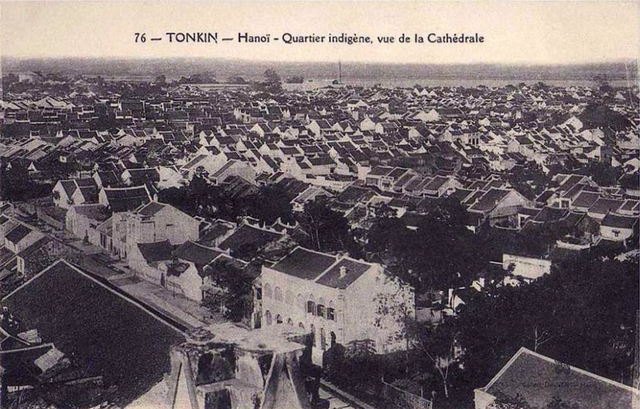
The characteristic of the old town architecture is the narrow and long tube houses. Most of the houses here are one-story with two high-rise walls, the top of which are two battle pillars. The living space of the people here became more sophisticated when the houses with matches were born.
Match house is a two-story house built of bricks and wood. The loft has a hammock door (small door, round door, fake door) overlooking the street. The architecture of this house is not only airy, but also light, even though the area is small.

Documentary photo: Ancient townhouse architecture
The tiled roof of a house with match husbands is tilted down to the street surface and there is also a thatched roof that extends to the sidewalk to cover the sun and rain for the porch.
Although, in the old days, the architecture of the old town was soon exposed to the aesthetic of French architecture. French townhouses are painted in pale yellow with blue wooden doors. The aesthetics of the architecture of this house is quite sophisticated, the high roof top is decorated with decorative patterns around it. The balcony must be semicircular, embracing the door, and the railing is embossed in the style of a turntable.

Documentary photo: Ancient townhouse architecture
French-style townhouses on the first floor are for rent or for sale or business. The other floor is where the family lives. However, the structure of tube houses in the Old Quarter was basically shaped before the French arrived in Hanoi. Therefore, the French also respect the local architecture as much as possible and build French-style townhouses on vacant land or in place of houses destroyed by previous fires.
Just like that, over the years, the roofs are dark and dusty with time. Currently, many houses have changed their architecture to be trendy, but the remaining roofs are still enough to retain the old features of Hanoi’s old quarter.

@st
Favorite destination every holiday, Tet
When the carpentry trade in Ma May Vi street (now merged with Hang May, Ma May city) died out, the carpentry profession in Hang Ma was not much better. The shops in the street mainly sell colored paper, carpentry paper and paper lights, decorations.
In the past, business in Hang Ma was crowded and bustling before the full moon of the 7th lunar month (forgiving the dead) about a month. Before the day of Mr. Cong Ong Tao until noon on the 30th day of the Lunar New Year is also the time when Hang Ma is colorful and bright.
Hang Ma in a modern shape
Hang Ma, a street only about 339m long. This small street has run through the childhood of many Hanoians, imprinting in the hearts of tourists from far away the memories of color, light and brilliance throughout the four seasons all year round.
Running from East to West through the intersection of Hang Luoc, Thuoc Bac, Hang Roi, Hang Cot to Phung Hung, Hang Ma is always bustling. Decorations for holidays all year round from the Lunar New Year, the traditional full moon of July to Valentine’s Day, Halloween to the “imported” Christmas are more and more diversified.


@scorpiot
The Lunar New Year in Hang Ma has a very unique flavor. They call it nostalgia. If you take a walk in Hang Ma in the cold and sweet days bordering the New Year, preparing to welcome spring, the crowdedness of this place seems to pull people to a halt for a moment.


@giadoan
Red couplets, antique stalls selling in the same Hang Luoc and Hang Rui areas and full of colorful flower vases looming red and yellow red envelopes, in the distance are rows of swaying and flashing lanterns.. Old mossy tiled roofs, creaking wooden stairs, rusty iron balconies,… That scene, that spring between the houses of the husband of matches, brought people temporarily “through the air” to the old Hanoi in the past. shortly.
On the occasion of the Mid-Autumn Festival, it is even more noisy.
If on weekdays, Hang Ma still has the colors of paper and paper wares, then on big occasions like Mid-Autumn Festival, Hang Ma will really “makeover” and put on a vibrant, lively look.


If on the occasion of the full moon of July, people also hustle and bustle about shopping in Hang Ma in a quieter and more pensive way, then on the occasion of the full moon in August, all people near and far will see that Hang Ma has a unique appearance. very eye catching.
Many traditional toys such as masks, unicorn heads, drums, and sparkling star lights breathe life into a corner of Hanoi’s streets. From a simple bamboo pinwheel covered with colored paper to colorful lanterns, masks and animal lamps, Hang Ma has become the most colorful and “burning” street in 76 streets. neck.


@hothiennga, @buitienthanh, @truongdinhminh
Hang Ma not only attracts people who want to buy decorations and jewelry, but young people and children are also very eager to come to save beautiful photos. It is also said, “The street has lights up, I haven’t dressed yet” to Hang Ma, you have not experienced the full Mid-Autumn Festival.
The unique feature of the “craft street” remains forever
Hang Ma is one of the typical shopping streets of Hanoi. And today, Hang Ma is also one of the rare streets that retains the old profession. While many streets have “changed jobs” like Hang Khoai, they no longer sell potatoes but sell dishes. Hang Ga stopped selling chickens and ducks, but switched to printing wedding invitations. And Hang Ma is still the same. This place twists and turns with the times, increasingly “picking up equipment” for themselves with many decorative items, items of all sizes, materials and colors.
The old craft street in Thang Long – Ke Cho is known for its traditional nature, rudimentary production, well-thought-out experience and has not changed much in design. But the present Hang Ma has transformed itself according to the needs of the times, which is also a timely step to preserve the soul of the street name.

Documentary photo: Ancient Hang Ma
As time goes by, people and scenery will be lost, as well as many beautiful memories of the old Hang Ma, according to many people about the afterlife. We also cannot revive the old things from the past, but time has also preserved and built up a vivid and colorful Hang Ma of the present.

@hothienga/ Hang Ma now
Hang Ma of the old citadel and Hang Ma of the capital today are both haunting in the minds of many Hanoians with their own feelings and even the footage that keeps the beautiful memories of anyone who has ever set foot in Hang Ma. .
There, the vibrant colors light up the nostalgia and do not forget to highlight the beauty of beloved Hanoi…
Source: CafeF
Discover more from Vietnam Insider
Subscribe to get the latest posts sent to your email.