

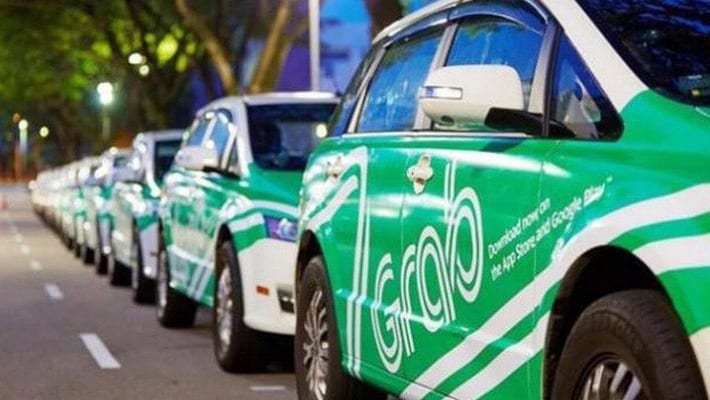
The High-Level People’s Court of Vietnam’s Ho Chi Minh City has concluded that Southeast Asian ride-hailing giant Grab’s operations in Vietnam were partially responsible for past losses of local taxi firm Vinasun, asking Grab to pay $206,000 (4.8 billion dong) as compensation.
The court on Tuesday rejected the appeals by both companies and upheld the first-instance judgment. “The losses of Vinasun, either caused by Grab’s presence in the market or by other factors, could not be distinguished. Therefore, the trial panel does not accept Vinasun’s lawsuit in full,” said a court statement. Nguyen Thi Bich Ngoc reports on on Deal Street Asia.
The Vietnamese taxi firm had in 2017 sued Grab for 41 billion dong ($1.8 million) in damages, claiming the latter enjoyed an unfair advantage as it operated as a technology company instead of a transportation firm. A preliminary court in December 2018 ruled that the Singapore-headquartered ride-hailing firm was a transportation business, and asked it to pay 4.8 billion dong to Vinasun.
Related: Mai Linh, the major taxi operator in Vietnam tries to focus on providing ridesharing services
Both Vinasun and an independent assessor appointed by the court had failed to prove how much of the Vietnamese firm’s losses could be attributed to Grab. Grab said in a statement late Tuesday that the judgment was baseless, asserting the support of the People’s Procuracy of Ho Chi Minh City and the High-level People’s Procuracy in Ho Chi Minh City, which had previously confirmed that Grab’s business activities in Vietnam did not violate the law.
“There is no evidence proving that the damages claimed by Vinasun were caused by Grab’s business activities,” it said. In January this year, Vietnam came up with the regulations for taxi and ride-hailing services, after a four-year pilot program.
The new law, Decree 10/2020/ND-CP, that will take effect in April requires technology ride-sharing companies to put the label of “contracted car” on its driver-partner vehicles, while taxi operators are granted the option of either installing light-boxes or using “taxi” decals (car stickers) on the windshield.

“With the legalization of e-hailing in Vietnam under Decree 10 beyond a pilot project, there are no grounds for Vinasun to use the courts to interfere with the implementation of the Government’s policies,” Grab said.
The super app operator affirmed that the appellate court’s decision will not affect its business and expansion in Vietnam. “We will seek recourse to ensure our basic right to a fair trial and due process is served.” Vinasun said during the hearing that it did not accept only 4.8 billion dong and requested the full compensation it had claimed.
The company could not be immediately reached after the court verdict was announced. Vinasun had argued earlier that the 41 billion dong compensation was for its losses in 2016 and the first half of 2017. It managed to record a 47 billion dong profit in 2019, nearly five times higher than a year earlier, according to local media reports.
Meanwhile, also on Tuesday, Malaysia’s high court dismissed Grab’s application to challenge the country’s antitrust authorities that had proposed a fine of $20.95 million on the company for violating the competition law by imposing restrictive clauses on its drivers.
Read original article on Deal Street Asia
Discover more from Vietnam Insider
Subscribe to get the latest posts sent to your email.