

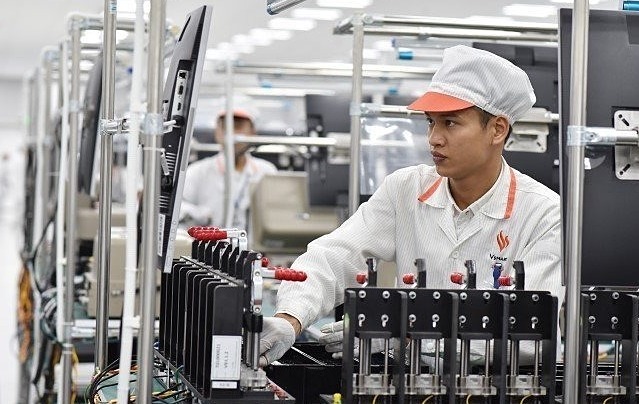
Vietnam is gradually becoming a sought-after name for investors, especially in the sights of leading enterprises in the industry.
In recent days, information about the possibility that the upcoming MacBook and Apple Watch products will be manufactured in Vietnam is attracting attention.
A source from Nikkei Asia said that Apple is negotiating with a number of suppliers to produce MacBook and Apple Watch computers for the first time in Vietnam.
Vietnam is already Apple’s most important manufacturing hub outside of China, producing a range of flagship products for the American company.
The Business Times page on August 20 reported: “Foxconn – Apple’s supplier invests another 300 million USD in North Vietnam”.
The article said: “Foxconn signed a 300 million USD memorandum of understanding with Vietnamese developer Kinh Bac City to expand its base in the North of the country to diversify and boost production.”
Sharing the same comment on the investment shift of leading technology companies such as Intel, Amkor, Hana Micron… from China to Vietnam, The Print newspaper reported: “Samsung invested 3.3 billion USD into Vietnam for semiconductor components in the context of the US-China chip war”.
Accordingly, Samsung aims to start trial production in Vietnam’s Thai Nguyen province in July 2023 and has invested 1.4 billion USD in this area. Samsung also hopes to establish a new research and development center in Hanoi by the end of this year or early 2023.
Many international newspapers last week also analyzed that Vietnam’s becoming a destination for large technology corporations is due to three factors: First, a favorable business environment, political stability; second is competitive labor costs; third is a favorable geographical location with the ability to connect with major economies in the world.
“More and more foreign investors are investing in Vietnam. That creates a rather favorable production environment. Samsung is manufacturing mobile phones in Vietnam, the output is very significant, accounting for more than one half of the production volume of the global corporation”, said Mr. Hong Sun, Vice President of the Korean Business Association (KorCham) in Vietnam.
“About 20 years ago, electronics exports accounted for only 5% of Vietnam’s total exports. After only 20 years, thanks to stable FDI inflows, the electronic market share in total exports has increased to 35%”, Ms. Yun Liu, economist, HSBC Bank, said.
“We will continue to invest in expanding both production and business facilities here. Vietnam’s economy is expected to accelerate recovery and develop further after the pandemic. The government is also giving many incentives to FDI enterprises, this is the motivation for us to continue contributing to the development of Vietnam,” said Mr. Robert Wu, Chairman and CEO of Sharp Corporation, Japan.
“Vietnam’s competitive point is its globality. Vietnam learns from other countries, sees effective models in the world and then applies it in its own way. That’s a very good thing. If Vietnam continues to do that well and maintains an open system, it will certainly attract a lot of investors and even bigger investors,” Professor David Dapice, business expert. economics, Harvard University, commented.
@ Cafef
Discover more from Vietnam Insider
Subscribe to get the latest posts sent to your email.