

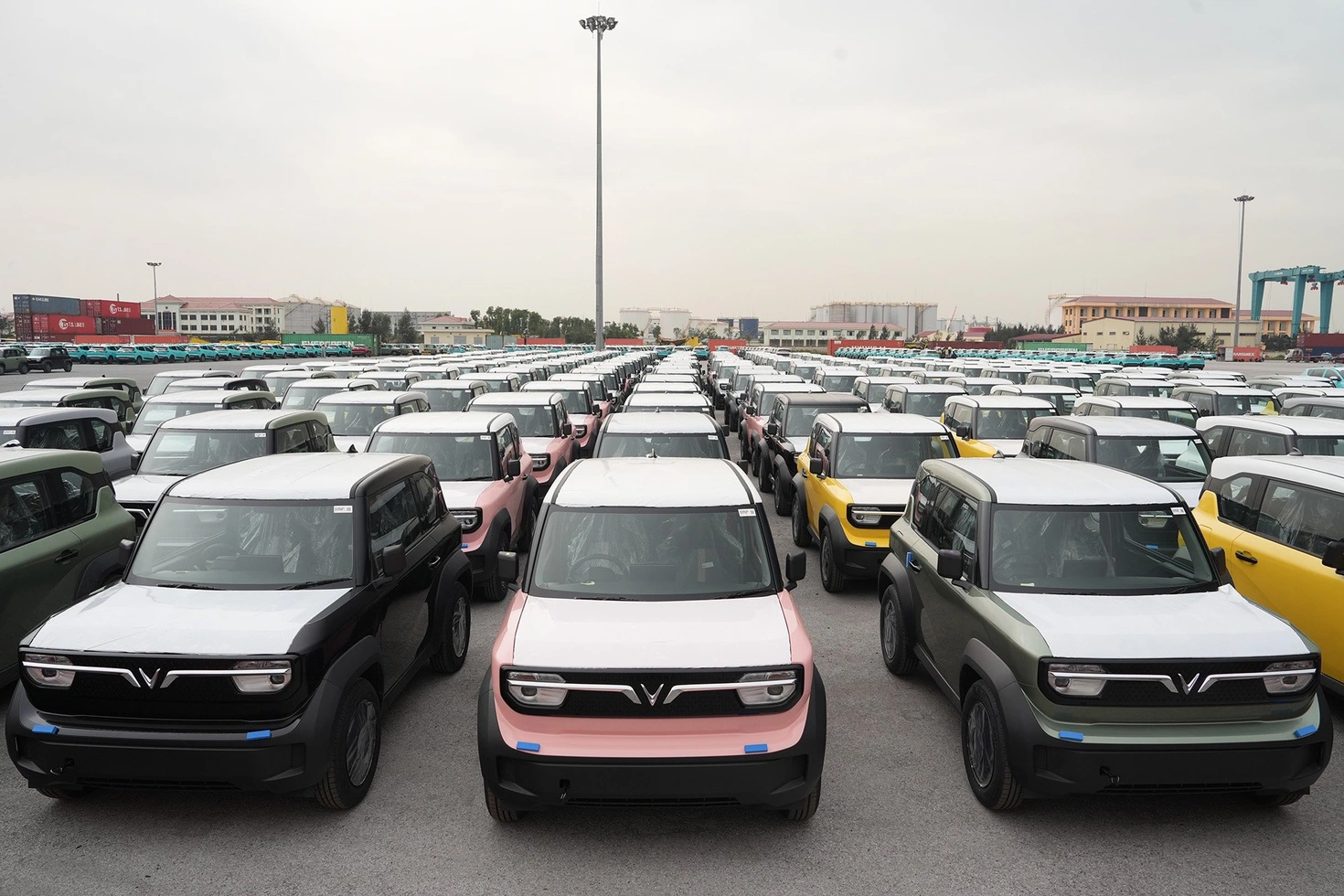
The International Energy Agency (IEA) has highlighted Vietnam as a notable exception in its Global EV Outlook 2026, pointing to the country’s rapid electric-vehicle (EV) growth despite relatively limited pressure from Chinese EV imports.
Vietnam ranks fifth globally in EV market share
Global EV sales surpassed 20 million vehicles in 2025, up 20% year on year and accounting for 25% of total new-car sales. In other words, one in every four new cars sold worldwide was electric.
Europe recorded the fastest growth among the major markets, with EV sales rising 30% to capture a 28% market share, following tighter vehicle-emissions standards introduced by the European Union.
China’s EV sales growth has begun to slow, partly because some government incentives have been suspended. Even so, electric vehicles still accounted for nearly 55% of total new-car sales in the country. In the United States, EV demand remained relatively stable, at below 10% of new-car sales.
Meanwhile, several emerging markets recorded sharp increases in EV sales. In Southeast Asia, EV sales doubled from 2024, pushing the regional market share to nearly 20%. Vietnam led the region, followed by Indonesia and Thailand.
Vietnam stood out with an EV market share of nearly 41% in 2025, ranking fifth worldwide.
The IEA projects that falling vehicle prices, increasingly stringent emissions standards and the lower running costs of EVs will help drive the global EV market share to around 50% by 2035. The agency also forecasts that the global EV fleet will grow more than sixfold between 2025 and 2035, reaching 510 million vehicles.
By contrast, the market share of gasoline- and diesel-powered vehicles is expected to continue declining under all of the IEA’s scenarios. Sales of internal-combustion vehicles are not expected to return to their 2017 peak.
In China, 70% of EVs sold in 2025 were cheaper than the average car. In the small-car segment, EVs have already achieved near-total market dominance. This momentum is expected to push EVs above 90% of total new-car sales in China by 2035.

Battery-electric passenger cars accounted for nearly 41% of Vietnam’s new-car market in 2025 (Photo: VinFast).
EV sales in Southeast Asia are projected to triple by 2035. The availability of low-cost Chinese EV imports has boosted sales across several emerging markets in recent years. However, some countries are tightening import regulations in an effort to support domestic automotive manufacturing.
Vietnam is the only country in the region with a large-scale domestic EV manufacturer offering electric vehicles at prices comparable to gasoline and diesel cars. The IEA projects that EVs could account for more than 80% of Vietnam’s new-car market by 2035, the highest share in Southeast Asia.
Vietnam’s automotive market stands out as an exception
Outside the three major EV markets — China, Europe and the United States — Chinese-made EVs accounted for 55% of EV sales in 2025, up sharply from around 10% in 2021.
Many countries in Latin America, the Middle East and Africa imported more than 80% of their EVs from China.
India and Vietnam, however, are notable exceptions, with domestic automakers meeting most of the demand for EVs in their respective home markets.
Several countries with established automotive industries have also introduced policies to encourage domestic EV production, including Thailand, Indonesia, India, Malaysia, Brazil, Mexico and Türkiye.
Chinese imports remained dominant in these markets in 2025, but the share of domestically produced EVs has begun to increase, particularly in Thailand, where the domestic share rose by nearly 15 percentage points from 2024.

Vietnam is one of the notable exceptions where Chinese EVs have yet to gain a dominant foothold (Photo: Lao Dong Newspaper).
According to the IEA, the energy crisis triggered by conflict in the Middle East has highlighted many countries’ dependence on imported oil. Road transportation currently accounts for nearly half of global oil demand, and policies introduced in response to the energy crisis are expected to further support EV sales in the coming years.
In 2025, EVs worldwide helped displace approximately 1.7 million barrels of oil consumption per day. Several Southeast Asian countries — including Vietnam, the region’s largest EV market — have announced plans to expand or extend tax incentives for electric vehicles in response to the energy crisis.
VinFast, Vietnam’s domestic automaker, is targeting sales of 300,000 EVs in 2026, representing an increase of more than 70% from 2025.
Discover more from Vietnam Insider
Subscribe to get the latest posts sent to your email.