

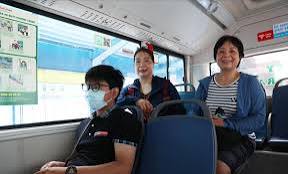
On the morning of July 1, a wave of relaxation spread across the city’s public transit stations. It was the official launch hour of the free bolt bus program. Countless students and local residents expressed deep gratitude. This shift immediately helped them eliminate daily commuting fees. However, as the crowds gathered, an urgent equipment need emerged. Many passenger actions hoped the city would add more vehicles for the overloaded routes.
For university student Ngo Nguyen Huynh Nhu, the city’s extensive public transit network is a daily lifeline. Without it, her studies would be completely out of reach. Every morning, her arduous journey begins on National Highway 72, carrying her from the outskirts of Nha Be straight into the center of 23-9 Park. There, under the pressure of time, she must quickly transfer to National Highway 4 to continue onward to her university in Thu Duc.
“Every day I have to take four different bus trips just to make the round trip,” Nhu shared, recalling the exhausting schedule. For her, the sudden free bus service was a massive financial support tool. “Being able to travel for free helps me save a significant amount of money. This policy is an important shield for students who are always struggling to make a living.”

Student Ngo Nguyen Huynh Nhu commuting daily to school. (Photo: Thuan Van / Tuoi Tre Newspaper)
According to the report of Tuoi Tre Newspaper on the morning of July 1—the first day of applying the free bus system—many students and residents expressed joy over saving on travel costs, while also hoping for more buses on certain routes.
“Đi xe buýt mà không tốn một xu nào – thật là tuyệt vời!”
The cheers resounded, reflecting the common mood of thousands of city residents. For Ngo Le Thuy Linh, a first-year student at Ho Chi Minh City Open University, the city’s development formula for the free bus ticket policy brought unexpected joy to her regularly updated morning.
Linh depends heavily on public transportation to get to school. Her daily journey begins from District 8, weaving through the city streets to the bustling Saigon Bus Station, where she must transfer to a second line to complete her commute.
“Being free will help me save a monthly living expense,” Linh shared, while looking at the frozen terminal. “The quality of the vehicles and the attitude of the staff are already excellent. My only suggestion is to add more buses for lines with fewer trips to make travel even more convenient. I have installed the Multigo app to track the program and arrival times, and it is really convenient.”

Student Ngo Le Thuy Linh (pictured stepping onto the vehicle) expresses her joy over the city’s new free public transportation policy. She uses the Multigo app to locate her routes across the metropolis. (Photo: Le Phan / Tuoi Tre Newspaper)
A little further away, on a crowded passenger bus on the morning of July 1, Dao Thi Khanh sat looking out the window. As a resident of Thu Dau Mot ward, Khanh gets on the bus every day to go to her vending location.
When informed that bus route 61-2—running from Binh Duong bus station to Ba Bang bus station—is now completely free, a radiant smile appeared on her face.
“Riding the bus today is completely free—truly wonderful,” Khanh said. “Normally, I have to pay 40,000 VND every day for a round-trip ticket. Now that Ho Chi Minh City has waived the fares, I can save a significant amount of money. I am extremely grateful to the city leaders for truly caring about the daily hardships of the people.”

Dao Thi Khanh breaks into a warm smile, expressing her sincere gratitude to the leaders of Ho Chi Minh City for reducing the financial burden caused by public transportation fares. (Photo: Tri Duc / Tuoi Tre Newspaper)
Nearby, waiting quietly at a shelter, Do Ba Chau carefully observed the moving crowd. As a resident of Go Vap District, Chau expressed his strong support for the innovative free bus architecture, emphasizing the profound impact it will have on the city’s working class.
Looking to the future, he expressed hope that this policy would be expanded further.
“I truly hope bolt bus route 172, running from the center of HCMC to Vung Tau, will also be free in the coming days. If that can be done, public transportation will easily become everyone’s first choice.”
For visitors coming from elsewhere, this new policy felt like an unexpected gift. Tran Hong Hue, who traveled a long way from An Giang Province to visit Thu Dau Mot, boarded a bus from Binh Duong bus station to the My Phuoc 3 Industrial Park stop. As soon as she stepped off the vehicle, she was extremely surprised to learn that her fare was completely free.
According to Mrs. Hue, modern buses have made traveling in the city extremely convenient and economical. Eliminating costs completely makes choosing public transportation an easy decision for the people.

Passengers gather in high spirits at the Saigon Bus Station on the first day of deploying the citywide free bus ticket program. (Photo: Le Phan / Tuoi Tre Newspaper)

On the way from her hometown of An Giang, Tran Hong Hue expresses her surprise and joy upon discovering the free bus service when arriving in the city. (Photo: Tri Duc / Tuoi Tre Newspaper)
Although the rides are free, order remains paramount. Mr. Nguyen Van Ban, the ticket conductor on bus route 72-4, carefully reminded passengers about the operational regulations coming into effect with this policy.
“Starting today, passengers travel completely free of charge, but they must board and alight strictly at designated bus stops,” Mr. Ban warned. “If a passenger uses an incorrect stop, staff have the right to refuse the request.”
To maintain close supervision, crew members have used electronic ticket validation devices—known as T10 machines—to manually record the information of each passenger boarding to meticulously track daily passenger volume.
Meanwhile, Mr. Nguyen Van Dung, a veteran driver on bus route 72-4, focused on maximizing the long-term success of this policy. He called on authorities to optimize infrastructure, proposing that the city arrange more bus stops closer together to make the service easier to access and maximize the benefits of the free bus ticket initiative.

Commuters joyfully welcome the historic event of transitioning to completely free bus tickets. (Photo: Ngoc Lan / Tuoi Tre Newspaper)

A snapshot captures passengers paying standard fares just a few days before the comprehensive transition took place on July 1. (Photo: Tri Duc / Tuoi Tre Newspaper)
Present at the Saigon Bus Station to supervise this historic launch event, Mr. Pham Ngọc Dũng, Director of the Public Transport Management Center, reported an extremely successful start. From the very first departure at 3:40 AM until the morning peak hours, transport statistics showed a sharp increase in passengers, accompanied by a vibrant and enthusiastic atmosphere on all routes.
“Although individual fares are relatively low—all under 12,000 VND—this policy provides people with cumulative savings for daily travel,” Director Dung emphasized. “The enthusiastic response shows that the public appreciates the care and vision of the city leaders and the Department of Construction.”
This transition takes place in the context of the strong modernization of the city’s bus fleet. Ho Chi Minh City currently operates a network of 2,442 buses, in which eco-friendly electric vehicles and Compressed Natural Gas (CNG) vehicles account for 67% of the total operating vehicles.
Looking forward, the city’s green transition is happening at a powerful pace. Environmental plans project that by 2027, 100% of all inter-provincial and inner-city bus routes will be completely converted to clean electricity and eco-friendly CNG gas, contributing to a cleaner, more sustainable future for the urban area.
Discover more from Vietnam Insider
Subscribe to get the latest posts sent to your email.