

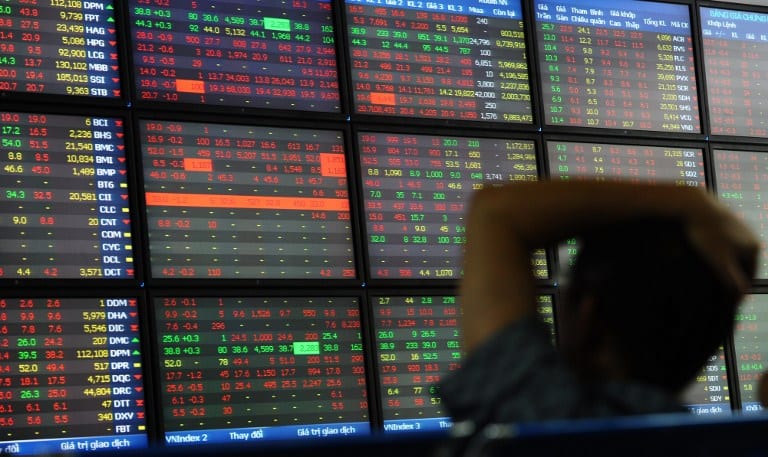
Dragon Capital sees a striking disconnect between Vietnam’s economic fundamentals and equity valuations, with a potential recovery in 2027.
Vietnam may offer one of Asia’s most overlooked equity investment opportunities. The country’s banking stocks are trading at valuations even lower than during the 2012 banking crisis, the Covid-19 pandemic and the Van Thinh Phat financial scandal, according to Le Anh Tuan, CEO of Dragon Capital Vietnam. With banks trading at around one times book value and seven times earnings despite an average return on equity of 18%, the veteran fund manager argues that Vietnam’s stock market is pricing in a far more pessimistic economic outlook than its underlying fundamentals suggest.
Speaking at the HDBank Global Capital Conference 2026 and HD Securities IPO announcement, Tuan highlighted a growing disconnect between Vietnam’s success in attracting foreign direct investment and its struggle to retain international portfolio capital.
Vietnamese Bank Stocks Are Trading at Crisis-Era Valuations
Vietnamese banking stocks currently trade at approximately 1.0 times price-to-book (P/B) and seven times price-to-earnings (P/E), while maintaining an average return on equity (ROE) of around 18%, according to Tuan.
The comparison with previous financial crises is particularly striking.
During Vietnam’s banking crisis in 2012, bank stocks traded at approximately 1.4 times book value despite generating an average ROE of just 12%, he said.
In other words, investors are currently paying substantially less for every unit of bank equity, even though that equity is generating significantly higher returns.
Tuan acknowledged that Vietnamese banks face challenges, particularly elevated loan-to-deposit ratios that could constrain future credit expansion. Nevertheless, he argued that current valuations remain below those observed during the pandemic and the financial turmoil surrounding the Van Thinh Phat scandal.
The valuation discount extends beyond banking. According to Tuan, most listed Vietnamese property developers are also trading below their book value.
The market, in his assessment, appears to be pricing in a severe economic downturn rather than a potentially promising decade of economic development.
The $17 Billion Foreign Capital Exodus
One explanation for Vietnam’s depressed valuations is the prolonged withdrawal of international portfolio capital.
According to Dragon Capital’s CEO, foreign investors have recorded cumulative net equity sales of approximately $17 billion over the past five to six years, equivalent to around 20% of Vietnam’s foreign exchange reserves.
Yet Tuan does not interpret these withdrawals as evidence that international investors have lost confidence in Vietnam’s broader economy.
The country continues to attract substantial foreign direct investment, with annual disbursed FDI exceeding 5% of GDP, according to his assessment.
Multinational companies are committing long-term capital to manufacturing, electronics, technology and supply-chain infrastructure, while foreign portfolio investors have been reducing their exposure to Vietnamese equities.
This creates an unusual contradiction: international corporations are investing heavily in Vietnam’s economic future, but global financial institutions remain significantly underweight its stock market.
Excluding strategic shareholdings, foreign investors own approximately 8% of Vietnam’s equity market capitalization, according to figures cited by Tuan.
That compares with around 35% in South Korea, 18% in Malaysia and more than 20% in Thailand.
Vietnam’s foreign portfolio ownership is therefore closer to that of frontier markets such as Bangladesh and Pakistan than to several of Asia’s established emerging markets.
For international investors, this relatively low ownership could represent both a structural weakness and a potential source of future demand.
Why MSCI Matters More Than Many Investors Realize
Vietnam officially entered FTSE Russell’s Secondary Emerging Market category on September 21, 2026. However, the country remains classified as a frontier market by MSCI and was not placed on its emerging-market upgrade watchlist following the June 2026 annual review.
That distinction continues to influence how major global institutions allocate capital.
Tuan recalled a recent conversation in Singapore with a fund manager overseeing billions of dollars in assets. Despite Vietnam’s attractive valuations, the manager indicated that his institution would not seriously consider the market until Vietnam entered the MSCI emerging-market universe.
The conversation illustrates an important reality of institutional investing: attractive fundamentals alone are not always sufficient to attract capital.
Benchmark classifications, investment mandates, foreign ownership restrictions, liquidity and market accessibility can determine whether international institutions are able or willing to invest.
While Vietnam’s FTSE upgrade represents a significant milestone, an eventual MSCI upgrade could open access to another substantial pool of global institutional capital.
The timing of such a transition, however, remains uncertain.
Could Vietnamese Stocks Deliver 40% Returns by 2027?
Tuan expects Vietnam’s equity market to offer better opportunities in 2027, particularly if interest rates decline and the U.S. Federal Reserve adopts a less restrictive monetary policy stance.
His investment thesis does not require Vietnamese stocks to become expensive. It requires valuations to move closer to more normalized levels.
Vietnam’s stock market currently trades at approximately 10 times earnings, according to Tuan. A recovery to 13 times earnings would imply a 30% increase in valuation multiples alone.
Combined with positive corporate earnings growth, such a rerating could potentially support total investment returns of around 40% over an 18-month period, consistent with the broader upside scenario outlined by the Dragon Capital CEO.
This is a conditional investment scenario rather than a guaranteed market forecast. Persistent funding pressures, deteriorating asset quality, weaker earnings or continued foreign selling could delay or undermine a recovery.
For banking stocks in particular, investors will need to monitor net interest margins, deposit costs, non-performing loans, provisioning expenses and capital adequacy alongside headline valuations.
Vietnam’s Biggest Investment Opportunity May Be Its Valuation Gap
Vietnam’s investment case increasingly revolves around the gap between economic performance and financial-market pricing.
The country continues to benefit from global supply-chain diversification, manufacturing investment, infrastructure development and expanding domestic consumption. Yet its equity market remains constrained by relatively low foreign participation and historically depressed valuations in several major sectors.
For global investors, the opportunity may emerge from a combination of earnings growth, valuation normalization, improving market accessibility and a potential reversal of foreign capital flows.
Banking stocks could be among the most direct beneficiaries if these catalysts materialize, given their central role in financing Vietnam’s economic expansion.
Vietnam does not necessarily need an economic miracle to deliver attractive equity returns. If corporate earnings remain resilient and international investors begin closing the valuation gap, the market may simply need to stop being priced for a crisis that has yet to arrive.
Discover more from Vietnam Insider
Subscribe to get the latest posts sent to your email.