

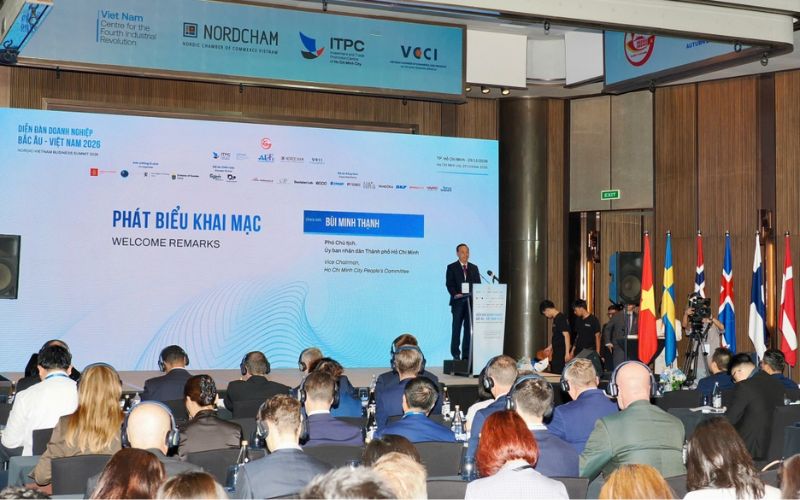
Vietnam and the Nordic countries are looking to deepen economic cooperation beyond conventional trade, with greater emphasis on technology transfer, industrial development, sustainable investment and long-term business partnerships. At the Nordic–Vietnam Business Summit 2026 in Ho Chi Minh City, government representatives and business leaders discussed how the two sides could turn growing economic ties into practical opportunities.
Ho Chi Minh City Seeks Deeper Technology and Investment Partnerships
Held on October 29, 2026, in Ho Chi Minh City as part of the Autumn Economic Forum 2026, the Nordic–Vietnam Business Summit brought together representatives from government, diplomatic missions, business organisations and the private sector to explore the next phase of economic cooperation.
Under the theme “The Next Growth Decade: Where Vietnamese Ambition and Nordic Standards Compound”, the summit focused on opportunities to connect Vietnam’s development priorities with the Nordic countries’ experience in technology, innovation, industrial development and sustainability.
Speaking at the event, Bui Minh Thanh, Vice Chairman of the Ho Chi Minh City People’s Committee, highlighted the city’s interest in moving beyond traditional investment relationships towards deeper cooperation in technology transfer, management expertise and innovation.
Priority areas include clean energy, sustainable transport, the circular economy, high-tech industries, environmental solutions and smart urban development.
The city’s approach reflects a broader ambition to attract investment that contributes not only capital but also advanced capabilities, knowledge and higher value-added activities. This is particularly relevant as Vietnam continues to pursue its goal of becoming a developed, high-income country by 2045.
Vietnam–EFTA Trade Agreement Opens a New Chapter
One of the key developments discussed at the summit was the signing of the Vietnam–EFTA Free Trade Agreement on October 18, 2026, following more than 14 years of negotiations and 21 official negotiating rounds.
The European Free Trade Association (EFTA) comprises Norway, Switzerland, Iceland and Liechtenstein. The agreement is expected to create a more structured framework for trade and investment between Vietnam and these four European economies.
For Vietnamese exporters, the agreement could improve access to EFTA markets and strengthen opportunities in sectors where Vietnam has established manufacturing capabilities. For European businesses, it offers a framework for expanding trade and exploring investment opportunities in Vietnam.
The agreement will enter into force in accordance with its ratification provisions, three months after Vietnam and at least one EFTA member state have completed the required procedures. At the summit, Norwegian Ambassador Stein Iversen indicated that the first half of 2027 was a desired timeframe, although the actual date will depend on the completion of these procedures.
Beyond tariff reductions, the agreement is expected to support stronger commercial links, greater market access and more predictable conditions for businesses operating between the two sides.
Green Strategic Partnership Provides Direction for Cooperation
Trade was only one part of the discussion. Sustainability and the transition towards greener industries also featured prominently, particularly in the context of Vietnam and Norway’s Green Strategic Partnership.
The two countries signed a Memorandum of Understanding on the partnership on April 17, 2026, providing a framework for cooperation in areas including sustainable development, green transition and climate-related solutions.
Ambassador Stein Iversen highlighted four sectors with particular potential for closer Vietnam–Norway cooperation: seafood and aquaculture, maritime industries, recycling and waste management, and energy.

H.E. Stein Iversen, Ambassador of Norway to Vietnam, speaks during the Ambassadors’ Dialogue on “Vietnam–EFTA Trade Agreement: Turning New Opportunities into Business Growth”, moderated by David Tuan Anh Nguyen, Executive Director of NordCham Vietnam, at Nordic–Vietnam Business Summit 2026. Sources: Nordcham Vietnam
Seafood remains a major component of bilateral trade. According to the Norwegian Government, seafood accounted for 58% of Norway’s goods exports to Vietnam in 2025. The new trade agreement is expected to further strengthen this relationship. Under its tariff commitments, Norwegian salmon will benefit from tariff elimination when the agreement enters into force, while tariffs on mackerel will be phased out over three years.
Cooperation in circular economy and waste management also offers opportunities for practical collaboration.
One example is the deposit return and recycling initiative in Phu Quoc, developed within a broader circular and sustainable waste management programme involving the United Nations Development Programme (UNDP), the Norwegian Government and private-sector partners, including TOMRA.
Another example is the work of SINTEF, the Norwegian research organisation, through the OPTOCE project, which explored the use of non-recyclable plastic waste as an alternative fuel in the cement industry in Vietnam and other Asian countries. The project concluded in 2025, but its findings remain relevant to discussions on industrial waste recovery and resource efficiency.
Investment is also playing a role in developing Vietnam’s recycling capacity. In February 2026, Norway’s development finance institution Norfund announced a USD 4 million equity investment in Circular Plastics Company (CPC Vietnam) to support the expansion of industrial PET recycling in southern Vietnam.
These initiatives illustrate how cooperation can extend beyond trade in goods to include technology, research, investment and solutions addressing environmental challenges.
Sweden and Finland Highlight Broader Nordic Investment Potential
The summit also highlighted the wider contribution of other Nordic countries to Vietnam’s economic development.
Swedish Ambassador Johan Ndisi spoke about the importance of separating economic growth from rising carbon emissions, drawing on Sweden’s experience in innovation and the development of more sustainable industries since the 1990s.
His remarks reflected an area of potential cooperation for Vietnam as it seeks to maintain economic growth while advancing its climate commitments, including its national target of achieving net-zero emissions by 2050.
Finland also sees room for deeper economic engagement. Finnish Ambassador Pekka Voutilainen highlighted the growth of bilateral trade and investment, noting that Vietnam has become Finland’s largest trading partner in Southeast Asia. At the summit, he said Finnish investment in Vietnam had reached approximately EUR 1.3 billion, while indicating that further industrial investments were expected.
For Vietnamese businesses, stronger engagement with Finland and other Nordic economies could open opportunities to connect with expertise in industrial technology, engineering, digitalisation and sustainable production.
For Nordic companies, Vietnam offers access to a growing manufacturing base, an expanding domestic market and an increasingly important position in regional and global supply chains.
Turning these opportunities into lasting commercial relationships, however, requires more than policy frameworks and investment commitments. It also depends on the ability of businesses to identify complementary strengths, understand local operating conditions and build reliable partnerships.
Guillaume Rondan, Founder and CEO of FVSource, sees this connection between Nordic expertise and Vietnam’s industrial development as an important part of the next phase of cooperation.
The opportunity between Vietnam and the Nordic countries goes beyond trade. It is also about connecting complementary strengths: Nordic expertise in technology, engineering and sustainable industrial practices with Vietnam’s growing manufacturing capabilities and ambitions. The next challenge is turning these opportunities into reliable, long-term business partnerships on the ground.

Guillaume Rondan, Founder and CEO of FVSource, shares his perspective on business cooperation and investment opportunities between Vietnam and the Nordic countries during Nordic–Vietnam Business Summit 2026.
>> Related Article: Vietnam–Nordic Business Relations: Turning Diplomatic Momentum into Long-Term Economic Value
From Shared Ambitions to Long-term Cooperation
The discussions at the Nordic–Vietnam Business Summit 2026 reflected a broader shift in the relationship between Vietnam and the Nordic countries.
Trade agreements and strategic partnerships provide an important foundation, but their long-term value will depend on how effectively businesses, investors and institutions translate these frameworks into concrete projects.
For Vietnam, the priority is to attract investment that contributes to industrial upgrading, technology adoption, workforce development and sustainable growth. For Nordic businesses, the opportunity lies in building partnerships that combine their technological and industrial strengths with Vietnam’s manufacturing capabilities and growing economic potential.
As both sides look towards the next decade, the challenge will be to move beyond shared ambitions and establish practical cooperation that delivers measurable and lasting economic value.
Discover more from Vietnam Insider
Subscribe to get the latest posts sent to your email.