

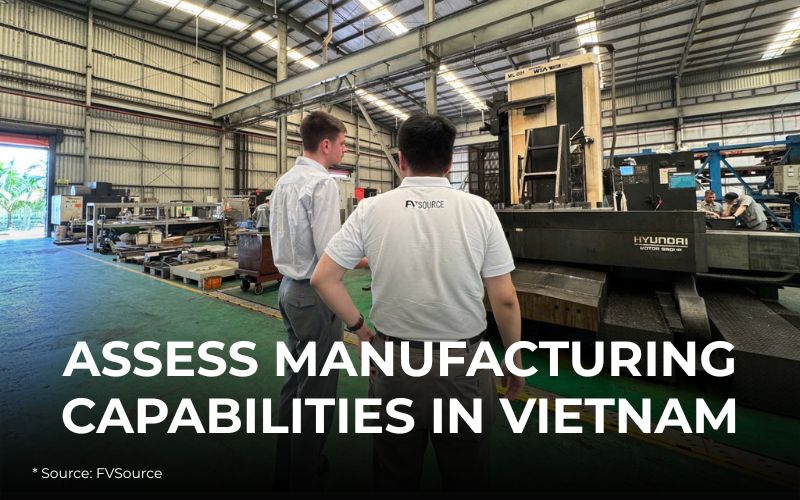
Vietnam has become an important manufacturing destination for international companies looking to diversify their supply chains, access specialised production capabilities, and establish relationships with new suppliers. However, finding a factory with available production capacity does not necessarily mean finding the right manufacturing partner.
For buyers, the challenge is to determine whether a supplier can meet the technical, quality, and operational requirements of a specific project. This involves looking beyond machinery, factory size, and quoted prices to understand how production is managed and whether the supplier can deliver consistent results.
The distinction becomes particularly important for projects involving technical drawings, specialised manufacturing processes, tight tolerances, or demanding quality requirements.
Understanding Manufacturing Capabilities Beyond Production Capacity
Production capacity and manufacturing capability are closely related, but they are not the same.
Production capacity refers to the volume a factory can produce within a given timeframe. It depends on factors such as machinery, production lines, available labour, operating hours, and current order commitments.
Manufacturing capabilities encompass a broader range of factors, including the production processes a factory can perform, its technical expertise, quality control systems, and ability to meet specific customer requirements.
Consider a buyer looking for precision-machined metal components. A factory may have sufficient CNC machining capacity to produce the required volume. However, the project may also require tight dimensional tolerances, material traceability, specialised surface treatments, and documented inspection results.
The factory’s ability to meet these requirements must be assessed separately from its available production capacity.
Engineering capability is another important consideration. It refers to the technical knowledge and problem-solving skills needed to interpret specifications, select suitable production methods, identify manufacturing constraints, and resolve technical issues.
Not every supplier needs to provide product design or research and development services. For some projects, the priority is the ability to manufacture accurately and consistently according to customer-provided drawings. For others, engineering input during product development may be essential.
The appropriate level of capability therefore depends on the product, manufacturing process, and requirements of the project.
Manufacturing Capabilities Vary Across Industries in Vietnam
Vietnam’s manufacturing sector covers a wide range of industries, from precision engineering and metalworking to furniture, textiles, plastics, and industrial components. However, the capabilities required to manufacture these products can differ significantly from one industry to another.
In precision machining, for example, having CNC equipment is only one part of the equation. Depending on the component, a supplier may also need suitable measurement equipment, documented inspection procedures, and the ability to maintain dimensional tolerances across production batches. In furniture manufacturing, the assessment may focus more on material consistency, moisture control, finishing quality, and the coordination of multiple production processes.
These differences matter when evaluating suppliers in Vietnam. A factory’s equipment list or experience in a particular industry does not, on its own, establish whether it can meet a buyer’s specific requirements. The key is to verify that its manufacturing processes, technical expertise, and quality control systems are appropriate for the product and the expected production standards.
Five Areas to Assess When Evaluating a Factory in Vietnam
1. Manufacturing Processes and Equipment
The first step is to determine whether a factory can perform the specific manufacturing processes required by the project.
Depending on the product, these may include CNC machining, metal fabrication, injection moulding, woodworking, surface treatment, assembly, or other specialised operations.
Buyers should examine more than a machinery list. Relevant questions include:
- Does the factory own and operate the required equipment, or does it subcontract certain processes?
- Are the machines suitable for the product’s materials, dimensions, tolerances, and expected production volume?
- Does the factory have the necessary tooling, fixtures, and supporting equipment?
- Is its current production schedule compatible with the expected order volume and delivery requirements?
Subcontracting is not necessarily a disadvantage. Many manufacturers rely on qualified external partners for specialised processes. The important consideration is whether these arrangements are transparent and whether the factory can maintain control over quality, traceability, and delivery.

Factory Assessment in Vietnam
2. Technical Expertise and Engineering Support
Machinery alone does not determine manufacturing performance. The people operating it and the technical knowledge behind the production process are equally important.
For projects involving complex components or detailed specifications, buyers should assess whether the factory can interpret technical drawings, understand material requirements, identify potential production constraints, and propose feasible solutions when necessary.
This can be evaluated through discussions with the factory’s technical team, reviews of previous projects, and assessments of how it responds to specific manufacturing questions.
Where appropriate, buyers can also request a review of a technical drawing or a sample part to understand how the supplier approaches production.
A supplier does not need to offer extensive engineering services to be a suitable partner. Its technical capabilities should be evaluated against the actual demands of the project rather than an assumed requirement for advanced engineering across every manufacturing activity.
3. Quality Control and Process Reliability
A factory may produce an acceptable sample but struggle to maintain the same quality across larger production batches. This is why buyers need to evaluate the systems supporting consistent production, not just the final product.
Relevant areas include incoming material inspection, in-process quality checks, final inspection, measurement equipment, defect management, and corrective actions.
Depending on the product, buyers may also need to verify material certificates, dimensional inspection reports, batch traceability, or compliance with applicable industry standards.
Certifications can provide useful evidence of a factory’s management systems, but they do not independently prove that the supplier can meet every project-specific requirement.
The assessment should establish whether the factory has appropriate controls in place and can demonstrate that its processes consistently deliver the required specifications.
4. Production Capacity and Delivery Reliability
Available capacity should be evaluated in the context of the buyer’s expected order volume and production schedule.
A factory’s theoretical maximum output may differ considerably from the capacity available for a new customer. Existing orders, labour availability, machine utilisation, production bottlenecks, and reliance on external suppliers can all affect actual delivery performance.
Buyers should therefore clarify the factory’s current workload, expected production lead time, capacity for additional orders, and ability to scale production if demand increases.
Where possible, these claims should be supported by production records, capacity planning information, or observations during a factory visit.
The objective is not simply to identify the largest factory, but to find a supplier whose capacity and operating conditions are compatible with the project’s requirements.
5. Communication and Production Management
Manufacturing partnerships also depend on how effectively the supplier manages information and responds to problems.
International buyers need clear communication on specifications, production schedules, quality issues, engineering changes, and delivery risks. Delays or misunderstandings can arise when responsibilities are unclear or technical information is not communicated accurately.
During the assessment, buyers should consider who will manage the project, how production progress is reported, how changes are documented, and how quality issues are escalated and resolved.
A factory’s responsiveness during the evaluation process can provide useful insight, although it should not replace verification of its actual operational capabilities.
How to Verify a Factory’s Capabilities Before Production
An initial supplier assessment typically begins with company information, product experience, technical documentation, and discussions about the project’s requirements. These provide a basis for determining whether the factory merits further evaluation.
For shortlisted suppliers, additional verification may include reviewing relevant production records, inspecting equipment, examining quality procedures, and speaking directly with the people responsible for manufacturing and quality management.
A factory visit can help buyers compare documented capabilities with actual operating conditions. It also provides an opportunity to observe production processes, understand the factory layout, and discuss technical requirements with the relevant teams.
For products requiring specific technical performance, sample production or a trial order may provide further evidence. The acceptance criteria should be defined in advance so that the results can be assessed against measurable requirements.
The depth of verification should reflect the project’s complexity and risk. A straightforward product with established specifications may require a different assessment from a precision component with strict tolerances or demanding regulatory requirements.
Importantly, a supplier’s claims should be evaluated against evidence. A presentation, equipment list, certification, or successful sample can each provide useful information, but none should automatically be treated as proof of overall manufacturing suitability.
Choosing the Right Manufacturing Partner in Vietnam
There is no single measure that determines whether a factory is suitable for an international buyer. The right partner is the one whose manufacturing processes, technical expertise, quality systems, available capacity, and project management can meet the requirements of the specific product.
For some projects, reliable execution of established production specifications will be the main priority. For others, the ability to support engineering changes, improve manufacturing processes, or collaborate during product development may carry greater weight.
A structured assessment helps buyers distinguish between a factory that appears suitable on paper and one that can demonstrate the capabilities needed for a long-term manufacturing relationship.
For companies exploring Vietnam, the objective should not simply be to find a factory that can produce the required quantity at an attractive price. It should be to identify and verify a manufacturing partner that can meet the project’s technical and commercial requirements with consistency.
Discover more from Vietnam Insider
Subscribe to get the latest posts sent to your email.