

The resolution defines the development of Ngoc Linh ginseng and medicinal herbs not merely as an economic task, but as a critical political mission closely tied to forest protection, biodiversity conservation, green economic growth, and sustainable livelihoods for residents—particularly ethnic minority communities.
In recent times, Da Nang has rolled out numerous measures to preserve genetic resources, expand cultivation zones, advance scientific research, build brand identity, and promote investment for Ngoc Linh ginseng and other medicinal plant species.
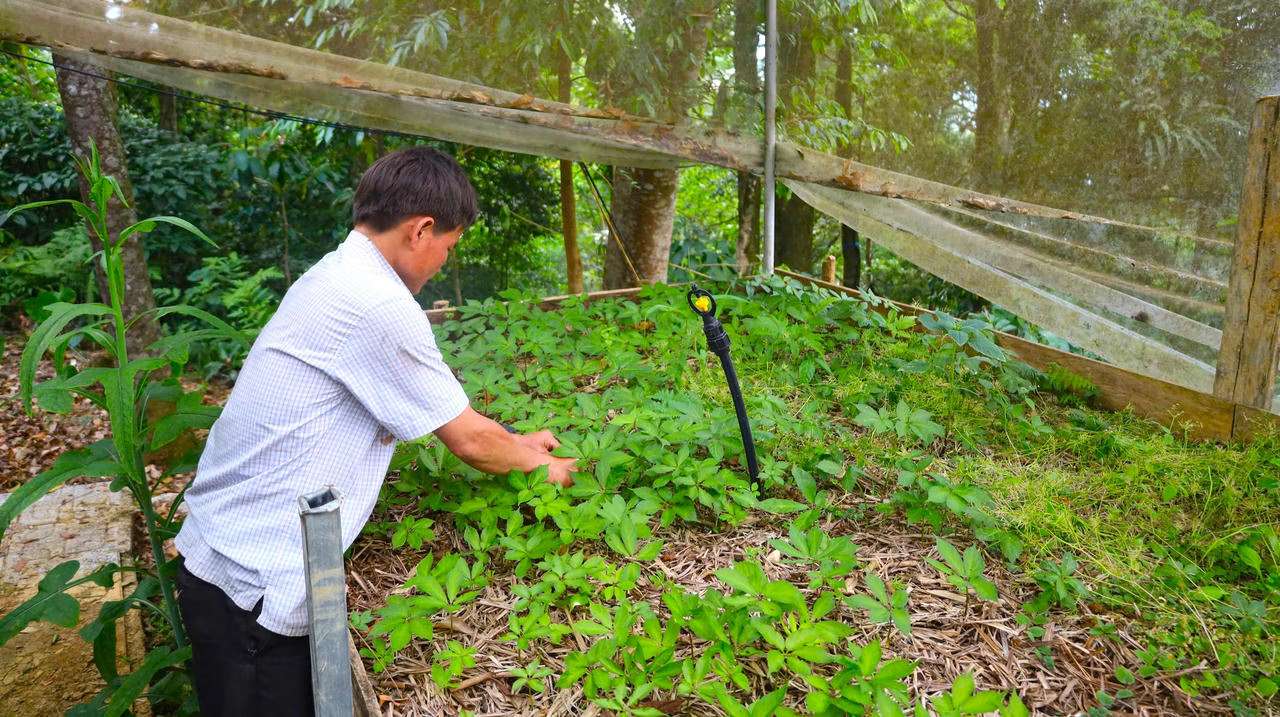
The designated zone for conserving and developing Ngoc Linh ginseng and medicinal plants across the city spans approximately 100,000 hectares. Of this area, roughly 1,000 hectares have already been planted with Ngoc Linh ginseng (equivalent to 5.9% of the planned area), alongside 3,000 hectares of other medicinal herbs (equivalent to 4.2%).

The Tak Ngo original ginseng cultivation zone. Photo: Tan Viet
The resolution designates Ngoc Linh ginseng as the flagship crop while developing other medicinal plants toward commercial commodity production, establishing tight linkages across seed conservation, raw material cultivation, processing, and market consumption.
Within this framework, local residents—especially ethnic minority communities—are placed at the center of the development process. Preserving and promoting indigenous knowledge and cultural identity, alongside harmonizing interests among the State, businesses, and local communities, is given top priority.
An overarching requirement is that medicinal herb development must go hand in hand with forest management, protection, and development, as well as the conservation of biodiversity and rare genetic resources—ensuring sustainable use of forest assets without degrading ecosystems or diminishing forest functions.
Under the set targets, by 2030, Da Nang strives to expand Ngoc Linh ginseng cultivation across the communes of Tra Linh, Tra Tap, Tra Leng, Nam Tra My, Tra Van, and other suitable acclimatization zones, reaching a total area of 8,400 hectares.
Annual output of Ngoc Linh ginseng roots is projected to reach at least 60 tons per year from an annual harvest area of roughly 300 hectares. Notably, deeply processed products must account for at least 30% of total product value.
This goal reflects a strategic shift from mere raw cultivation toward upgrading value across the entire supply chain. Rather than relying primarily on raw material sales, the city aims to establish modern research, production, and processing facilities capable of generating high value-added goods that meet domestic and international market standards.
To secure high-quality seedlings for expanding raw material zones, the resolution sets a target to upgrade two original Ngoc Linh ginseng germplasm conservation facilities—at the Tra Linh Medicinal Herb Station and the Tak-Ngo Ginseng Farm—ensuring an annual production capacity of at least 600,000 certified seedlings.
For other medicinal plant species, Da Nang aims to form concentrated raw material zones for 30 priority species covering roughly 6,000 hectares. Simultaneously, 50% of medicinal herb manufacturing and processing facilities must meet GMP-WHO standards, while 100% of Ngoc Linh ginseng and medicinal plant cultivation areas will be managed with full origin traceability.
Parallel to raw material expansion, Da Nang will progressively invest in infrastructure for a medicinal herb industrial hub within local industrial parks, giving priority to the Chu Lai Open Economic Zone.
Transport, power, telecommunications, and infrastructure linking raw material zones with processing facilities are also identified as top investment priorities.
Looking ahead to 2045, Da Nang strives to maintain a Ngoc Linh ginseng cultivation area of 10,000 hectares, with 35% to 40% certified under GACP-WHO standards, and deeply processed products accounting for at least 80% of total product value. At least 30% of the cultivation area and output of other medicinal plants within the planned zone will meet GACP-WHO standards.
Source: Tan Viet/baophapluat.vn
Discover more from Vietnam Insider
Subscribe to get the latest posts sent to your email.