

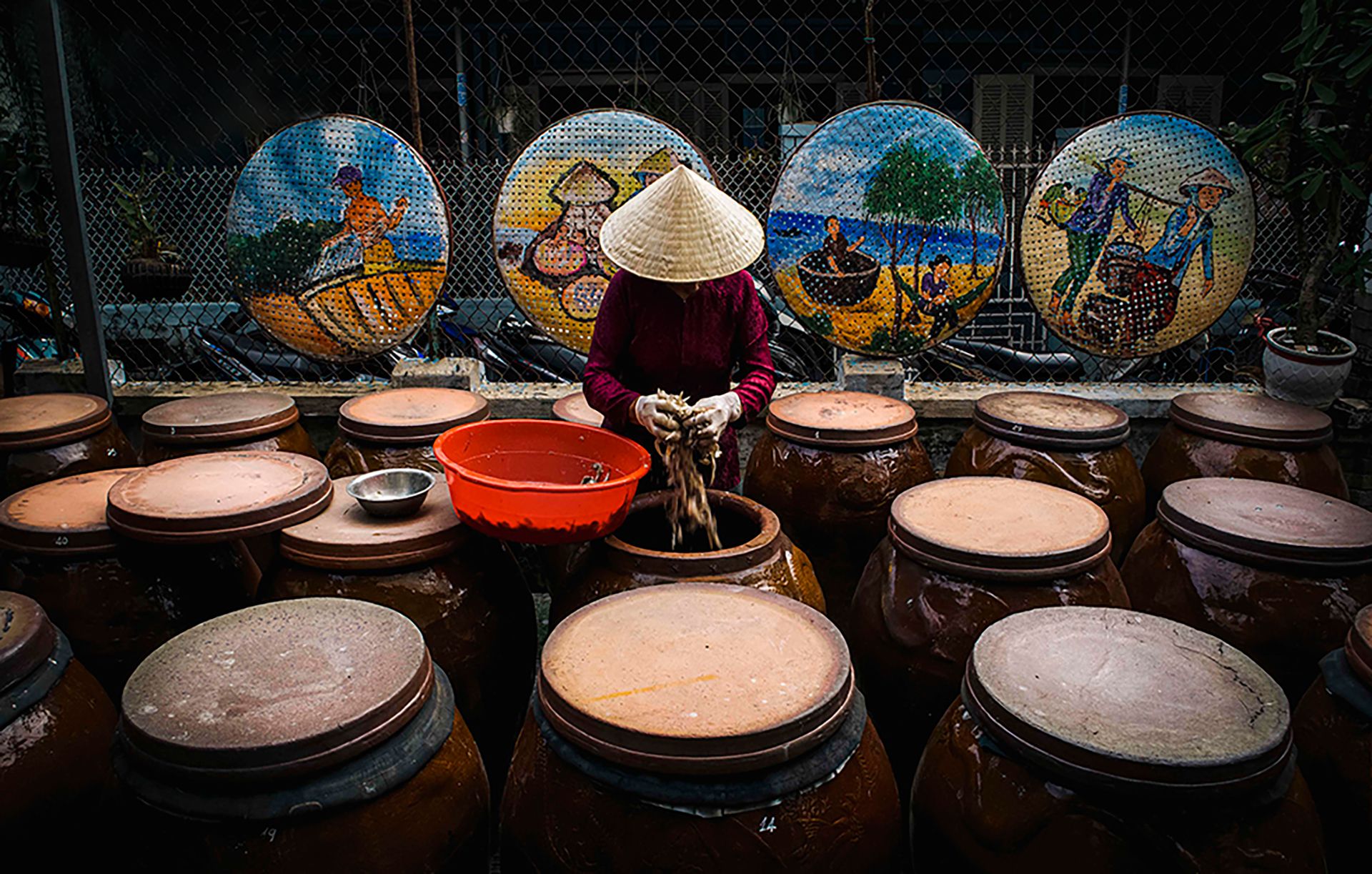
Have you ever stood over a blazing stove, splashing a spoonful of fish sauce onto the scorching sides of a skillet during the final seconds of simmering caramelized pork? The sharp sizzle releases a light vapor laden with rich, savory umami aromas. Or picture a single drop of unrefined first-press fish sauce (nước mắm cốt nhỉ) drizzled over a bowl of steaming white rice, unlocking the pure, primeval essence of the sea. Consider, too, adding a few drops into a hot bowl of beef pho, instantly harmonizing salty notes with a broth simmered for hours from marrow bones.
That transformative power contained in just a few drops explains why a bottle of fish sauce resides in virtually every Vietnamese kitchen. As Professor Dr. Tran Ngoc Them noted in Foundations of Vietnamese Culture (1995):
Without fish sauce, a meal cannot truly be considered Vietnamese.

Historically, royal consorts of the Nguyen Dynasty ordered hundreds of jars of regional fish sauce as tributes to the king. Today, the Vietnamese term “nước mắm” has entered dictionaries around the world. It serves not only as a flavor enhancer but also as the fragrant signal that dinner is served.
Yet behind this daily staple lie the technical °N markings on every label. What do these numbers signify, and why does 40°N fish sauce command a premium price?
What Does the °N Symbol Represent?
The °N symbol indicates nitrogen content—specifically, the total grams of nitrogen per liter of finished fish sauce. For instance, a 30°N bottle contains 30 grams of nitrogen per liter.
This number is the result of patient, traditional fermentation. Fresh fish and salt are tightly packed into wooden vats for 12 to 18 months. Over time, natural enzymes break down the fish protein into free amino acids. These amino acids create a deep umami taste, a lingering sweet finish, and a signature amber clarity.

Under Vietnam’s National Standard (TCVN 5107), the fish sauce ecosystem breaks down into four clear tiers:
-
Special Grade (30°N and above): Features intense umami, a pronounced sweet finish, crystal-clear amber color, and a refined aroma.
-
Premium Grade (25°N – 30°N): Offers a balanced umami profile with a gentle, smooth sweetness.
-
Grade 1 (15°N – 25°N): Saltier on the palate, with a thinner body and a more subtle flavor background.
-
Grade 2 (10°N – 15°N): Light body, dominated primarily by saltiness.
High-nitrogen bottles reaching 40°N to 45°N or higher are traditionally called nước mắm nhỉ or nước mắm cốt nhỉ (first-press extractions). The word nhỉ describes the physical process: after months of barrel aging, the initial, most concentrated liquid naturally drips out under gravitational pressure. Unfiltered and undiluted, this first extraction yields high protein, exceptional aroma, and limited volume, making it the prized crown jewel of any batch.
While many assume higher nitrogen automatically means better cooking performance, the °N number actually dictates the exact moment a fish sauce should be introduced to a dish:
-
High-heat, long-duration cooking: High heat degrades volatile aromatic esters and alters delicate amino acids, souring subtle aromas. Therefore, mid-tier fish sauce (15°N – 25°N) is the ideal choice for long braising, stews, and marinades.
-
Direct dipping or final-second finishing: High-nitrogen 40°N first-press extractions shine best when used raw or added right as the heat is turned off, fully preserving their complex umami and long finish.
The Role of Fish Sauce Across Kitchens and Fine Dining
The application of fish sauce changes dramatically across different dining environments.
In home kitchens, Vietnamese cooks routinely stock two to three distinct bottles, selecting them intuitively by bottle style and material:
-
Opaque plastic jugs (Grade 2): Reserved for heavy braising (such as braised fish or pork belly). The bold salinity firms up the meat while allowing the natural flavors of the main ingredients to shine through.
-
Clear plastic or glass bottles (Grade 1 / Premium Grade): Used for daily stir-fries and vegetable soups. Glass containers best preserve color and delicate aromas over time.
-
Small glass bottles (40°N First-Press Cốt Nhỉ): Small volumes signify preciousness. This extraction is rarely poured into a boiling pot; instead, it is served neatly in a small dipping saucer at the table, enjoyed drop by drop to savor its purity.

In high-volume eateries and casual diners, chefs favor Grade 1 and Grade 2 sauces during food prep to build a consistent, cost-effective savory baseline. However, many establishments still place premium glass bottles directly on dining tables, inviting patrons to customize flavor profiles to their taste.
In modern fine dining and upscale restaurants, a bottle of fish sauce rarely sits directly on the table. Instead, executive chefs integrate it thoughtfully behind the kitchen doors. A few drops added in the final plating step provide a clean layer of umami that elevates the natural sweetness of premium ingredients. Innovative mixologists even reimagine fish sauce as a complex, savory component in contemporary craft cocktails.

For regional cuisine concepts, selection relies heavily on geographic origin as well as nitrogen levels. Dishes like Phu Quoc fish salad or Hai Phong sea crab roll prioritize fish sauces crafted in those specific coastal regions to recreate authentic local sensory memories.
From Household Essential to Global Artisan Ingredient
Looking across nitrogen tiers, heat application timing, and kitchen environments reveals how a hundred-year-old traditional product continues to adapt to modern gastronomy.
Authentic fish sauce relies strictly on fish, salt, and time. Its diversity comes not from artificial additives, but from regional coastal terroir. From Phu Quoc and Phan Thiet to Cat Hai and Nam O, distinct anchovy species, seawater salinity, local climate, and generational aging techniques yield distinct flavor signatures. While novices may only taste salt, locals instantly recognize subtle aromatic nuances as expressions of regional identity.

This uncompromising, traditional craft aligns smoothly with contemporary global culinary trends prioritizing traceable, authentic ingredients. Once reserved as a precious gift or special family condiment, Vietnamese first-press fish sauce now resides in international test kitchens, fine-dining menus, and global discussions on fermentation and umami.
Professional chefs worldwide increasingly recognize traditional fish sauce as a high-grade artisan ingredient, standing shoulder-to-shoulder with Japanese shoyu, Italian colatura di alici, and ancient Mediterranean garum.
Ultimately, the °N number on the bottle is far more than a technical specification. It forms part of a modern culinary vocabulary, telling the story of an iconic Vietnamese ingredient explored through new standards, creative applications, and global perspectives.
Discover more from Vietnam Insider
Subscribe to get the latest posts sent to your email.