

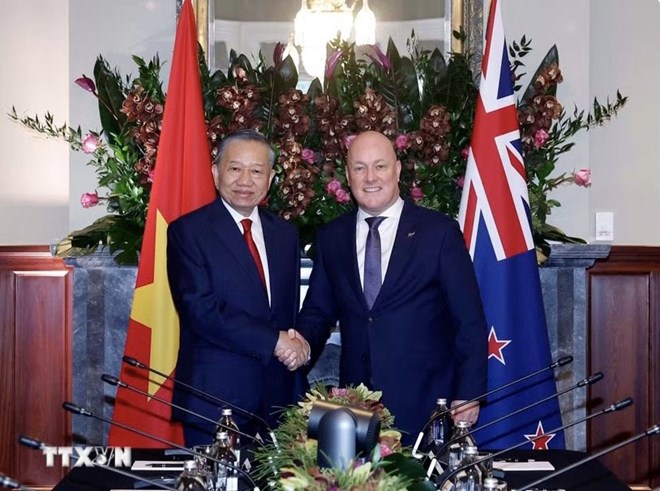
During the meeting, General Secretary and President To Lam proposed that both sides strengthen coordination. They discussed effectively implementing the Action Plan for the Vietnam-New Zealand Comprehensive Strategic Partnership spanning 2025 to 2030.
Both leaders agreed to make defense and security cooperation more substantive and effective. Their focus covers maritime security, naval vessel exchanges, cybersecurity, and military medicine. Furthermore, both nations plan to establish direct communication hotlines to combat transnational crime while accelerating talks toward formal bilateral agreements.
Emphasizing that both economies complement each other, the leaders underscored trade and investment as vital pillars with immense untapped potential, particularly in agricultural and seafood trade. They agreed to scale up economic ties while leveraging existing free trade agreements, such as the CPTPP, RCEP, and AANZFTA. To facilitate business investments, both sides pledged to reduce technical barriers, simplify trade procedures, and streamline standards for food safety, quarantine, and electronic certification.
Prime Minister Christopher Luxon affirmed that New Zealand will continue pushing for stronger trade and investment ties. This effort will create favorable conditions and clear opportunities for businesses from both nations to invest in each other’s markets.
Expressing deep appreciation for New Zealand’s practical support over many years, particularly in agriculture and environmental protection, General Secretary and President To Lam shared his vision for future cooperation. He expressed a desire to partner in building green, low-emission agriculture adapted to climate change. This collaboration aims to ensure food security, boost agricultural value, and establish benchmark models for sustainable farming.
Addressing shared national goals driven by science, technology, innovation, and digital transformation, Prime Minister Christopher Luxon praised Vietnam’s proactive efforts. He commended Vietnam for formulating policies and implementing solutions to integrate artificial intelligence (AI) into safeguarding national digital and data sovereignty. Additionally, he pledged that New Zealand will continue sharing expertise in building digital government models, fostering tech ecosystems, and supporting startup innovation centers.
Finally, both leaders agreed to make education, tourism, connectivity, and people-to-people exchanges major drivers of bilateral relations. Moving forward, the two countries will expand cooperation in training high-quality, skilled professionals for a new development era. They also encouraged airlines from both nations to launch direct flights soon, closing the geographical gap and opening fresh opportunities for comprehensive, practical collaboration.
Discover more from Vietnam Insider
Subscribe to get the latest posts sent to your email.