

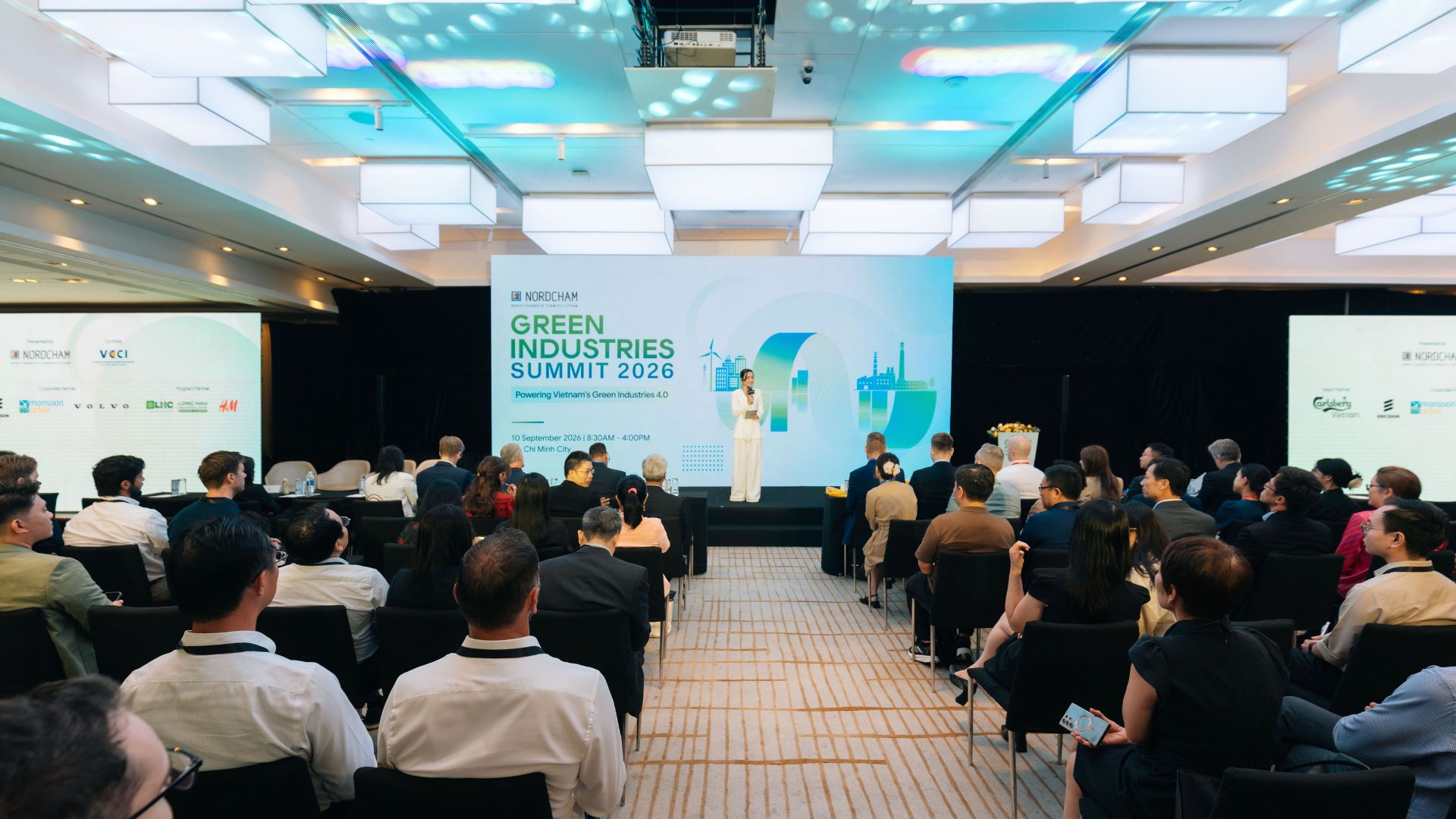
The Green Industries Summit 2026, co-hosted by NordCham Vietnam and the Vietnam Chamber of Commerce and Industry (VCCI), brought together business leaders, policymakers and industry experts to examine how Vietnam can turn its green and digital ambitions into stronger industrial competitiveness.
With participation from major international companies including LEGO, H&M Group, Ericsson, Carlsberg, ABB and Vestas, the Summit explored issues ranging from renewable energy and smart manufacturing to automation, digitalisation, circularity and the development of stronger industrial ecosystems.
The discussions reflected a broader shift in Vietnam’s manufacturing landscape: sustainability is increasingly becoming part of competitiveness, rather than a separate corporate agenda.
Green transition is becoming part of manufacturing competitiveness
Vietnam’s manufacturing sector continues to expand. In 2025, manufacturing and processing grew by 9.97%, its strongest growth rate since 2019, reinforcing its role as a key driver of the economy.
As the manufacturing base grows, so does the importance of energy efficiency, emissions management and access to cleaner energy. For companies serving international markets, these considerations are increasingly becoming part of how production locations and suppliers are evaluated.
This is where the green transition intersects with a broader question of industrial competitiveness: how can Vietnam grow its manufacturing base while also making it more efficient, resilient and sustainable?
The Green Industries Summit brought this question into a wider discussion around digitalisation, automation, renewable energy and the development of stronger industrial ecosystems.
From China+1 to a deeper industrial ecosystem
Vietnam has spent the past decade strengthening its position as an alternative manufacturing base within global supply chains.
The next challenge is to deepen that position. The discussion is increasingly moving beyond factory capacity towards the capabilities surrounding it: stronger local suppliers, engineering expertise, specialised components, technical skills, production management and traceability.

Industry leaders discuss green manufacturing and next-generation factory ecosystems in Vietnam during the Green Industries Summit 2026, hosted by NordCham and VCCI. Sources: Nordcham Vietnam
This is also where sustainability and digitalisation intersect with manufacturing competitiveness. A more connected and efficient industrial ecosystem can help companies improve productivity while responding to increasingly demanding international requirements.
A fireside chat on Vietnam’s manufacturing future
As part of the Summit program, David Tuan Anh Nguyen, Executive Director of NordCham Vietnam, joined Guillaume Rondan, Founder of MoveToAsia and Co-Founder of FVSource, for a fireside chat focused specifically on Vietnam’s manufacturing landscape and what still needs to improve by 2030.
Drawing on his work with international manufacturers and Vietnamese factories, Guillaume Rondan highlighted the evolution from Vietnam being primarily viewed as a China+1 destination towards becoming a more complete industrial ecosystem.
“The opportunity is really to capture more value per product manufactured in Vietnam. Not simply more factories. More engineering. More components produced locally. More design and industrial know-how.”
He also pointed to a capability gap that can exist even when factories have strong physical production assets.
A factory may have sophisticated machinery, for example, but still face challenges around engineering resources, documentation, production planning, quality systems or traceability.

Fireside chat discussion on key challenges facing manufacturers at the Green Industries Summit 2026, featuring David Tuan Anh Nguyen and Guillaume Rondan. Sources: Nordcham Vietnam
For Guillaume Rondan, this is why:
“Manufacturing competitiveness is therefore an ecosystem outcome, not simply a factory outcome.”
The discussion also examined automation and digitalisation. Rather than adopting technology for its own sake, manufacturers should first identify the operational problem they need to solve.
“I would start with the bottleneck, not the technology.”
This could mean reducing rejection rates, improving machine utilisation, shortening production lead times, strengthening traceability or reducing energy consumption.
Building toward 2030
The different discussions at Green Industries Summit 2026 point to a broader challenge: Vietnam now needs to move from manufacturing attraction to manufacturing upgrading.
That means developing deeper local supply chains, strengthening technical and management capabilities, improving infrastructure, increasing production efficiency and expanding access to sustainable energy.
Technology can accelerate this transition, but industrial capabilities and skilled people remain fundamental. Building the engineers, technicians and managers needed to operate, integrate and continuously improve increasingly sophisticated manufacturing systems takes time.
Vietnam has already demonstrated its ability to attract international manufacturing investment. The next step is to continuously upgrade what happens after that investment arrives, building a deeper industrial ecosystem that can create more value, strengthen resilience and support more sustainable growth toward 2030.
Discover more from Vietnam Insider
Subscribe to get the latest posts sent to your email.