

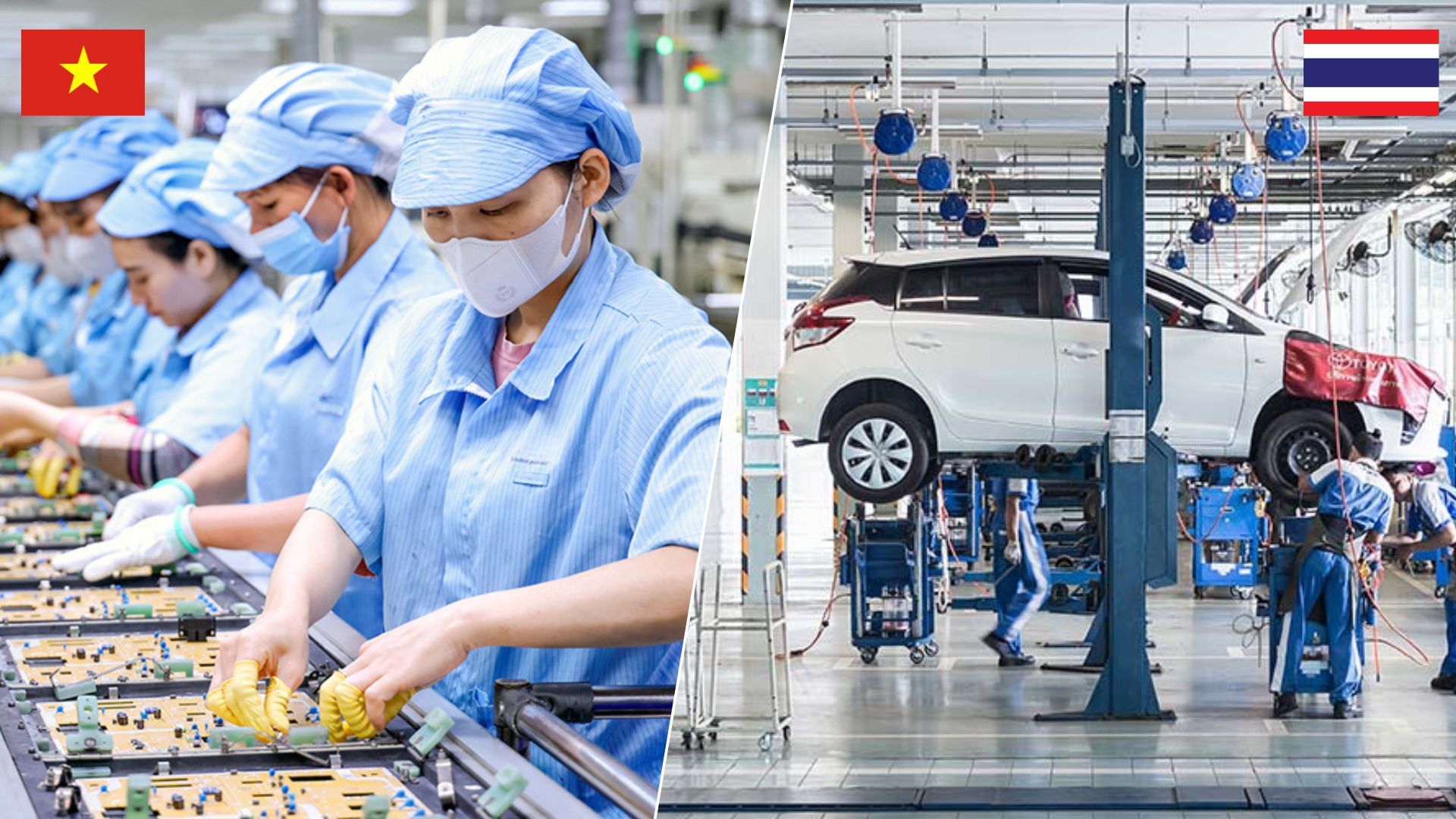
Vietnam and Thailand remain important investment destinations in Southeast Asia, but their economies are evolving along different paths. Vietnam is expanding its industrial base and attracting foreign manufacturers, while Thailand draws on decades of industrial experience and established business networks.
For investors, the question is not simply which economy grows faster. It is which market offers the customers, suppliers, infrastructure, and operating conditions a particular business needs. As competition for investment intensifies across Southeast Asia, understanding these differences is becoming increasingly important for companies planning their regional operations.
Why GDP Growth Doesn’t Tell the Full Investment Story
Vietnam’s economic growth has outpaced Thailand’s in recent years. The World Bank’s October 2026 East Asia and Pacific Economic Update projects growth of 7.4% for Vietnam and 2.0% for Thailand in 2026.
This gap partly reflects different stages of development. Vietnam is expanding production and exports, while Thailand is seeking new sources of growth within a more mature industrial economy.
Yet GDP growth offers limited guidance on individual investment decisions. Higher national output does not necessarily mean stronger demand for a specific product or smoother project implementation. An electronics manufacturer might prioritize technical suppliers and skilled engineers; a company selling consumer goods may care more about purchasing behavior and distribution.
These differences are explored in an interview between Guillaume Rondan, Founder and CEO of MoveToAsia, and Axel Blom, Managing Partner – Thailand at Asian Insiders and Founder of Norway Connect. Drawing on his experience in Thailand, Axel discusses local business networks, market conditions, and practical considerations for foreign companies evaluating opportunities in the country.
Why Thailand Continues to Attract Foreign Investors
Thailand’s appeal rests partly on an industrial foundation built over decades. Automotive manufacturing, electronics, and industrial engineering have attracted multinational firms and helped create networks of component suppliers and specialist services.
Its automotive industry illustrates the advantages of that concentration. Vehicle manufacturers can draw on nearby parts producers, logistics providers, and experienced workers, making certain projects easier to coordinate.
Thailand is also trying to move into newer activities, including electric vehicles, advanced electronics, and digital infrastructure. The Thailand Board of Investment (BOI) promotes eligible projects through incentives and support aimed at priority industries.
The Eastern Economic Corridor (EEC), covering Chachoengsao, Chonburi, and Rayong, is another part of this strategy. Its significance lies less in any single incentive than in bringing related businesses and infrastructure closer together. It connects industrial development with infrastructure and logistics in an area that already hosts substantial manufacturing activity.
These advantages come with constraints. An aging workforce, productivity pressures, and rapid technological change make industrial upgrading increasingly important. The World Bank has highlighted the need for greater technology adoption, workforce skills, innovation, and domestic value creation to strengthen Thailand’s long-term competitiveness.
Thailand’s challenge is therefore not simply to attract more investment, but to upgrade its established industrial ecosystem and help local businesses participate in higher-value activities.
Vietnam’s Growing Appeal as an Investment Destination

Vietnam’s manufacturing expansion creates new opportunities within ASEAN supply chains.
Vietnam’s investment story centers on industrial expansion. International manufacturers have built facilities in electronics, textiles, machinery, and other export-oriented sectors, increasing the country’s role in global production networks.
According to Vietnam’s National Statistics Office, disbursed foreign direct investment reached US$24.08 billion in the first ten months of 2026, up 13.1% year-on-year. Manufacturing and processing accounted for US$19.96 billion, or 82.9% of the total, highlighting the continued importance of industrial production in attracting foreign capital.
Disbursed capital is particularly relevant because it reflects investment that has been implemented, rather than projects that have only been announced or registered.
As production expands, demand grows for components, logistics, maintenance, engineering, and other industrial services. These activities create opportunities for Vietnamese companies beyond operating factories or assembling finished products.
Electronics provides a clear example. International producers have helped build export capacity, but greater local participation depends on domestic suppliers meeting demanding technical and quality requirements.
However, manufacturing expansion does not automatically translate into stronger domestic industrial capabilities. Local suppliers still face challenges in meeting international technical standards, investing in advanced equipment, and developing the workforce required for more complex production. Infrastructure capacity, particularly in logistics and energy, also remains an important consideration for investors evaluating large-scale projects.
This is a critical next step. Without greater participation by capable local firms, expanding export volumes may have a more limited impact on domestic industrial expertise. Stronger supplier capabilities and closer links with foreign-invested companies could allow Vietnam to capture more value from the production taking place within its borders.
Where Vietnam and Thailand Offer Different Investment Advantages
Differences between the two countries become clearer at the project level. An operation requiring specialist components and established technical services has different needs from one focused on assembly capacity or regional sales.
For automotive investors, Thailand’s existing component ecosystem may be attractive. Vietnam, meanwhile, presents opportunities to expand supporting industries and develop new capabilities as its manufacturing sector evolves.
Electronics is less straightforward. Both countries host international producers, and the better location may depend on specific processes, component availability, workforce skills, and customer requirements.
For companies considering industrial equipment or machinery, the comparison may involve a different set of priorities. Access to local customers, technical servicing capabilities, maintenance networks, and the availability of replacement parts can matter more than manufacturing capacity alone.
The comparison changes again for companies seeking local customers. An industrial equipment supplier, for example, may need reliable local servicing long after the initial sale. Distribution networks, market competition, purchasing decisions, and after-sales expectations can matter more than manufacturing infrastructure.
The two markets can also complement each other. A company might place different production stages or commercial functions in each country rather than choose one location for everything. For example, an established supplier network in Thailand could support certain production requirements, while Vietnam could offer opportunities for additional manufacturing capacity or access to a different customer base. Whether this arrangement makes commercial sense depends on logistics costs, trade arrangements, and coordination between operations.
What Investors Should Consider Beyond Economic Growth
An attractive growth forecast or tax incentive cannot establish whether a project is viable. Investors need to test their plans against conditions on the ground.
For manufacturing projects, this means going beyond initial supplier quotations and assessing actual production capabilities, material availability, workforce skills, infrastructure, quality systems, and realistic implementation timelines. Supplier capacity and consistency should also be evaluated against the project’s long-term production requirements.
For market entry, it means understanding customer demand, competitors, pricing, and distribution channels.
Local relationships can be equally important. In Thailand, established business networks and familiarity with local commercial practices can influence how foreign companies identify potential partners, assess opportunities, and develop business relationships. As Axel Blom discusses in the interview, understanding the local business environment is an important part of navigating the market.
Vietnam requires its own assessment rather than an adaptation of assumptions made about Thailand. A strategy that works in one market may face different customer expectations or operational constraints in the other.
The most useful market research identifies specific commercial and operational risks before substantial capital is committed. Companies should distinguish between opportunities that appear attractive at the national level and those they can realistically access through their available resources, local partners, and operational capabilities.
Investment Outlook for Vietnam and Thailand

Thailand investment in advanced manufacturing and Vietnam’s industrial growth may shape future ASEAN supply chains
Future investment performance will depend on more than announcements of new projects. What matters is whether investment turns into productive facilities, stronger businesses, skilled employment, and lasting industrial capabilities.
For Vietnam, an important measure will be how far domestic suppliers move into more technically demanding activities. This depends on investments in skills, equipment, and reliable quality systems, as well as opportunities to work with international manufacturers.
Thailand faces a different test: whether established producers can upgrade their technologies and remain competitive as industries change. Training, productivity improvements, and new industrial investment will shape that transition.
For both countries, the ability to connect foreign investment with domestic businesses will be important. Stronger local supplier networks, technology transfer, and workforce development can help ensure that industrial expansion creates value beyond the initial investment.
These developments may also create complementary roles within ASEAN supply chains, with companies using the distinct capabilities of both countries for different activities. Such arrangements still depend on logistics costs, trade rules, and the ability to coordinate production across borders.
Conclusion
Vietnam and Thailand offer different investment advantages, reflecting the evolution of their economies. Vietnam is building industrial depth alongside continued expansion, while Thailand is adapting its established manufacturing base to new technologies and higher-value activities.
Neither market is automatically the better choice for every business. Investment decisions should start with the specific requirements of the project, the capabilities available in each location, and a realistic assessment of commercial and operational conditions. For some companies, the strongest regional strategy may not be choosing between Vietnam and Thailand, but understanding how the two markets can serve different roles within their wider Southeast Asian operations.
Discover more from Vietnam Insider
Subscribe to get the latest posts sent to your email.